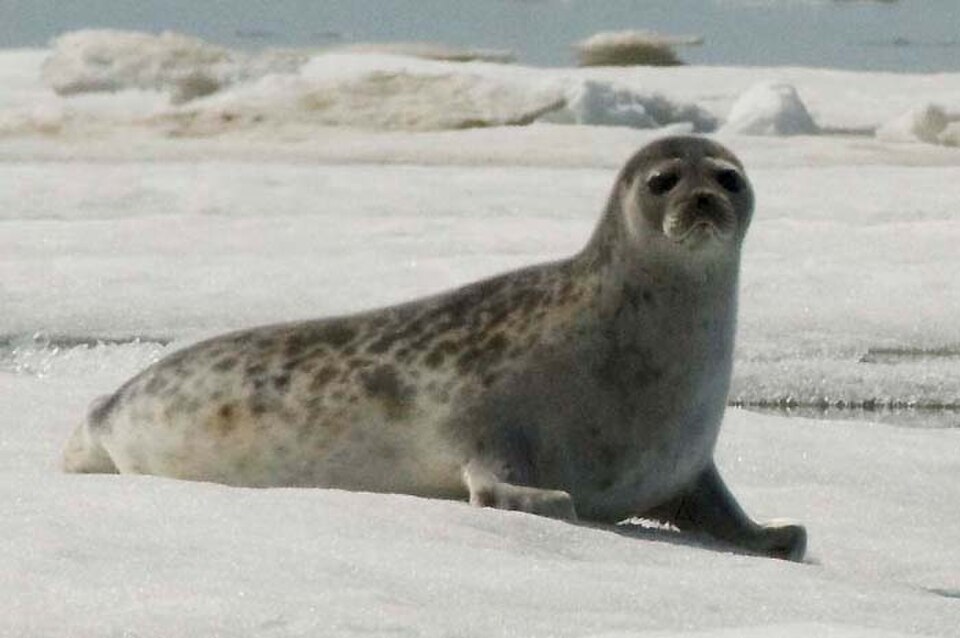
Ringed seal on ice. Photo credit: NOAA Seal Survey.
Tracking Seal Blubber Reveals Health
Reviewing: Hartwick, M.N., Reichmuth, C., & Thometz, N.M. (2026). Seasonal and developmental patterns of body condition in Arctic seals. Frontiers in Marine Science 13:1872458. Doi: 10.3389/fmars.2026.1872458
Seals are lovingly nicknamed the “puppies of the sea” – they are curious, playful, and adorable. Aside from their appearance and demeanor, they are of interest to researchers because they play a critical role in maintaining a healthy Arctic environment. Seals are in a key position of the food chain: they are fierce predators of fish and smaller invertebrates, but they are also prey to apex predators including polar bears and orca whales. Researchers have therefore used seal populations as an indicator of species diversity and abundance, changing ocean conditions, and overall environmental health throughout the Arctic.
In order for seals to successfully play their role in the ecosystem, they themselves need to be healthy. One indicator of individual seal fitness is the amount of blubber on a seal. Blubber is a layer of fat found on many marine mammals that serves functions including thermoregulation, body streamlining, buoyancy, and energy storage. Blubber percentage varies throughout the year in response to seasonal events and external factors, making it a valuable variable for tracking individual, and therefore population, health.
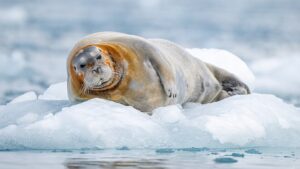
Figure 1: Bearded seal on ice. Photo credit: Stefan Brending.
Hartwick and her team sought out to define predictable seasonal and developmental patterns in Arctic seal bodies to establish expected blubber content at a given time. This biological reference will be useful for analyzing individual seal health because it provides researchers with a baseline of what blubber percentage a healthy seal should have. Not only did Hartwick’s team define patterns, but the project also included best field practices for monitoring and increased researchers’ ability to differentiate between routine fluctuations and changes driven by stressors or disease. The team’s results contribute to overall understanding of how to monitor seal health and use it to analyze the Arctic ecosystem’s health.
Captive Study and Results
Arctic-dwelling seals, including spotted, ringed, and bearded seals, are challenging to monitor due to their remote and ice-covered habitats and often cryptic behavior.

Figure 2: Spotted seal and pup. Photo credit: NOAA Fisheries.
Therefore, Hartwick and her team conducted their study on captive seals over a seven year period. The seals (four spotted seals, three ringed seals, and one bearded seal) were housed at two facilities: one in Seward, Alaska, and the other in Santa Cruz, California. The seals, and their captive environment, were frequently monitored to ensure an accurate environment and sustained health. Throughout the study period, several body measurements such as mass, length, width, and blubber thickness were taken at multiple sites along the body (Figure 3).
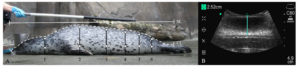
Figure 3: A) Body measurements of length and width along a seal. B) ultrasound image to measure blubber thickness. Figure courtesy of Hartwick et al. 2026.
Measurements were condensed into monthly and annual averages to identify patterns of blubber thickness and analyze how those patterns correspond to seasonal events and developmental milestones in an individual seal’s life. Hartwick’s team also noted the annual minimum and maximum blubber masses and what month those occurred in.
Over the course of the seven year study period, each seal demonstrated both observable and consistent seasonal changes in blubber content (Figure 4). For both the spotted and ring seals, the minimum blubber percentage occurred every spring, which coincides with the annual molting period. Molting refers to a seal shedding its coat and growing a new one, a practice crucial for protecting skin from injury and UV radiation and increasing an individual’s hydrodynamic ability. Annual patterns were more difficult to determine in the bearded seal.
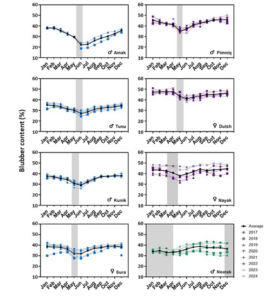
Figure 4: Mean monthly % blubber mass for four spotted seals (blue), three ringed seals (purple), and one bearded seal (green). Name and sex noted in each panel. Each calendar year has a unique symbol. Black line shows the average annual trend.
Conclusion
Hartwick and her team successfully documented predictable seasonal changes in blubber content for spotted, ringed, and bearded seals over annual cycles and developmental changes. Blubber content, and body condition, fluctuate annually due to life history events, food availability, developmental stage, activity levels, and environmental conditions. Age and environmental context were particularly important in influencing blubber content, as younger seals need greater insulation for energy and warmth. Furthermore, although the study was conducted on captive individuals, the results contribute to ongoing seal research by providing a biologically grounded reference point for wild individuals.
Since 2011, spotted, ringed, and bearded seal populations have experienced mass mortality events where large numbers of individuals were sick, stranded, or dead, with many more presenting poor body condition and bad health. Seal health is indicative of overall Arctic health, so it is critical to pay attention to and mitigate risks to seal health. Hartwick’s team’s research contributes to understanding of seal health through observing when blubber content and body condition deviate from typical seasonal, annual, and developmental patterns.

I am a student in the Master of Oceanography program at the University of Rhode Island and enjoy scuba diving, boating, walking my dogs, reading, and being with friends and family.