Nemeth, C., Gough, W. T., Segre, P. S., Fish, F. E., Szabo, A., Fassmann, W. N., Thomson, S. L., Van Aswegen, M., Burrows, J. A., Chenoweth, E. M., Di Clemente, J., Friedlaender, A. S., Goldbogen, J. A., Simon, M., Straley, J. M., Videsen, S. K. A., Visser, F., Weir, C. R., & Bejder, L. (2025). The key to bubble-net feeding: How humpback whale morphology functionally differs from other baleen whales. Journal of Experimental Biology, 228(16), jeb249607. https://doi.org/10.1242/jeb.249607
Giant-winged whales
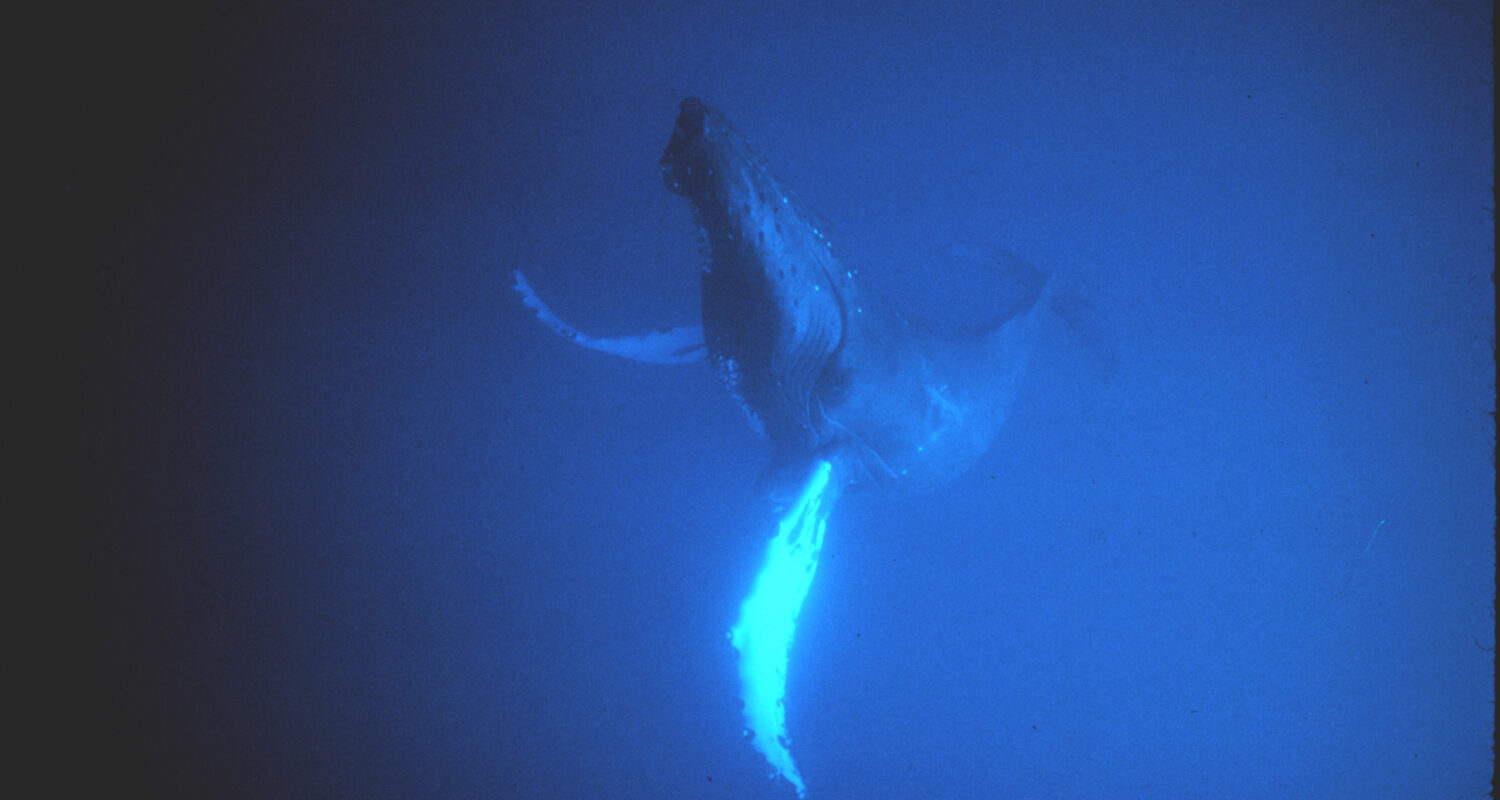
If you’re lucky enough to spend any time in the company of humpback whales – or even just spend a lot of time looking at footage of them – there is likely one thing about their appearance that you’ll notice. Humpback whales have really long pectoral fins – the front flippers that we might be tempted to call “arms”. They can be up to five meters long, or up to one third of the length of the whale’s total body length. This feature is even flagged in their scientific name – Megaptera novaeanglia. Megaptera comes from Ancient Greek and can be translated as “giant wing”. A recent study by Cameron Nemeth and co-authors, published in the Journal of Experimental Biology, explores some reasons why these giant wings may be helpful to humpback whales.
Adaptions for your environment
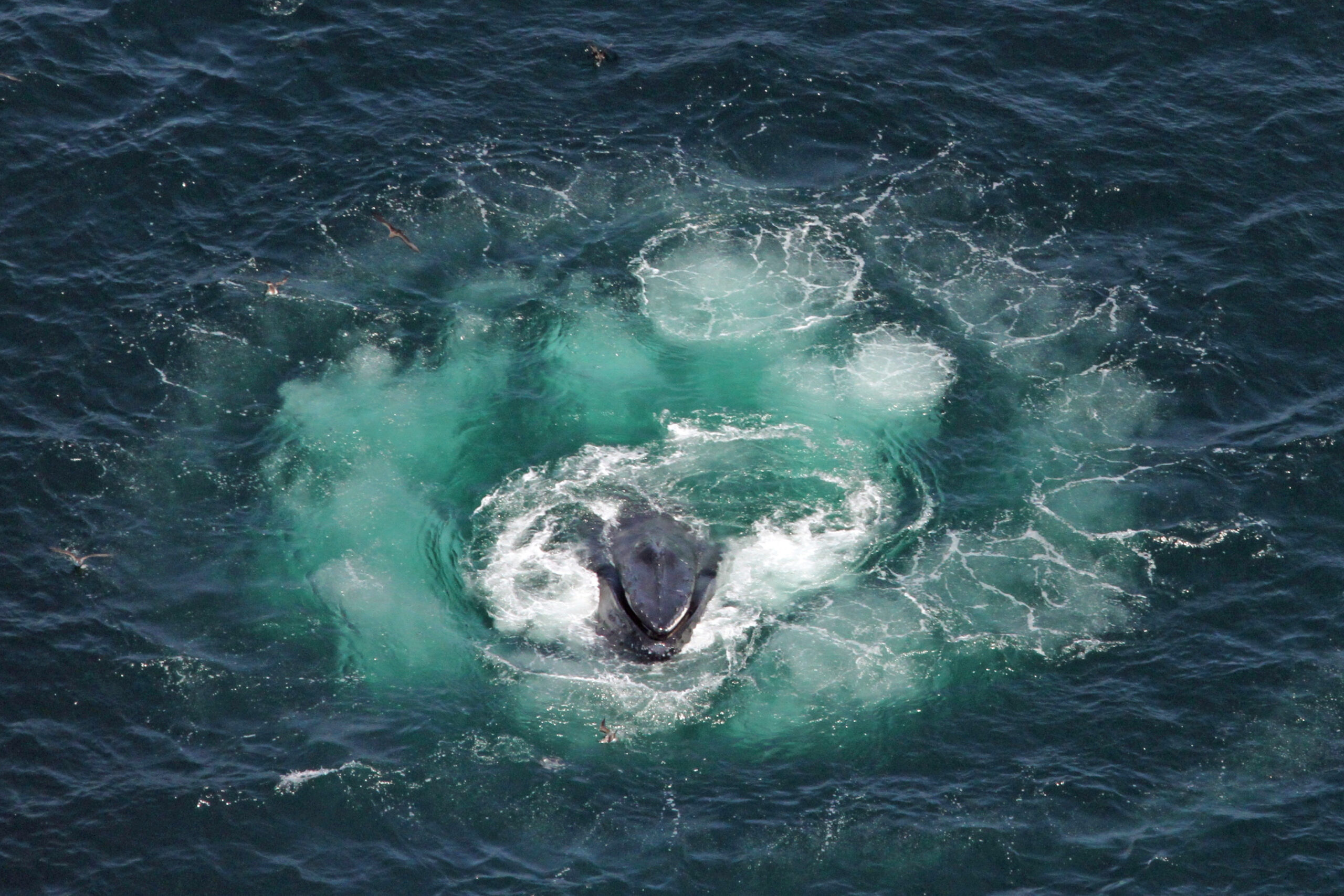
Cetaceans – whales, dolphins and porpoises – have a wide range of adaptations which allow them to thrive in an underwater environment. These include echolocation to help with finding food and navigating, or the enormous mouths and throats that you see on large baleen whales which allow them to take on huge quantities of food in one go. For humpback whales, it looks like their long pectoral fins are another one. All cetacean species have pectoral fins. They help with stability in the water when swimming, and also with maneuverability, allowing animals to turn. This can come in very useful when conducting activities such as bubble-netting – where whales swim around a group of prey, blowing bubbles, which act like a kind of net stopping the prey animals from escaping and making them easier to catch. This activity is often performed by small groups of humpback whales, but can also be performed by solitary individuals.
Physics sidenote
A quick sidebar into some physics… bear with me!
When we turn in a circle (you, me, a humpback whale…) the force that acts on our body to make it follow the curved path is called centripetal acceleration. Centripetal means “towards the centre”. This acceleration is responsible for continuously changing your direction (not your speed) to maintain your movement in a circle. You can feel it if you’re in a car that goes around a sharp bend; it’s the force that is pulling you inwards to make the curve. The higher the force – the tighter the turning circle.
Spying on whales
Nemeth and his co-authors used a combination of drones and suction-cup tags to investigate the turning abilties of humpback whales. Sensors in the suction-cup tags measure the speed of the whale, pitch (forward and backwards motion – like a rocking horse), roll (side to side motion) and also include a high-resolution camera. The data from these tags was used to examine the movement of the whales when they make bubble nets. Drones were flown over three of the five tagged whales, and the footage was used to measure the diameter of each bubble-net ring. These data sources allowed the team to calculate the turning performance of humpback whales that were solitary bubble netting. This performance was compared with that of six other whale species, and humpback whales were found to have the best performance by far.
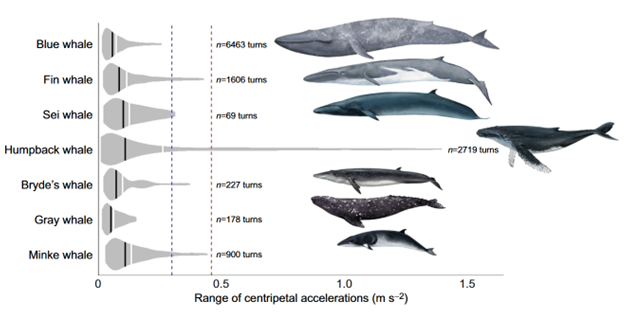
Figure 2: Plot showing the range of centripetal accelerations. Data are recorded from tags of seven whale species for turns with a duration of at least 60 s, between an average speed of 1 and 3 m/s. Species are listed in order of increasing body length from the bottom to top. The dashed blue and red lines represent the mean centripetal acceleration used during solitary bubble-net feeding for the outer and innermost rings, respectively. The species-specific mean (white) and median (black) centripetal accelerations are represented by the solid bars in each range. Nemeth et al., 2025
Giant wings = giant lift
The authors of the study attribute this improved turning ability to the humpback whale’s super long pectoral fins. These “wings” generate a substantial lift force, which allows humpback whales to roll faster, banking inwards to decrease their turning radius, and contributing to centripetal acceleration. Authors say that this adaptation leaves them uniquely able to carry out tight enough turns to make bubble-nets on their own, allowing them to exploit prey patches that may not otherwise be available to them.
Cover photo – A humpback whale under water by R. Wicklund

I am a post-doctoral researcher at the University of Hawaiʻi at Mānoa. My research interests cover many aspects of the ecology of marine mammals, in particular the factors that drive distribution and abundance of whales and dolphins, as well as the impacts of human activities on these animals. I’ve spent a lot of time in the field, conducting surveys (very lucky). When back at my desk, I use ecological modelling techniques to investigate relationships between animals and their environment.