Queen T, Smith G, Spadaro AJ and Gravinese PM (2026) Elevated temperature alters swimming behavior in Caribbean king crab larvae. Front. Mar. Sci. 13:1923343. doi: 10.3389/fmars.2026.1923343
Pushed to the Limit
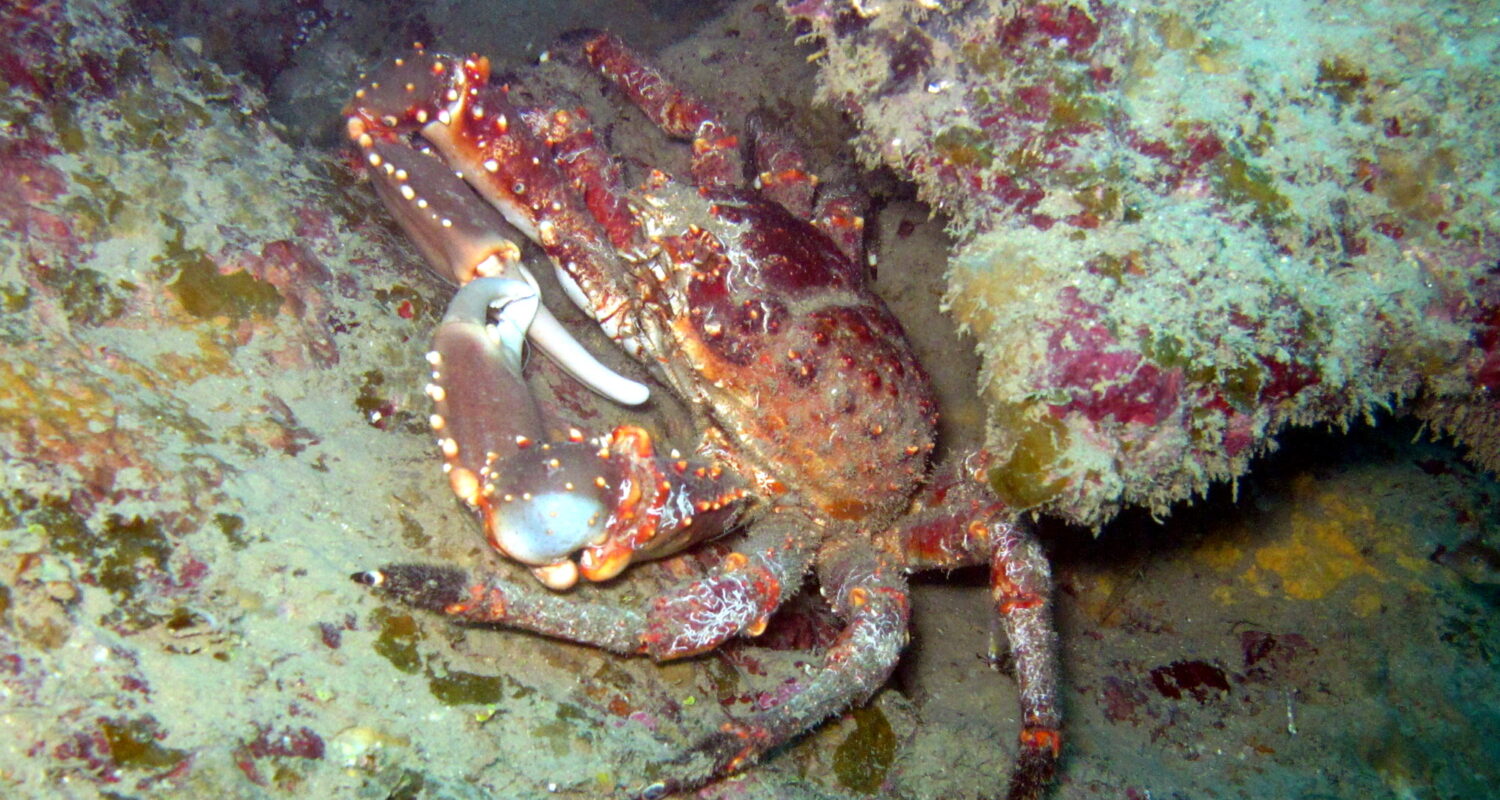
Coral reefs are important ecosystems but face some of the strongest challenges with climate change. Ocean warming can cause corals to expel their symbionts, the photosynthetic algae that live in the corals, in an event called bleaching. Coral bleaching events allow for macroalgae to spread into these areas, which deters animals that rely on corals. In Florida, USA, strategies for coral restoration are shifting to include ways to minimize the algae growth. Enter the Caribbean king crab! This native crab species is an important herbivore in the Caribbean and Florida Keys that scientists believe will help their goals (Figure 1).

Figure 1: A male Caribbean king crab. Photo by Adiël A. Klompmaker, Roger W. Portell, Aaron T. Klier, Vanessa Prueter, Alyssa L. Tucker, CC BY 4.0, via Wikimedia Commons.
In order for this species to help, we need to know how their life cycle is completed. Like many other crabs, the larvae—or the newly hatched crabs—are the weakest link. This life stage is sensitive to changes in the environment, especially temperature. A group of scientists set to work to examine if elevated temperatures affected the larvae of Caribbean king crabs.
Queen and her research team quantified the larval responses to elevated temperature by performing an experiment by putting two groups of larval Caribbean king crabs in either a control temperature (28ºC or 82ºF) or an elevated temperature (32ºC or 90ºC). The Caribbean king crab has multiple stages in their larval development, known as zoeal stages. The scientists looked at the first two stages, named Z1 and Z2. They measured the survival, oxygen consumption, and swimming behaviors of these two larval stages in both temperature groups.
Turning Up the Heat
Overall, the science team found that the Caribbean king crab larvae had lower survival and less oxygen consumption in the elevated temperature treatment across both larval stages. The swimming behavior of the crab larvae were varied between treatments as well; however, the two zoeal stages had contrasting results. These crabs use gravity to help them swim, which is called geotactic swimming. Queen and her team found that larvae in the Z1 stage were swimming down more frequently in the elevated temperature treatment (Figure 2). Additionally, the larvae in the elevated temperatures also swam faster than those in the control temperature (Figure 3).
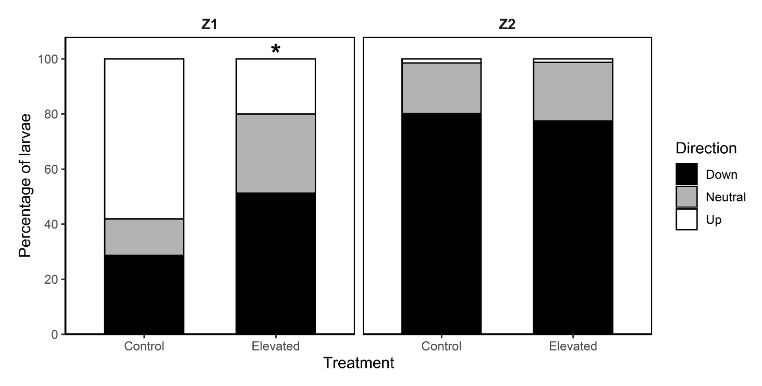
Figure 2: Direction of the larval king crab swimming at the two different larval stages (Z1 and Z2) in both the control and elevated temperature treatments. From Queen et al 2026.
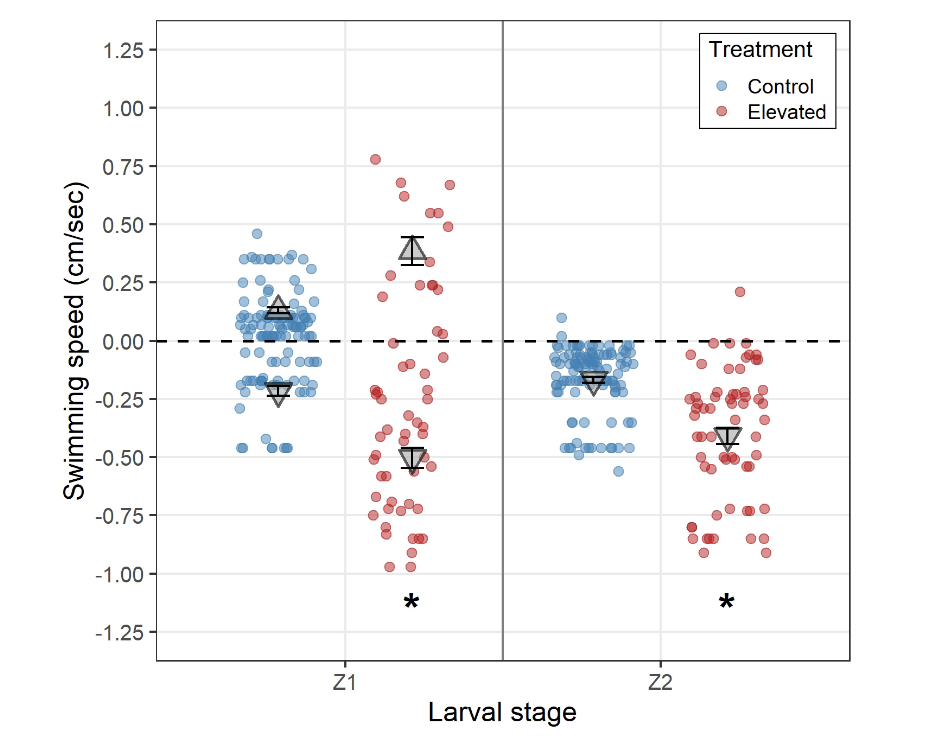
Figure 3: Swimming speed of Caribbean king crab larvae at both zoeal larval stages in control and elevated temperature treatments. Positive numbers mean upward swimming and negative numbers are downward swimming. Triangles in each group represent the mean for that larval stage in either the upward or downward swimming. From Queen et al 2026.
Teamwork Making the Dream Work
These behavioral changes have major consequences to how these larvae would interact with the coral reefs in the wild. The changes in geotactic swimming means that the larvae may not spread across the reef in the same way under increased temperatures. Faster swimming in elevated temperatures means that larvae may end up deeper in the water column during times of increased water temperatures, causing them to miss the habitat that scientists want to restore.
The question to be asked now is how do we use this information for restoration practices? If coral restoration efforts want to utilize this species of crab to help with algae control, it is important to let these findings inform restoration decisions. Being strategic with the timing of when these crab larvae are added to coral reefs will enhance the benefits that they can provide. Working together, these crab larvae may provide a way to bolster conservation efforts.
Cover image is of a Caribbean king crab. Photo by Pc.wiki4, CC BY-SA 4.0, via Wikimedia Commons.

I am a Ph.D. candidate in Oceanography at Rutgers University where I study early life stages of bivalves. My research interests include bio-physical interactions in the ocean and invertebrate larval ecology. When I have free time, I spend it reading, participating in theatre productions, and writing poetry.


