Beemster, J.G.W., Talke, S.A., Van Maren, D.S. et al. Human footprint on estuarine tidal hydrodynamics. Nat. Geosci. (2026). https://doi.org/10.1038/s41561-026-01969-4
What is an estuary?
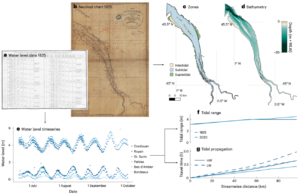
Estuaries are partially enclosed coastal bodies of water that serve as dynamic environments between the land and sea (NOAA). You may have heard of them referred to as lagoons, sounds, or bays, but more informally, estuaries are places where freshwater input from rivers and saltwater from the ocean mix to make brackish waters (Fig. 1A). These bodies of water are nutrient-rich and support extremely productive ecosystems, like fish nurseries. They also serve as important, natural barriers against coastal storms.
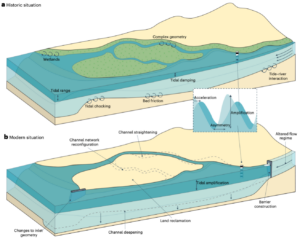
The natural shape of estuaries (Fig. 1A) strongly controls tidal propagation, or the speed at which high-water peaks travel inland. This control is mainly related to friction caused by the bottom and sides of the estuary and the funneling effect caused by the narrowing of a river as one moves upstream. The friction can help to slow the total energy of the incoming tide, leading to a reduced risk of flooding, while the narrowing of the river concentrates the energy and increases the speed of the waves.
Altering shapes to suit our needs
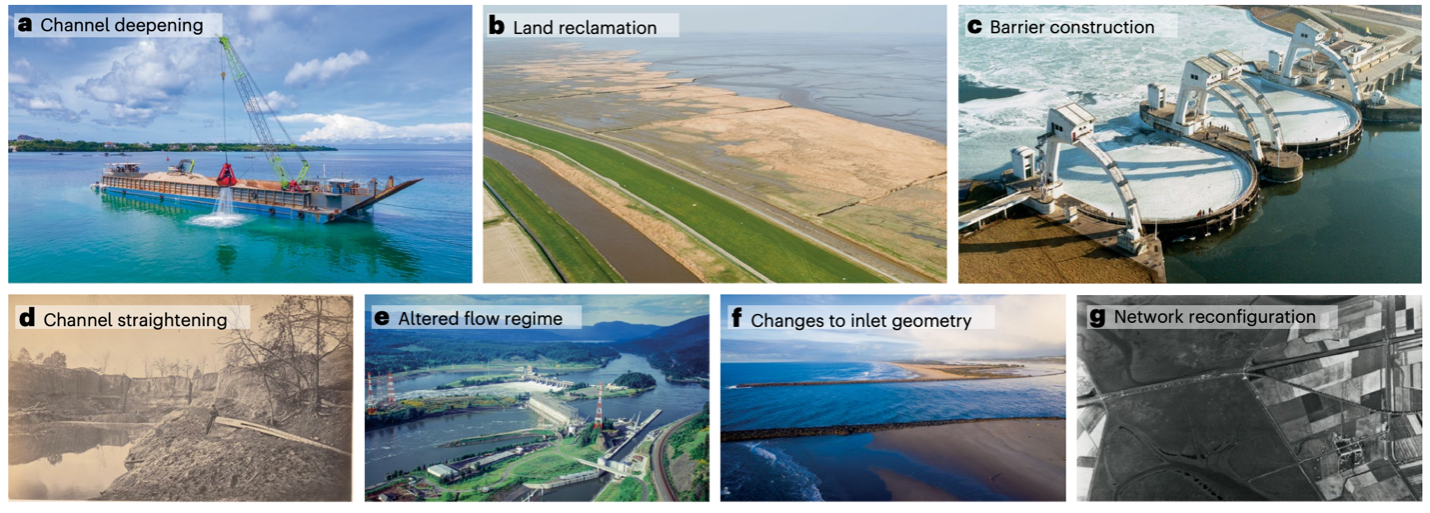
Humans have been changing the shapes of estuaries for centuries to suit a variety of needs (Fig. 1B). For example, global trade requires the construction of ports that can accommodate large ships close to land. Thus, channels need to be deepened by removing material from the seafloor (Fig. 2A). Our actions, however, have consequences for the estuarine environments they affect. Removing material from the bottom of the estuary can, unfortunately, destroy the benthic (bottom-dwelling) community of plants, animals, algae, and so on. These actions also influence the way tides interact with the environment, yet these dynamics can be difficult to disentangle.
Studying changing tides
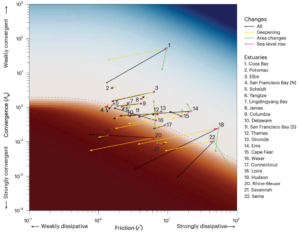
To investigate the impact of human activities on estuarine tidal dynamics, Beemster and his team compared historical maps, hydrographic surveys, and tide gauge records (Fig. 3) to modern day data for 25 estuaries worldwide that have experienced some type of human activity (Fig. 2). They were able to capture snapshots of data across decades to centuries to evaluate how tidal behavior had changed and what human activities were the most influential.
The authors found that in 20 of the 25 systems, more water was able to move farther inland after humans altered the estuary. Additionally, 22 of the 25 systems showed an increase in tidal propagation speed, averaging 2.03 m/s faster than what was shown in historical records. Lastly, 24 of the 25 systems showed faster movement of high-water (high water level) relative to low-water (low water level). Beemster and the other scientists suggest activities like channel deepening and limiting river discharge (damming) ultimately reduce the amount of friction felt by incoming tides, allowing them to build speed as they head for land, increasing flood risks.
Do human impacts impact humans?
The answer is yes! The team found that our actions indeed have consequences for us humans, especially those living in coastal communities prone to flooding during storm events (even 100 km inland!). But how do these local human actions compare to the threat of global sea-level rise (SLR) caused by climate change? Beemster and his team employed a simple analytical model (Fig. 4) to highlight the relative importance of different human activities (e.g., channel deepening, area changes, all 7 factors from Fig. 2 combined) and SLR on changing estuary water levels. When looking at individual factors, the model suggests that channel deepening (yellow arrows) has the most influence, followed by area changes (green arrows), and that SLR (pink arrows) has the smallest influence on the changing water levels observed at these estuaries.
To combat the increased flood risk, the authors suggest a greater focus on estuary restoration to a more natural state (Fig. 1A). Ultimately, this will build coastal community resilience to SLR, storm surges, and high-tide flooding.
Cover image same as Fig. 2.
I just completed my Ph.D. in Geological Oceanography at the University of Rhode Island, Graduate School of Oceanography. I received my B.S. in Geology from Union College (NY). I study submarine volcanoes! I use the chemical composition of lava to figure out what is happening inside the Earth and how magma is formed. When I’m not working with rocks, I enjoy reading on the beach, cooking, and hiking.

Is human modification of estuaries more responsible for coastal flooding than sea-level rise? Why or why not?