Shin Ikegami, Kanta Sugiura, Mehmet Oguz Derin, Yusuke Takeda, Jörg Mutterlose, Shintaro Sasaki, Neil H. Landman, Takahiro Harada, Kazuki Tainaka, Aya Kubota, Harufumi Nishida, Yasuhiro Iba; Squids radiated globally prior to the Cretaceous–Paleogene mass extinction. Geology 2026; 54 (9): 938–942. doi: https://doi.org/10.1130/G54372.1
Squishy Guys are Important, Too
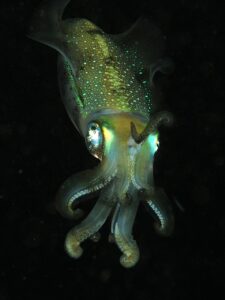
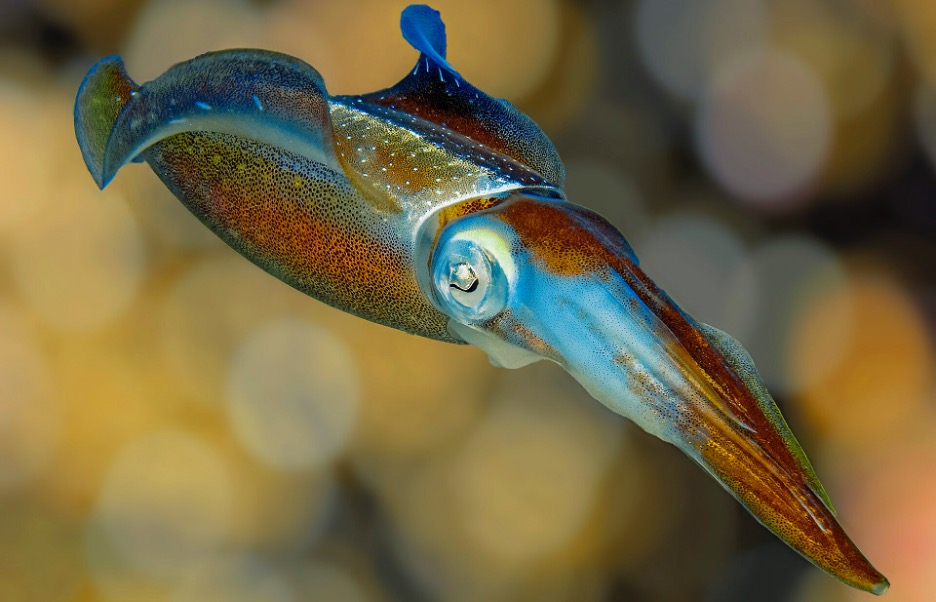
Cephalopods, marine animals characterized by symmetrical bodies, a prominent head, and a set of tentacles (like squid, octopus, cuttlefish), are among the most important and successful marine animals in oceanic ecosystems throughout our planet’s history (Fig. 1). They are extremely intelligent and have developed elaborate nervous and movement systems that support their ability to fill many roles in marine food webs and survive in a wide variety of oceanic zones and conditions. We know that they have been around for at least 500 million years thanks to the fossil record, and their lengthy history makes them ideal candidates for understanding deep-time and evolution. Their squishy bodies are, however, extremely hard to preserve in fossil-form, so we are likely still missing a lot of information about their past.
Part of that information includes where in the world cephalopods, particularly squid, lived many millions of years ago. Squid are of interest because they are the most common and diverse group of cephalopods around today and can be found all over the globe, but it may not have always been that way. Ikegami and a team of scientists sought to uncover more clues about the mysterious history of squids to try and track their ancient movements.
Finding Beaks
Unlike the squishy bodies, squid beaks are more likely to be fossilized because they are hard, making them the target of Ikegami’s study. The scientists identified a 67 million year old rock layer (from the Maastrichtian age ~72-66 million years ago) called the Timber Lake Member from northern South Dakota that is known for its marine fossils and got to work looking for beaks.
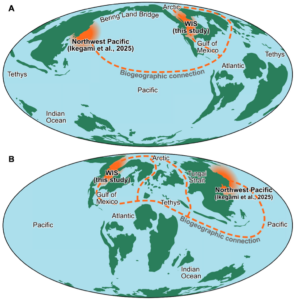
Now, I know what you’re thinking – ocean fossils in the middle of the continent? How does that happen? During that time in Earth’s history, much of North America was covered by an inland sea called the Western Interior Seaway (WIS) that connected the Arctic Ocean to the Gulf of Mexico (Fig. 3). The WIS served as a highway between major oceans for many types of marine animals, as indicated by the rich layers of fossils left behind. This makes the rock layer a good candidate for identifying marine creatures from that period.
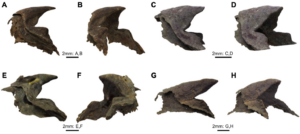
A head-sized sample of the rock was cut into blocks and imaged at a high resolution to identify the small beaks. 3D models of the beaks were then constructed for comparison to the beaks of modern squid to identify any similarities between species (Fig. 2). In all, the team identified four squid beaks belonging to two new species: Scuthoteuthis concavus sp. nov. (3 beaks; Fig. 2A-F) and Fringillorostrus simplex gen. et sp. nov. (1 beak; Fig. 2G-H).
Squid Movements
Prior to this study, squids had only been identified in the northwest Pacific Ocean during the Maastrichtian age, leading scientists to believe that their widespread presence only occurred after the Cretaceous-Paleogene (K-Pg) mass extinction 66 million years ago. However, the presence of squid beaks in the South Dakota rock reveals that squids were, in fact, outside of the northwest Pacific and thriving 67 million years ago. This discovery provides scientists with more information about exactly when squids became the global mainstays they are today. It also provides five possible paths the squids could have taken to reach the WIS based on where bodies of land were located during that time. These paths are called biogeographic connections (orange dashed lines in Fig. 3) and show just how far these little guys would’ve had to swim to end up in the rocks in present-day South Dakota. Moreover, squids would have had to inhabit the regions along these paths since the distance between the northwest Pacific and WIS was immense (~10,000 km, or ~6,214 miles).
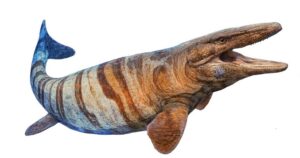
Today, squids are prey for marine predators (think whales and sharks). They likely served a similar role in ancient marine food webs and kept WIS marine reptiles, like mosasaurs (Fig. 4) and plesiosaurs, fed and happy. This new insight allows ecologists to reassess how ancient food webs may have functioned and, ultimately, improve our understanding of modern food webs.
Cover image is a Caribbean reef squid from WikiMedia Commons.

I just completed my Ph.D. in Geological Oceanography at the University of Rhode Island, Graduate School of Oceanography. I received my B.S. in Geology from Union College (NY). I study submarine volcanoes! I use the chemical composition of lava to figure out what is happening inside the Earth and how magma is formed. When I’m not working with rocks, I enjoy reading on the beach, cooking, and hiking.


