Metcalfe, A., Pank, K., Druitt, T. H., Kutterolf, S., Preine, J., Nomikou, P., Hübscher, C., Ronge, T. A., IODP Expedition 398 Scientists. (2026). Temporal linkages of explosive activity of Kolumbo and Santorini Volcanoes (Greece). Geology 54 (5): 393–398. https://doi.org/10.1130/G53965.1
If a volcano erupts on the seafloor and no one is around to see it, is it explosive?
Most volcanism on this planet happens on the seafloor at submarine volcanoes. The eruptive history of these volcanoes, however, is extremely hard to know because the volcanic material produced remains largely inaccessible, sometimes a few miles beneath the surface of the ocean. This increases uncertainties about how frequently a volcano erupts, if it is explosive, and if neighboring volcanoes interact with one another. It is important to untangle these uncertainties because they all contribute to how hazardous a volcano may be – especially regarding human safety.
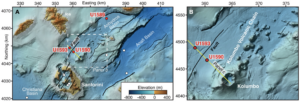
Kolumbo Volcano is a large submarine volcano just north of Santorini, a volcanic Greek island (Fig. 1). Kolumbo has an explosive history that is well hidden by the sea. Its last large, known eruption resulted in the death of 70 people on Santorini in 1650 CE. However, we don’t know how often this type of eruption happens at Kolumbo, or if activity can be linked to other volcanic activity in the region. Thus, a period of unrest from 2024-2025 was particularly worrisome for the island community.
Eruptive Archives
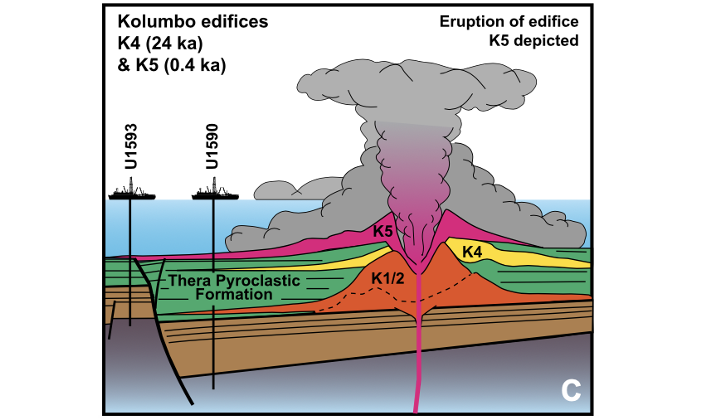
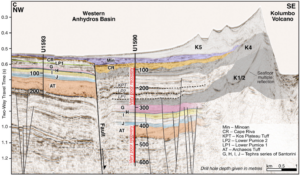
To better understand the eruptive pattern of Kolumbo, Metcalfe and the science team on International Ocean Discovery Program (IODP) Expedition 398 set out to core the seafloor in multiple spots around the region to recover a stratigraphic record of the eruptive history of the volcano. Here, a core is like a giant straw that you stick down into the mud on the seafloor to collect sediment and stratigraphy refers to layers of volcanic material that are produced by different eruptions through time (Fig. 2). Older eruptions are towards the bottom of the core (e.g., orange layer in Fig. 2), while younger eruptions are towards the top of the core (e.g., layer K5 in Fig. 2). This study looked at two core sites (U1593 and U1590) on the western side of Kolumbo (Fig. 1 & 2).
Once the cores were pulled up from the seafloor, scientists split them in half the long way to observe and identify the different layers (Fig. 3E). Layers indicating different eruptive events are determined based on characteristics like color and sediment size. There were three large eruptive periods identified and named K1/2, K4, and K5 (Fig. 2 & 3) and many smaller layers in between. Next, they took samples of volcanic glass (lava that is cooled rapidly) from the different layers and analyzed it for its chemical makeup. The scientists were able to identify 19 distinct eruptions from Kolumbo using this type of analysis (Fig. 3C).
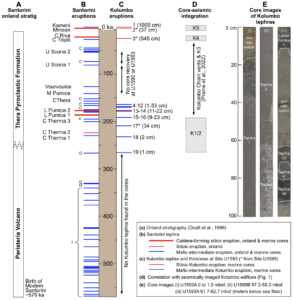
Interestingly, when compared to the eruptive history of Santorini (Fig. 3B), Metcalfe and the team found the eruptive activity at Kolumbo (Fig. 3C) matched up quite well. Blue lines represent more effusive, calm eruptions, while the red lines represent explosive eruptions (Fig. 3). This finding suggests that the two volcanic systems are coupled and a larger, regional force, like the cracking of the seafloor (faulting), may contribute to their similar periods of explosive volcanism.
Building a Volcano and Informing a Community
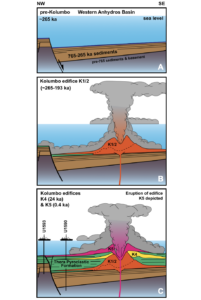
The thick layers (K1/2, K4, and K5) coincide with these large, explosive eruptions and are the events attributed to building the volcanic edifice at Kolumbo over the last ~265 ka (Fig. 4). Eruptions forming K1/2 occurred between 265-193 thousand years ago (ka). K4 was formed 24 ka. K5 was formed 0.4 ka. By identifying the timing and length of these eruptive periods, Metcalfe and the team calculated an estimate of ~6,000 years between major explosive eruptions at Kolumbo and other nearby volcanoes. This estimate, in addition to the strong link between volcanic activity at Santorini and Kolumbo, provides scientists and policy makers with important information that can ultimately be used to inform positive change to the volcanic hazard mitigation plan for the island of Santorini and save lives during the next eruption.
Cover image from Metcalfe et al. (2026).
I just completed my Ph.D. in Geological Oceanography at the University of Rhode Island, Graduate School of Oceanography. I received my B.S. in Geology from Union College (NY). I study submarine volcanoes! I use the chemical composition of lava to figure out what is happening inside the Earth and how magma is formed. When I’m not working with rocks, I enjoy reading on the beach, cooking, and hiking.