Laura Gnesko, Timothy Stahl, Joshu J. Mountjoy, Jonathan M. Carey; Transient evidence of shallow coseismic submarine landslides shaping canyon head geomorphology: Insights from the 2016 Kaikōura earthquake, New Zealand. Geology 2025; 53 (12): 1029–1034. doi: https://doi.org/10.1130/G53867.1
Earthquakes!
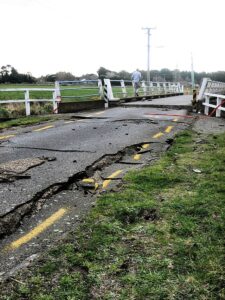
An earthquake is the sudden shaking of Earth’s surface caused by the release of built-up energy in the crust, the hard, rocky layer we live on. They usually occur when tectonic plates break or slip along faults (USGS). Earthquakes range in magnitude (Mw) from very minor events that release very little energy (e.g., Mw 3 to 4), to major events that release lots of energy (e.g., Mw 7 to 10). While earthquakes themselves can do lots of damage to the surface of our planet and the infrastructure we have built (Fig.1), they can also trigger other natural disasters if they are large enough and occur in the right environment. Large earthquakes in coastal environments, for example, run the risk of causing landslides that can trigger the creation of tsunami waves when the rubble is deposited into the ocean and displaces water.
Landslides!
Landsliding can also happen under water as the result of earthquakes, especially in regions where there are submarine canyons. Yet, the influence submarine landsliding has on changing the shape of the canyons, moving sediment, and the potential to create a tsunami is poorly understood due to low resolution seafloor data, or the lack of it all together in some regions.
Gnesko and her team aimed to get a better idea about how all these things are connected by investigating changes in Kaikōura Canyon after the 2016 Mw 7.8 Kaikōura Earthquake (Fig. 2). On land, the earthquake triggered over 29,000 landsliding events, so it was highly likely that there would be submarine landsliding as well. However, even with all the landsliding, no tsunami was generated. The team worked with two sets of high-resolution (2 meter) multibeam bathymetry (underwater terrain) data of Kaikōura Canyon – one pre- and one post-quake – to identify differences in the shape of the canyon, where landslides occurred, and how much material was moved in hopes to understand why such a large quake was not followed by a tsunami.
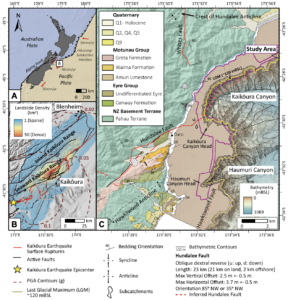
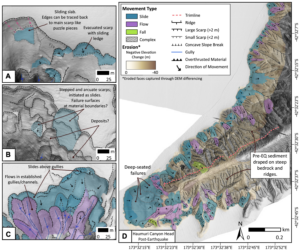
The authors found that the canyons, whose tops are 30-40 m below sea level, served as channels for moving material away from the cliff faces and out to sea. However, instead of finding large rock and debris avalanches like they did on land, the group identified many smaller landsliding events (e.g., slides, flows, falls) from the submarine canyon rims (Fig. 3). These events transported nearly 100x the material of the terrestrial landsliding events and caused the edge of the canyon rim to retreat up to 210 m. When comparing these findings to lower resolution maps of the same area, the team was unable to identify these smaller events and underestimated how much material had been moved post-earthquake.
Tsunamis?
The team thinks that although these events transported more material than the terrestrial landslides, their smaller size ultimately led to a lower tsunami hazard potential. Gnesko and her team stress that it is important to use high-resolution mapping data to catch all these small features that seemingly have important implications for the way material moves in a submarine environment. If other submarine regions produce these small slides, it is possible that tsunami hazard potential is actually much lower in some tectonically active settings than what was previously thought. These findings can be used to further refine tsunami hazard models to ensure coastal populations stay safe during these natural disasters.
Cover image from WikiMedia Commons.
I just completed my Ph.D. in Geological Oceanography at the University of Rhode Island, Graduate School of Oceanography. I received my B.S. in Geology from Union College (NY). I study submarine volcanoes! I use the chemical composition of lava to figure out what is happening inside the Earth and how magma is formed. When I’m not working with rocks, I enjoy reading on the beach, cooking, and hiking.