A trawling operation that contributes to overfishing of commercially valuable stocks. Photo credit: Allen Shimada.
Reviewing: Yan, H.F., Watkins, H.W., Siqueira, A.C., & Bellwood, D.R. (2026). Over a century of global decline in the growth performance of marine fishes. Nature Communications, 17: 2612, 1-11. https://doi.org/10.1038/s41467-026-69416-x
Billions of people around the world rely on seafood as a primary source of nutrition. From shellfish to squid to fish, seafood is an important addition to diets and a cultural delicacy. It is challenging, though, for seafood stocks to keep up with such high human demand. Overfishing is one of the most dire threats to fish populations and oceanic ecosystems, as it increases the risk of extinction of both iconic and valuable fish species. Although there are management practices in place for some species, they are usually imposed as a response to overfishing as opposed to as prevention. The impacts of overfishing coupled with management policies leads to major changes amongst the surviving population.
Yan and her team sought to reveal global trends in growth performance, a metric combining two linked life history traits of body size and the von Bertalanffy growth coefficient (the function used to determine how quickly an individual will reach its maximum length). The team compiled a global dataset encompassing 7,683 growth curves across 1,479 fish species over 113 years and ran a series of analyses. The results produced some alarming trends, yet it is important to consider these trends when discovering how overfishing impacts the ocean’s ecosystems. The results are also useful for application to future protection strategies and policies.
Why are fish getting smaller?
Yan’s team found that globally, growth performance across the included fish species declined by 7.9% and the size for an individual at a given age was reduced (Figure 1).
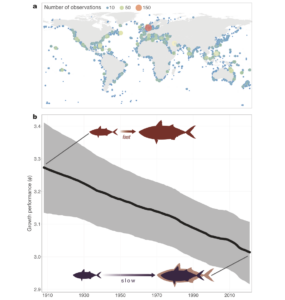
Figure 1: a) Global distribution of observations on growth performance. b) Global growth performance trend of fish species from 1908-2021. Thick black line indicates median trend, grey blocking indicates 90% credible interval. Figure courtesy of Yan et al. 2026.
However, Yan discusses an interesting caveat: because of potential sampling biases and spatial disparities in fishing grounds and rate of water warming, another variable must be introduced: management techniques. Interestingly, fishes from managed stocks exhibited the greatest declines in growth performances over the last century, with a 9.1% decrease from 1908. Meanwhile, unmanaged and unfished species exhibited no significant change in the same time frame (Figure 2).
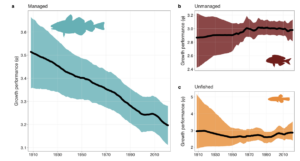
Figure 2: Changes in growth management over time. a) Managed stocks. b) unmanaged stocks. c) unfished stocks. Thick black line indicates median fitted trend, while colors indicate 90% credible intervals. Figure courtesy of Yan et al. 2026.
These unexpected results could be due to the fact that management policies are often introduced too late – only triggered once a stock is deemed overfished. Relentless and intense pressure is applied to commercially valuable fish to keep up with demand, and although overdue management policies can attempt to slow stock and size decline, there is little that can be done to entirely reverse the effects of overfishing.
Another explanation for the results presented in Figure 2 is known as the Rosa Lee phenomenon, which states that larger and faster-growing individuals are targeted first, which allows smaller and slower-growing individuals to survive and reproduce. This would eventually lead to a population with individuals of smaller sizing and indicate a reduction in growth performance.
Conclusions
The evident overall decline in growth performance of commercially valuable fishes demonstrates that size demographic changes are reinforced by fishery selectivity of larger and faster fish, leading to lower growth performance in subsequent generations. Major changes in life histories, such as body size, is difficult and slow to reverse, which has severe consequences on biomass, ecosystem productivity, and success of commercial fisheries. Although changes in growth performance varied across the globe, the overall downward trend indicates that overfishing is incredibly dangerous. Unless drastic measures are taken to protect fish stocks and allow them to replenish, it is likely that the growth performance decline will continue.

I am a student in the Master of Oceanography program at the University of Rhode Island and enjoy scuba diving, boating, walking my dogs, reading, and being with friends and family.