Christoph M Deeg, Christopher Tam, Svetlana Esenkulova, Abigail Wells, Valeriia A Soshnina, Nicholas J Ens, Carl Llewellyn, Angela D Schulze, Kristina M Miller, Spatiotemporal patterns of salmon winter habitat usage in the Northeast Pacific uncovered by environmental DNA, ICES Journal of Marine Science, Volume 82, Issue 7, July 2025, https://doi.org/10.1093/icesjms/fsaf104
Pacific Salmon Life History
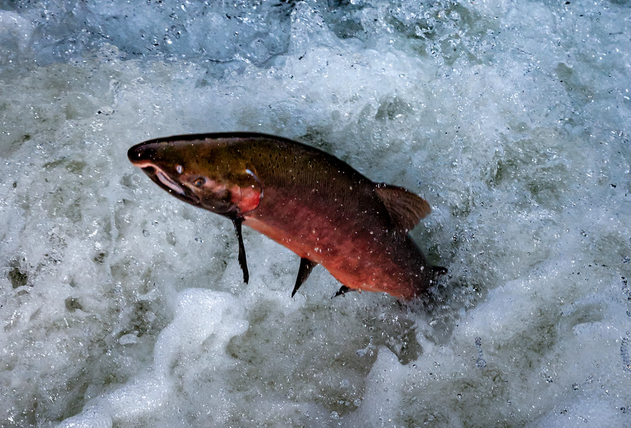
The life histories of Pacific salmon (Oncorhynchus spp) have always been of interest to scientists due to their use of both freshwater and marine systems. While their use of freshwater systems for reproduction have been well studied, their use of the ocean during their adult lives has received limited attention. This isn’t because scientists aren’t curious, but rather they’ve been limited by the logistics of sampling the Pacific during the winter. Bad weather, along with the high costs to charter a boat are some of the hurdles that have led to this knowledge gap. As salmon species continue to decline due to a variety of factors including climate change, overfishing, and habitat loss, there is an even stronger need to understand their adult lives. Recent developments in environmental DNA (eDNA) sampling and analysis have made this a reality now.
As any living thing goes about its life, it sheds cells that contain DNA. This DNA can persist in the environment for some time, acting like an indicator of where that individual was. This means you can sample sea water, in this case, for eDNA and know what types of animals are in the area without directly catching them. As you can imagine, this makes open water surveys significantly more viable. Rather than hope and pray your net isn’t completely empty when you bring it back to the surface, you’ll always get some sample data with eDNA.
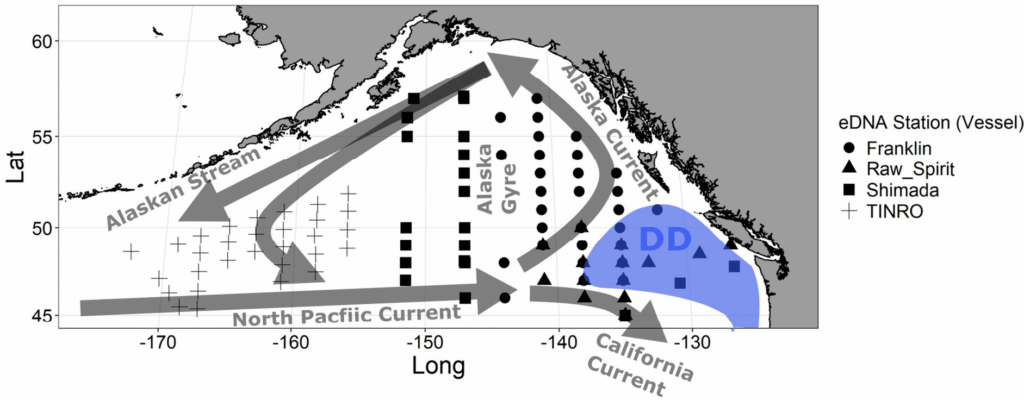
Equipped with this tool, scientists sampled the Gulf of Alaska in late winter/early spring to describe Pacific salmon species distributions prior to their migrations upstream.
DNA in the Ocean
The researchers registered a wide variety of animals with their eDNA sampling. This included small phytoplankton members all the way up to some of the largest whales and everything in between.
Six species of Pacific salmon (Oncorhynchus spp) were sampled including:
- Chinook (O. tshawytscha)
- Coho (O. kisutch)
- Sockeye (O. nerka)
- Chum (O. keta)
- Pink (O.gorbuscha)
- Steelhead (O. mykiss)
Salmon Found
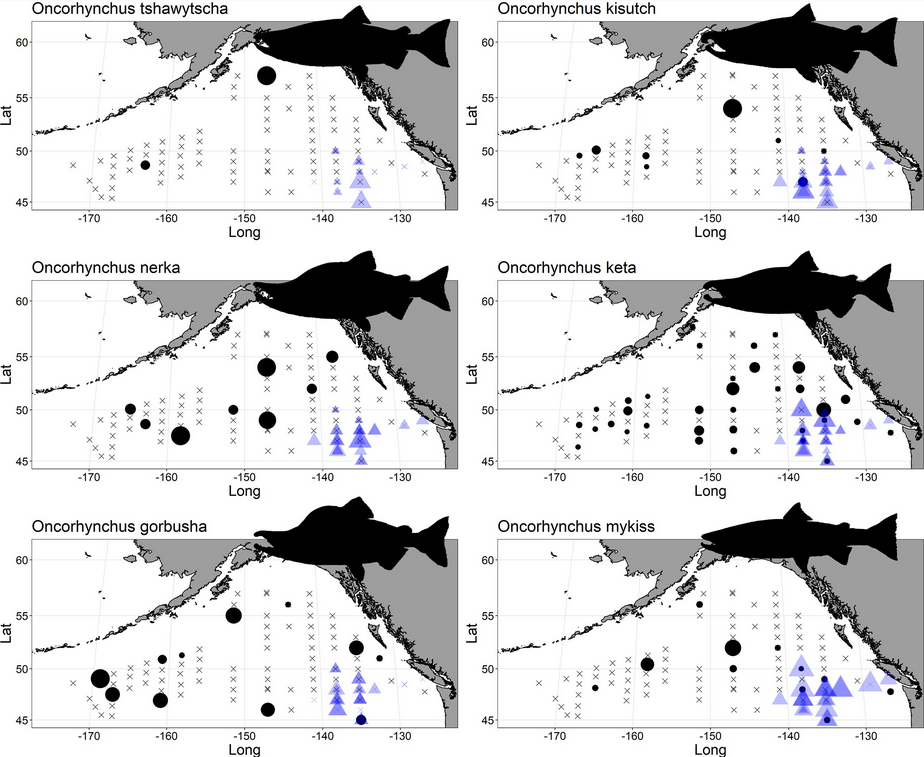
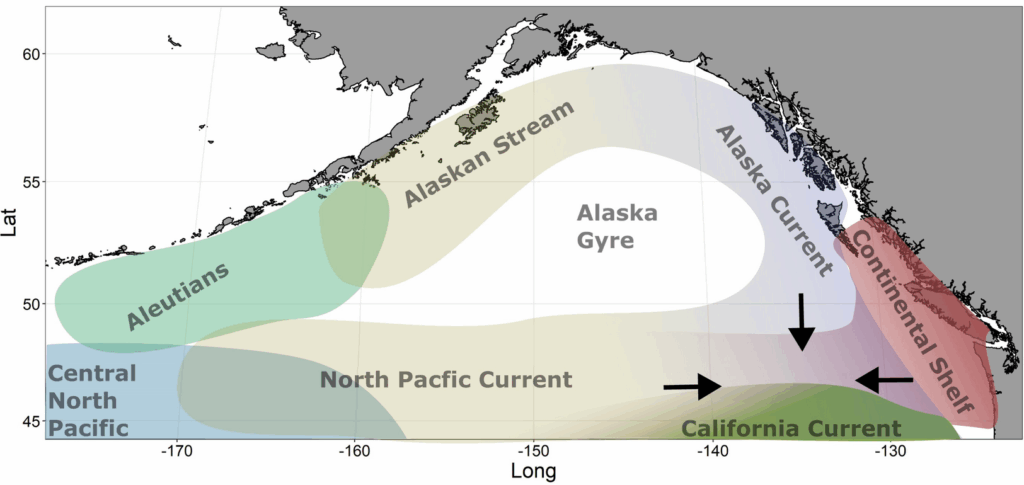
The salmon demonstrated species specific distributions across the Gulf of Alaska during the winter (Figure 2). In other words, they preferred staying with similar individuals rather than intermingling with other salmon species. However, at the beginning of March, researchers tracked a massive shift as all the salmon migrated to the southeastern portion of the gulf off the coast of Washington coinciding with the first spring blooms. The spring bloom can be best described as an explosion of phytoplankton as the seasons change, creating a highly concentrated food source that attracts all levels of the food web. This is a great way to kick off the spring season as the fish look to begin the salmon run.
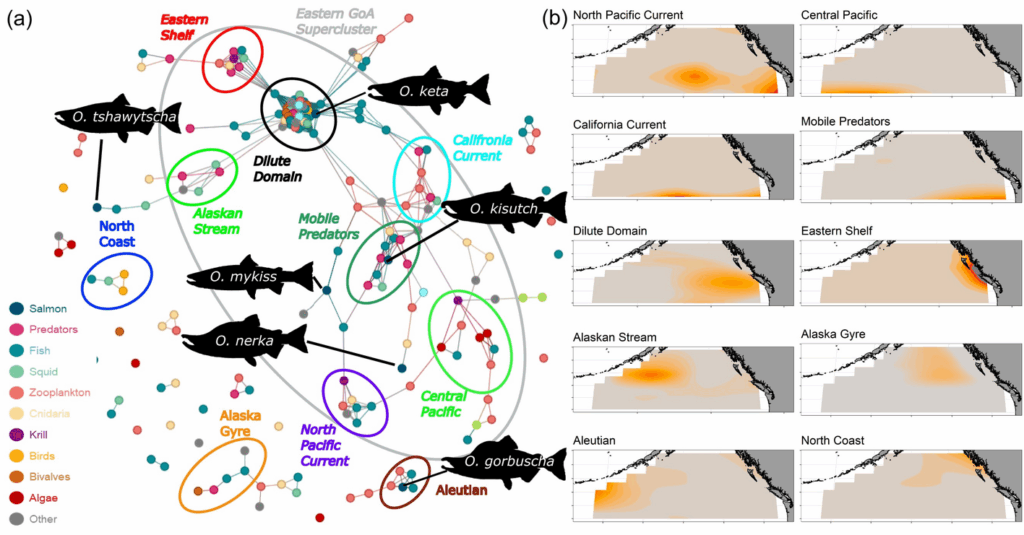
Researchers also did a cluster analysis of the species sampled (Figure 3), essentially looking for patterns and/or associations between animals. Overall, large scale oceanic features such as current and the continental shelf were the best predictors of where a particular species could be found. Ten subgroups were identified using these environmental parameters (Figure 3). Each Pacific salmon species belonged to a different cluster with some closely associated with a subgroup while others were loosely connected with corresponding species.
Environmental DNA for the Future?
These findings go a long way in describing and understanding Pacific salmon distribution in the region. The salmon not only live in species specific communities, but have distinct environmental preferences as described in the cluster analysis. Then, as spring comes, they all migrate to the southeast and concentrate in one area for the spring bloom. The movement and change in animal diversity in the area during this transition in the seasons is astounding. Recording it in real time with eDNA is even more exciting!
While eDNA is proven to be a powerful tool, it can’t always be used in isolation. Several species of phytoplankton sampled by traditional methods did not appear in the eDNA results. It seems some species may reduce how much DNA they shed during a season or may shed so little that it’s undetectable. It’s possible there were species that were present but went undetected because of the lack of DNA they left behind.
This supports the use of multiple sampling methods, where possible, to capture a complete picture of the species present. While traditional net surveys are not sustainable in this region due to finances and weather, environmental DNA offers a new approach to detecting fish without ever having to actually see them. More surveys should continue to give us more refined data, but this study gives us a strong baseline of what the Pacific salmon community looks like in the Gulf of Alaska.

I am a recent MSc graduate in marine biology from Bangor University, where I studied population dynamics of elasmobranchs off the coast of Wales. My interests lie in ecological data analysis to understand environmental processes and identify natural patterns. However, nothing beats being in the field and interacting directly with the marine life.
