Mauro Rosi, Stefano Caliro, Giovanni Chiodini, Mauro A. Di Vito, Carmine Minopoli, Flora Giudicepietro; Unveiling “too-old” radiocarbon ages at Serapeo (Pozzuoli) enhances understanding of the present unrest crisis at Campi Flegrei caldera, Italy. Geology 2025; 54 (1): 40–44. doi: https://doi.org/10.1130/G53578.1
Campi Flegrei, Italy
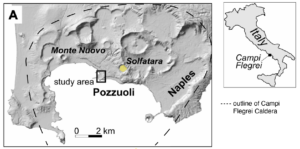
When asked about volcanoes in Italy, most people think of the 79 AD eruption of Mount Vesuvius that destroyed the city of Pompeii. While that eruption devastated the surrounding community, those settled around the Pozzuoli Bay have another volcanic threat to worry about in modern times: Campi Flegrei. The Campi Flegrei caldera, or volcanic crater, is classified as a supervolcano and encompasses Pozzuoli Bay and much of the adjacent land (an area of 100-150 km2; Fig. 1). It has been experiencing unrest since 1950 CE. With more than 500,000 people living immediately around the volcanic center, it is extremely important to monitor any volcanic activity to ensure proper hazard mitigation efforts go into effect in the case of an eminent eruption.
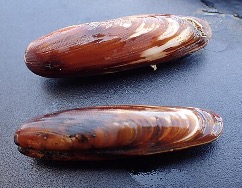
To understand current volcanic unrest, it is common practice to look back at the record of past eruptions for a volcano. In doing so, geologists can learn important information about how often a volcano erupts, the size of the eruptions, or what the precursor unrest looks like (e.g., ground inflation, change in gas/ thermal spring temperature and composition). Previous studies of Campi Flegrei identified three periods of unrest in the last 50,000 years, only one of which resulted in an eruption (Monte Nuovo, 1538 CE; Fig. 1). Each event documented ground inflation, which often indicates the movement of magma closer to Earth’s surface. This is the same type of unrest being observed today. Rosi and his team, however, found discrepancies in some of the dates suggested for these past events. This prompted the scientists to conduct their own study using radiocarbon (14C) dating of the marine organism Lithophaga (Fig. 2) to check Campi Flegrei’s past activity record.
14C Dating
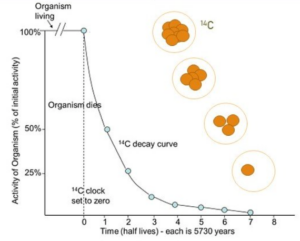
Radiocarbon, or 14C, dating is a commonly used method in geology for dating carbon-bearing materials 50,000 years or younger. After an organism dies, like the Lithophaga used in this study, a clock starts where the amount of 14C they have is considered 100%. As time passes, 14C decays. The time it takes for 50% of 14C to decay (aka one half-life) is 5730 years. This process continues until there is little to no 14C left, creating the decay curve in Figure 3. As time passes, carbon-bearing materials retain less 14C, so lower amounts of 14C record older ages.
Mussel dates agree to disagree
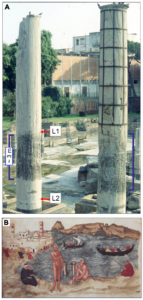
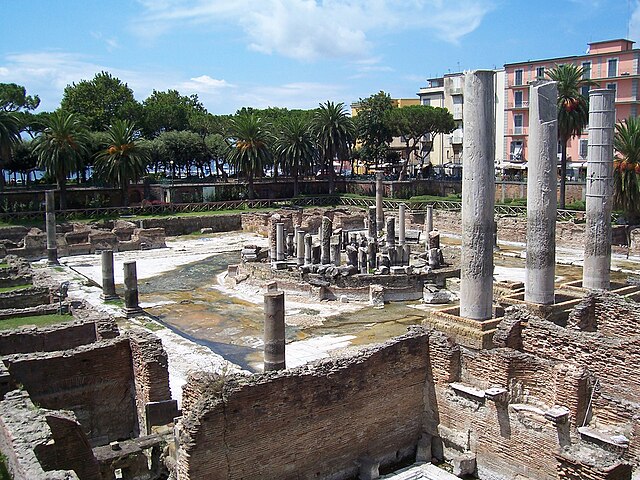
Rosi and his team targeted the Roman Macellum of Pozzuoli (Serapeo) as a sampling site because Lithophaga exist up to 7 meters high on the columns, indicating that the temple has a history of sinking beneath the sea and reemerging as land moved with volcanic unrest (Fig. 4). This history has also been recorded in ancient art where the columns can be seen emerging from the sea (Fig. 4B). What they also note is that Serapeo has a hydrothermal spring running through it, bringing water warmed by volcanic activity to the surface. This hydrothermal water, however, does not contain 14C and dilutes the 14C record of nearby living organisms. This makes the age of an organism appear much older than it actually is.
The scientists hypothesized that this dilution produced wrong ages, which were used to identify three previous periods of unrest. For comparison, Rosi and his team took samples from two different heights (L1 & L2) at both Serapeo and a cave called Rione Terra. The cave does not have any influence from hydrothermal water. They found samples from Rione Terra give a narrow range of ages that correspond to volcanic unrest before the eruption of Monte Nuovo in 1538 CE (L1 = 1300-1500 CE) and the recent unrest that started in ~1950 CE (L2 = 1870-1944 CE). Samples from Serapeo produce extremely old ages (back to 5600 BCE) that are clearly wrong because they are older than the temple itself.
Future eruption?
The authors conclude that there was only one (not three!) recorded uplift event in Campi Flegrei’s history, which ended in the eruption of Monte Nuovo. This suggests that the recent unrest likely indicates magma is moving up beneath the volcano. Rosi and his team caution that while it is difficult to predict volcanic eruptions, their refined look at Campi Flegrei’s past activity suggests new volcanic activity may happen in the near future.
Cover image from Wikimedia Commons.
I just completed my Ph.D. in Geological Oceanography at the University of Rhode Island, Graduate School of Oceanography. I received my B.S. in Geology from Union College (NY). I study submarine volcanoes! I use the chemical composition of lava to figure out what is happening inside the Earth and how magma is formed. When I’m not working with rocks, I enjoy reading on the beach, cooking, and hiking.

Wow, this is fascinating. Love how this study uses mussels for record keeping and gives an insight into Campi Flegrei’s volcanic history!