Toomey, M., Sandstrom, M., Huppert, K. et al. Vertical motion history of the island of O‘ahu, Hawaiian Islands, during the last two million years. Sci Rep 15, 26462 (2025). https://doi.org/10.1038/s41598-025-10350-1
Building an Island
Many ocean islands are volcanic, yet they are not all formed in the same way. One way to build a volcanic island is through hotspot volcanism. Hotspots are just what they sound like: fixed spots of the Earth’s interior where it is hotter than the surrounding area (purple region in Fig. 1). The higher temperatures melt mantle rock inside the planet (pink droplets in Fig. 1) that can erupt as lava on the seafloor.
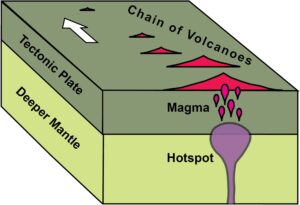
As eruptions continue, new lava settles over the top of old lava, building its way up from the seafloor and eventually breaking through the surface of the ocean to form an island. A chain of volcanic islands forms over long periods of time as plate motion (white arrow in Fig.1) drags new areas of the seafloor over the fixed hotspot and the island building process repeats itself. The Hawaiian Islands were formed this way.
Bending Under the Pressure
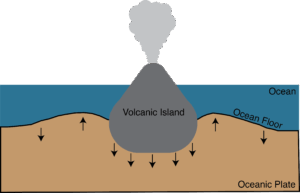
As volcanic islands are built through eruptions, their weight can actually bend the tectonic plate beneath them. This can cause surrounding islands, and other seafloor features to rise or subside (sink) relative to sea level depending on how close they are to the active volcanism (Fig. 2). These factors create a seesaw effect throughout the life cycle of a volcanic island.
Recording the Ups and Downs
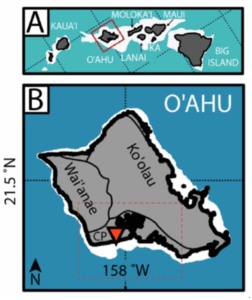
Toomey and his team investigated this vertical motion for the Hawaiian Island of O’ahu by using corals and a model developed for the region to figure out ages and relative sea level (RSL) for the coastline over the past two million years (Myrs). The team examined a 337 m-long (~1106 ft) drill core collected in 1965 from the Ewa Coastal Plain of O’ahu (Fig. 3).
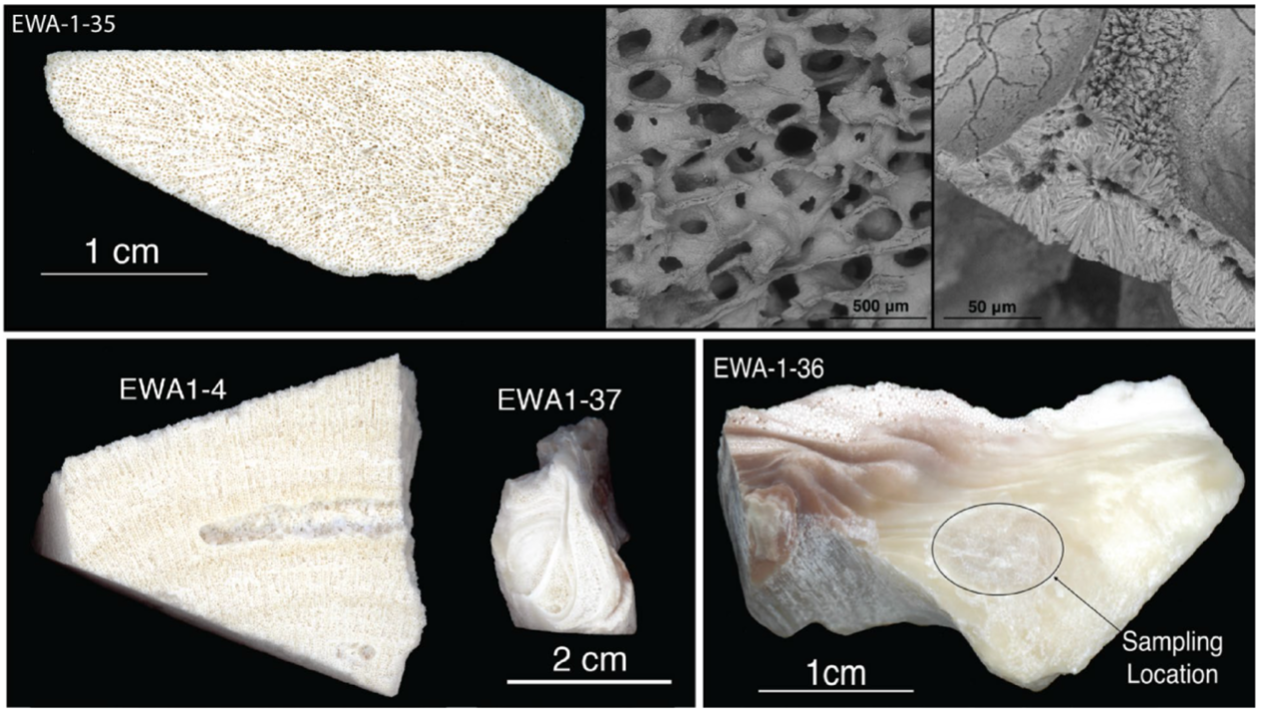
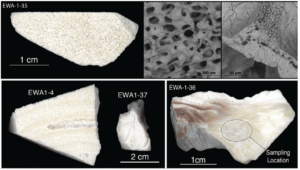
As the team of scientists moved down through the layers of the core, they moved back in time. Samples of corals were taken from different depths and dated (Fig. 4). These particular corals are useful because they live in shallow waters. Thus, the presence of a thick coral layer in the core tells scientists that the region was shallow for a long period of time (not moving up or down too much) allowing the coral to grow and thrive.
Based on the ages of the corals and the estimated RSL from the model, the scientists discovered that around 2 Myrs ago, O’ahu sank rapidly due to the formation of the island to its right. O’ahu was still close enough to be pulled down with the weight of the new island of Moloka’i. Sinking then slowed as O’ahu moved away from the main region of volcanic activity. Strong coral communities found in the core support this. Lastly, Toomey and his team discovered that sea level and vertical motion has remained fairly stable over the past million years or so. This, however, will eventually change as O’ahu gets farther away from the Hawaiian hotspot and subsidence will take over again.
Why is vertical motion important?
Understanding the patterns and magnitude of these vertical shifts on ocean islands is important, especially if the island has people on it. This data can inform climate change models and improve estimates of projected sea level rise. Ultimately, this will allow coastal communities on volcanic islands to better plan for Earth’s changing climate while taking local factors, like subsidence, into consideration.
Cover image from Toomey et al., 2025.
I just completed my Ph.D. in Geological Oceanography at the University of Rhode Island, Graduate School of Oceanography. I received my B.S. in Geology from Union College (NY). I study submarine volcanoes! I use the chemical composition of lava to figure out what is happening inside the Earth and how magma is formed. When I’m not working with rocks, I enjoy reading on the beach, cooking, and hiking.
