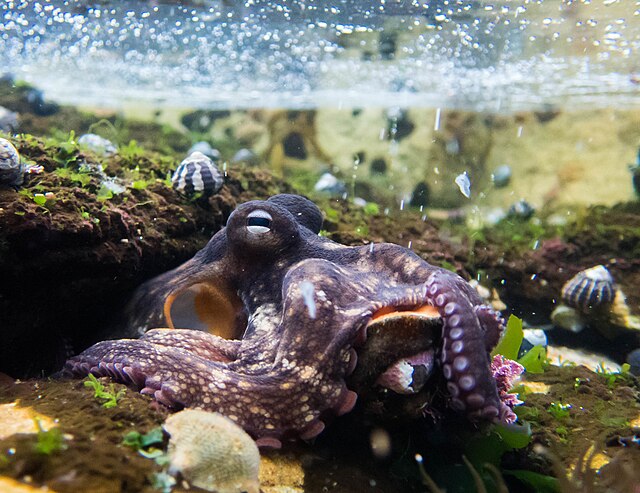
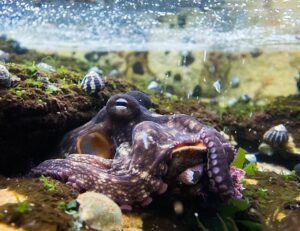
Common Sydney Octopus. Photo credit: Niki Hubbard.
Reviewing: Pryor, K.J. & Milton, A.M. (2025). Multi-Species Fish Foraging Associations Involving Common Sydney Octopus with Crimsonband Wrasse, Günther’s Wrasse and Yellowfin Bream. Marine Ecology, 46. https://doi.org/10.1111/maec.70021.
Do you ever wonder if animals have friends? Well, they do! Over the past several years, researchers have observed and documented encounters between different species of marine creatures. For example, whales and dolphins help each other fend off shark attacks, small fish clean out the teeth of eels and larger fish, and octopus and fish assist each other’s feeding. Studies in the Pacific Ocean, Indian Ocean, Atlantic Ocean, and Red Sea have indicated that several species of octopus (big blue octopus, common octopus, Brazil reef octopus, white-spotted octopus, and western rock octopus) associate with groupers, wrasse, and goatfish throughout the feeding process.
Kimberley Pryor and Ashley Milton set out to answer the question of whether a similar symbiotic relationship exists between octopus and fish in the understudied region of the Tasman Sea of the southwestern Pacific Ocean in New South Wales, Australia. The two researchers found that the common Sydney octopus was consistently attended by crimsonband wrasse, Günther’s wrasse, and the yellowfin bream while feeding.
Friendship, or association?
While certain interactions between marine species may not exactly be “friendships,” species and individuals can benefit from being associated with one another. A main type of association is known as an attendant association. This means that a predatory carnivore, known as the nuclear species, is followed by fish who scavenge the food that is uncovered or disturbed by the carnivore (Figure 1). Animals who participate in this form of collaborative hunting are able to find and catch prey more efficiently by blending each species’ strategy together. Octopus hunt by flushing prey out of small crevices and pouncing on it, whereas fish chase prey until they can capture it. Pryor and Milton explain that, when these strategies are combined, less energy is used by each animal and prey is easier to catch. However, it can be argued that fish benefit even more than the octopus because octopus can reach areas fish cannot and therefore uncover prey that fish may not normally be able to catch.

Figure 1: Yellowfin bream (YB), Günther’s wrasse (GW), and crimsonband wrasse (CWM) attending a foraging common Sydney Octopus (O). Courtesy of Pryor & Milton, 2025.
Pryor and Milton’s Study
Pryor and Milton conducted their study in the Fly Point-Halifax Park Aquatic Reserve, a fully protected sanctuary in the Port Stephens-Great Lakes Marine Park in New South Wales, Australia. Pryor had ten snorkelling sessions in which she video-recorded five foraging bouts by the common Sydney octopus. Combined, these five foraging bouts totaled 21 minutes and 44 seconds, with 23 attendants (9 crimsonband wrasse, 4 Günther’s wrasse, 10 yellowfin bream) recorded around the octopus.
The common Sydney octopus is a large and territorial octopus that lives in both the open ocean and rocky shores. As a member of an incredibly intelligent species, the common Sydney octopus forages in a “tactile and speculative manner” at any hour of day or night on crabs, snails and bivalves.
Crimsonband wrasse, a frequent attendant to the octopus, has a similar diet of crustaceans and bivalves and also lives on rocky reefs.
The Günther’s wrasse is another rocky reef resident, whose diet primarily consists of crustaceans on the seafloor.
Finally, the yellowfin bream, another fish found lurking around the octopus, also eats crabs, bivalves, and deceased fish (Figure 2). This makes the octopus the perfect nuclear species because the yellowfin bream can also eat its leftovers!
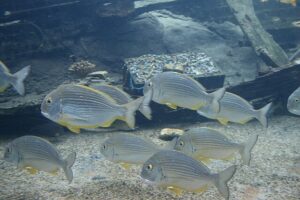
Figure 2: A school of yellowfin bream. Photo credit: Peter Black.
Not only did Pryor and Milton observe associations between the fish and octopus, but they also witnessed interactions between the different fish species. While there was no aggressive behavior between the octopus and fish, there was some hostility between fish. Both the crimsonband wrasse and Günther’s wrasse showed a hierarchy where larger fish got to be closer to the octopus and therefore have more access to food. There was even one occasion when a crimsonband wrasse struck a yellowfin bream because it was defending its position closer to the octopus.
Why is this study significant?
Pryor and Milton’s results are significant for many reasons: they produced the first record of multi-species foraging associations in the Tasman Sea, the first record of a common Sydney octopus as the nuclear species, and the first observations of the three specific fish species as participants in foraging associations with octopus. Documentation of these interactions is crucial for enhancing our understanding of ecosystem dynamics and the role of both octopus and attendant fish in the food chain. And there is still much to learn about these relationships, such as whether there is active communication between the two species.
I am a student in the Master of Oceanography program at the University of Rhode Island and enjoy scuba diving, boating, walking my dogs, reading, and being with friends and family.