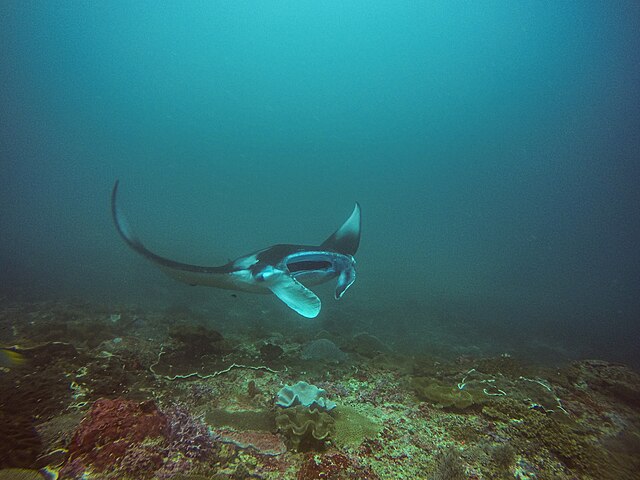
Manta ray in Nusa Penida, Indonesia. Photo credit: Rilando June Lamadjido.
Reviewing: Graham, R.T., Witt, M.J., Castellanos, D.W., Remolina, F., Maxwell, S., Godley, B.J., & Hawkes, L.A. (2012). Satellite Tracking of Manta Rays Highlights Challenges to Their Conservation. PLoS One, 7(5): e36834. https://doi.org/10.1371/journal.pone.0036834
There are a few marine gentle giants that scuba divers and researchers alike dream of encountering. Manta rays just may be at the top of that list for some. These elusive and beautiful creatures are the world’s largest batoid (a flat, ray-shaped fish), with some reaching a wingspan of 7.1 meters. While that may be an intimidating size, these animals feed only on the smallest of prey, such as fish eggs. There are several populations of manta rays across the globe, with the most famous ones residing in the Gulf of Mexico and Indonesia. The popularity of mantas doesn’t stop them from being vulnerable, though, and the International Union for Conservation of Nature (IUCN) has listed the species as “vulnerable” to extinction. Despite their legal protection in several countries, manta rays are still subject to fishing and are often spotted in heavily-trafficked shipping lanes. Manta rays grow and mature slowly. Females endure a 12-month gestation period and only give birth to one or two pups a year. These slow rates make it difficult for manta ray populations to bounce back if their numbers decline. To protect mantas, there is more we need to learn about them, such as their movement patterns.
Studying the movement of patterns of wide ranging animals, such as mantas, can be difficult – and as a result we don’t have a lot of data on this topic. Before establishing a marine protected area (MPA) or boundary, it is crucial to understand movement patterns of manta rays because policymakers will then be better informed and able to protect regions with high manta ray density. The author of this study, Graham, and her team aimed to gather insights into manta ray movement with the goal of generating environmental parameters for their movement, assessing how often manta rays enter MPAs, and determining new boundaries for protected areas.
Movement patterns of manta rays
The Gulf of Mexico has several MPAs that cover thousands of square kilometers. However, manta rays are rarely sighted within the MPA zones. In fact, during Graham’s study, only 11.5% of manta ray sightings occurred within an MPA (Figure 1). The vast majority of the time, mantas were spotted swimming in dangerous shipping areas (Figure 1). This begs the question of how policymakers and conservationists can expand or adjust MPA boundaries to include areas manta rays frequent.

Figure 1: Distribution of manta ray locations. a) Blue regions indicate MPA, black crosses are major tourism ports. Grey-black shapes indicate manta ray sighting areas. b) red lines indicate shipping lanes, with a small black square outlining region in (a). Figure courtesy of Graham et al. 2012.
Graham and her team set out on a 13-day research cruise near the Yucatan Peninsula and surrounding areas and tagged every manta ray they came across. By the end of the study, a total of six mantas were tagged: four females, one male, and one juvenile of an unknown sex. The tags on the mantas continuously transmitted environmental data and movement information to the researchers on the surface. On average, tags provided 27 days worth of recordings. Based on the depth, speed, direction, and distance the mantas travelled over the course of the study, researchers determined two main behaviors: transiting and foraging.
Of these two behaviors, mantas were primarily determined to be foraging – an overwhelming 97.7% of the time! These animals are not picky eaters, though. Their diet included shrimp, copepods, fish eggs, and more, but because their prey items are small, they need to spend a lot of time feeding! Certain regions are richer in these delicacies than others. For example, areas with heavy upwelling or where fish spawn produce more food for the mantas. Mantas also prefer to live and feed in warm waters, with sea surface temperatures ranging between 26ºC and 30ºC. Due to this, mantas primarily stayed shallower than 50 meters. Despite a small range of vertical movement, mantas still traveled quite far while tagged and tracked. Some individuals travelled up to 1,151 kilometers!
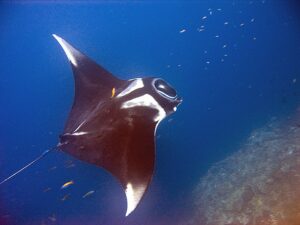
Manta ray swimming in Hin Daeng, Thailand. Photo credit: Jon Hanson.
Conservation implications
Based on data from Graham’s study, manta rays have foraging ranges of over 100km. Unfortunately, the existing MPA network does not encompass this range, as it is too far offshore and too wide. However, Graham’s data can help highlight which sites manta rays use most regularly which can then be applied to the establishment of new protected zones. Improved understanding of where manta rays live, feed, and migrate to is all critical information to establishing new protected areas.
Threats to manta rays still exist. Not only are they frequently caught by fishing operations, but there is growing demand in Asia for their gill rakers, which are used in medicine. A growing marine megafauna tourism industry also puts these animals at risk, as operations are rapidly expanding and mostly unregulated. These risks can all be mitigated by increased protection and larger boundaries for MPAs in regions manta rays live.

I am a student in the Master of Oceanography program at the University of Rhode Island and enjoy scuba diving, boating, walking my dogs, reading, and being with friends and family.