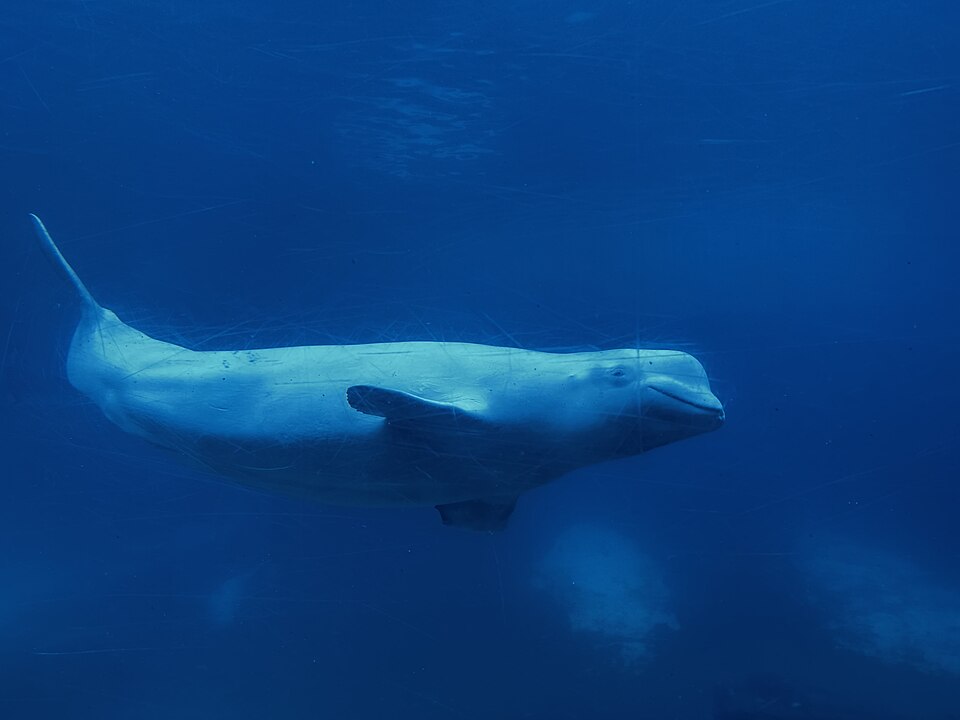
Beluga whale swimming. Photo credit: Fayasa L Bin Darul.
Belugas go on summer vacation in Canada
Reviewing: Coppolaro, V.L.M., Kirillov, S., Isleifson, D., Loseto, L.L., & Marcoux, M. (2026). Establishing an acoustic benchmark of beluga habitat use in the Churchill River estuary, Manitoba. Frontiers in Mammal Science 5:1903254. doi: 10.3389/fmamm.2026.1903254
Beluga whales (Delphinapterus leucas) are charismatic whales who are widely distributed across Arctic and sub-Arctic oceans. Many populations of belugas migrate to Canadian waters, including the Western Hudson Bay (WHB), leading the region to be characterized as an Ecologically and Biologically Significant Area (EBSA) (Figure 1). Despite this, the exact reasons behind belugas’ occupation of the region are not completely understood. Coppolaro and her team sought out to collect acoustic data in order to deepen scientific knowledge on how belugas use the WHB habitat.
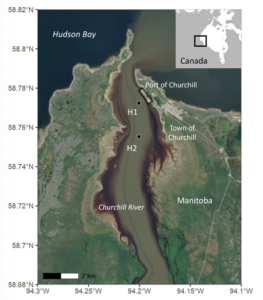
Figure 1: Map of beluga habitat in Western Hudson Bay, Canada. H1 and H2 represent moorings where acoustic monitors were placed during 2020 beluga study.
Beluga vocalizations give researchers insight into their activity. Clicks are rapid bursts of sound that are typically used for navigation and prey detection. Tonal sounds are longer, harmonic sounds used during social interactions. In order to record these vocalizations, Coppolaro and the team used passive acoustic monitoring (PAM), a long-term, all-weather, and non-invasive monitoring technique. Two moorings were placed in the Churchill River estuary region of the WHB for data collection (Figure 1). Each mooring was equipped with an underwater hydrophone and recorded vocalizations in August and September of 2020. Recordings were divided into tonal sounds and clicks, with 136 recording files used in final data analysis.
Results
High levels of vocal activity were recorded throughout the monitoring period, which confirms that the WHB Churchill River estuary is an important summer habitat for belugas. Several comparisons were drawn between the two mooring locations H1 and H2 (Figure 2). For example, the number of clicks recorded were substantially higher than the number of tonal sounds at both H1 and H2. This aligns with historical data on beluga vocalizations and was expected. Furthermore, the number of both clicks and tonal sounds sharply decreased in the first week of September, marking the beginning of beluga winter migration.
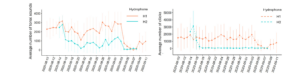
Figure 2: Trend of beluga average number of vocalizations and standard deviation per day. Figure courtesy of Coppolaro et al. 2026.
Coppolaro’s team also collected data on environmental variables (average air temperature, rain, wind, etc.) and shipping activity in order to begin understanding how these factors impact beluga habitat use. (Figure 3). While mean air temperature demonstrated a gradual seasonal decrease, the highest precipitation event occurred on August 30th and 31st. This also corresponded with the second highest strong wind event. Vocalizations at both H1 and H2 were at an extreme low during these weather events, indicating that beluga activity can be minimized by intense weather (Figure 3).
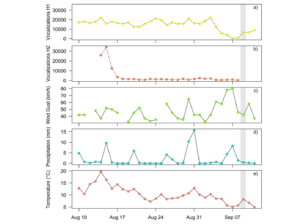
Figure 3: Average daily number of beluga vocalizations (sum of clicks and tonal sounds) recorded at a) hydrophone H1 and b) hydrophone H2; c) daily wind gust speed (km/h); d) total daily precipitation (mm); and e) daily mean air temperature (ºC) in the Churchill River estuary between August 10th and September 11th, 2020. Gray shaded area represents the time interval when a cargo ship was in the estuary. Figure courtesy of Coppolaro et al. 2026.
Conclusion
The quantity of beluga vocalizations recorded by Cooppolaro’s team during the 2020 study period underscores the significance of the WHB and Churchill River estuary as beluga summer habitat. In order to further determine exactly how belugas use the region, researchers must utilize multi-year acoustic monitoring as well as visual observations. The combination of these methods will create a more complete picture of when and how belugas use the estuary and answer questions on how tides, time of day, and human activity impact migrating beluga populations. It is critical to understand beluga habitat use in order to implement management and conservation strategies, as well as identify how to minimize disturbances from shipping vessels.
Coppolaro and her team greatly contributed to understanding WHB beluga habitat use and migration, and it will be fascinating for more studies to emerge and follow along how belugas can be protected in the region!

I am a student in the Master of Oceanography program at the University of Rhode Island and enjoy scuba diving, boating, walking my dogs, reading, and being with friends and family.