Joseph, K. M., Rehm, S. J., Chappel, J. R., Crocker, D. E., Holser, R. R., Costa, D. P., Khudyakov, J. I., Baker, E. S. A Legacy of Exposure: Lactational PFAS Transfer and Early-Life Accumulation in Northern Elephant Seals. Environment & Health (2026). https://doi.org/10.1021/envhealth.5c00782
PFAS
PFAS, or per- and polyfluoroalkyl substances, are everywhere. They have been detected around the world and are used in many everyday products and industrial applications, including nonstick cookware, clothing, food packaging, firefighting foams, and specialized coatings.
These human-made, long-lasting chemicals are known for their persistence in the environment, and scientists have found PFAS far from where they were originally used. However, important questions remain about how they are distributed in the environment and their health effects.
But why study elephant seals?
Northern elephant seal feeding and breeding behaviors make them a useful species to provide clues about the contaminants present in their environment and the contaminant transfer between mother and offspring.
Elephant seals migrate offshore and forage in the deep, open ocean, and elephant seals are capital breeders. This means that females rely largely on energy reserves built up before breeding rather than eating during the breeding and nursing period. The female seals fast while nursing their pups for about four weeks, transferring lipid reserves to their pups in energy-rich milk. During this time, mothers can lose about 60% of their body fat while their pups gain roughly 100 kilograms, with about 55% of that being fat. After weaning, pups rely on the energy reserves they built up while nursing to support another six-to-eight-week development period while fasting.
There is a lot of material moving from mother to pup in a very short time, which gives scientists the chance to study how contaminants move between mother and offspring.
Collecting milk and plasma
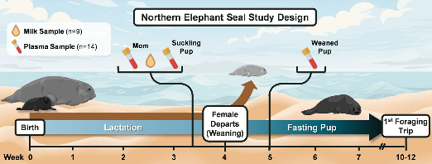
Researchers studied 14 northern elephant seal mother-pup pairs at Año Nuevo State Park in California. They collected plasma, the liquid portion of blood, from all mothers and pups, and they collected corresponding milk samples from nine of the mothers (Figure 1). Using several chemical analyses, researchers measured PFAS concentrations.
What types and concentrations of PFAS did they measure?
Long-chain PFAS were the dominant group detected in the seals, most likely due to their foraging in the mesopelagic zone, or the part of the ocean roughly 200 to 1,000 meters below the surface, where long-chain PFAS are hypothesized to accumulate.
Researchers also found that plasma PFAS profiles differed between mothers, nursing pups, and weaned pups. Across the 16 PFAS measured, the summed concentrations were 17.90 nanograms per milliliter (ng/mL) in mothers, 62.33 ng/L in nursing pups, and 89.08 ng/L in weaned pups. PFAS concentrations were substantially higher in pups than mothers. Nursing pups had more than three times the concentration measured in mothers, and weaned pups had about five times the maternal concentration.
The researchers also looked at seven specific PFAS used when interpreting human exposure. The concentration in all seals exceeded the lowest reference range where PFAS-related health effects are not expected in humans. Of course, human and elephant seal health risks cannot be directly matched, but the results showed that the northern elephant seals carry high PFAS burdens.
Why are pup PFAS concentrations higher?
Researchers found that maternal plasma explained a large amount of the variability in PFAS concentrations among nursing pups. This relationship became weaker after weaning. One possible explanation was that during nursing, mothers mobilize energy stores containing contaminants, including PFAS, into their milk. This can increase pup contaminant concentrations relative to mothers. After weaning, pups undergo major body changes that redistribute nutrients, and potentially PFAS, from blubber to plasma. This would help explain why pup plasma concentrations change even after they stop nursing.
So what about the milk?
Interestingly, PFAS concentrations in milk were lower than concentrations in plasma. However, that doesn’t mean milk is an irrelevant exposure source.
Elephant seal pups consume a large amount of milk in a short nursing period. When researchers accounted for the amount of milk consumed by the seal pups, they found that lactation represented a substantial route of early-life PFAS exposure.
The European Food Safety Authority sets a tolerable weekly intake based on the sum of four PFAS. For humans, this is 4.0 nanograms per kilogram per bodyweight per week. Scaled for seals, this was approximately 676 ng/kg/bw/week, or 170 times higher than the “safe” threshold. Again, this comparison is made to put the exposure into context, rather than suggest seal pups experienced health effects at a particular level.
The value of studying milk
One of the most interesting findings of the study is that milk can provide information about contaminant exposure not captured in plasma alone. Studying milk alongside blood provides a more complete picture of PFAS exposure and transfer between generations. There are still many questions to answer about potential metabolic processes and maternal transfers, but lactation is a critical pathway of early-life PFAS exposure. For scientists, collecting and studying milk provides an important piece of the story.
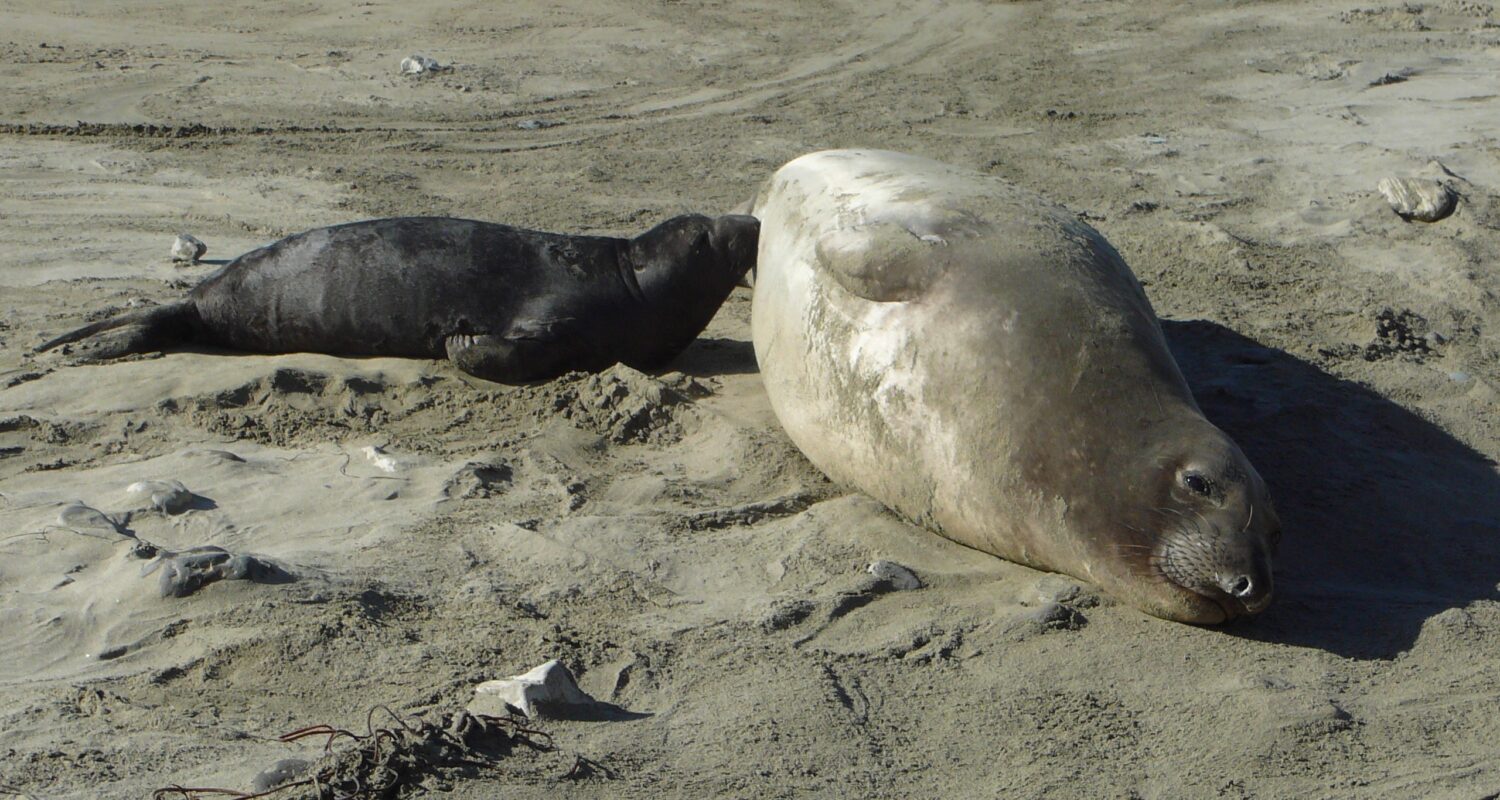
Cover image is a nursing elephant seal pup. Image credit courtesy of Dr. Brandon Southall and obtained from the NOAA Public Domain Library.
I am a Ph.D. Candidate at the University of Connecticut–Avery Point studying the marine carbonate system in the Arctic Ocean. My research focuses on biogeochemical changes occurring within sea ice as the Arctic continues to warm. Outside of my research, I enjoy hiking, running, aerial gymnastics, paddleboarding, traveling, and spending time with family and friends.

