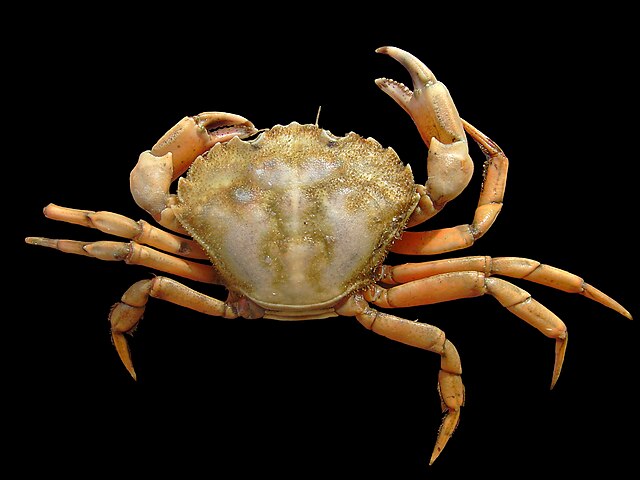
Carcinus maenas, or the European green crab, the subject of James’ study. Photo credit: Hans Hillewaert.
Do Male or Female Crabs Respond More to Electromagnetic Fields?
Reviewing: James, E., Ghodsi, M., & Ford, A.T. (2025). Female Crabs Are More Sensitive to Environmentally Relevant Electromagnetic Fields from Submarine Power Cables. Environmental Science and Technology Letters, 12:1487-1494.
In the last several years, there has been a shift towards renewable energy in an effort to reduce the anthropogenic driving of climate change. This has led to the expansion of offshore wind farms, as wind turbines are a strong source of green energy. However, the construction, maintenance, and operation of these turbines disturbs the surrounding marine environment. One such disruption is the deployment of submarine power cables, which transmit electricity from the offshore wind farms to energy grids on land. The introduction of power lines alters natural electromagnetic and geomagnetic fields, which has had negative impacts on many marine species.
Marine species including turtles, sharks, and crustaceans rely on magnetic cues for important life functions such as navigation, feeding, reproduction, orientation, and predator avoidance. The addition of anthropogenic electromagnetic fields (EMFs) disrupts how well marine animals are able to use naturally occurring EMFs. For example, in animals like crabs, EMFs influence locomotor activity, space use, and physiology. Crabs are crucial ecosystem engineers, as they play a critical role in nutrient cycling, sediment mixing, and food web dynamics. Therefore, it is important to understand how they are impacted by anthropogenic EMFs.
James’ Study
While several studies have been done on how EMFs influence crustaceans, none have focused specifically on female crabs. This knowledge gap needs to be addressed because females are responsible for reproduction, so if their behavior and physiology is altered by anthropogenic EMFs, there would be detrimental effects on the species population. James and her team chose to use Carcinus maenas, the European green crab, as the study species (Figure 1). C. maenas prefers the intertidal zone, and is widespread throughout the United Kingdom and temperate coasts around the world. It is a keystone species and is crucial to the health of the surrounding environment.
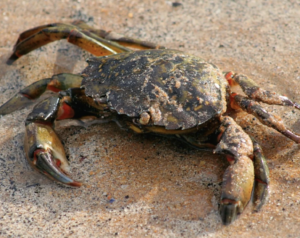
Figure 1: Carcinus maenas specimen. Photo credit: Animalia.
James’ team examined how juvenile green crabs in a lab environment would respond to environmentally accurate EMFs, with a focus on sex-specific effects and differences. The team hypothesized that females and males would react differently.
Crab specimens were taken from Langstone Harbour in the United Kingdom during low tide. The crabs were brought to the laboratory, where they were placed in a tank and tested under four conditions: control (naturally occurring EMF level), EMF 500, EMF 1000, and EMF 3200 μT (microtesla, a unit of magnetic flux). In total, 60 females and 60 males were tested under each condition.
The researchers analyzed three variables for each of the four EMF exposures: distance traveled, zone duration, and mobility. Distance traveled represents the total movement for each crab throughout the lab tank and zone duration refers to how much time each crab spent in various proximities to the EMF emissions (Figure 2).
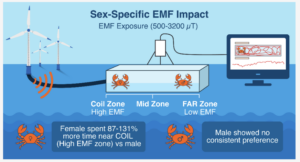
Figure 2: Illustration of James’ study and results. Image courtesy of James et al. 2025.
Who is more impacted by anthropogenic EMFs?
Throughout the course of the study, it was evident that females experienced more behavioral changes than males from EMF exposure. Typical crab behavior was altered, and sex-specific differences were prominent. For example, females consistently were attracted to EMF-exposed zones, with most of their time spent in the 1000 μT zone, while males did not show a significant zone preference. Researchers compared the lab results to previous observations in the wild and found similar results across crustacean species. Therefore, it can be assumed that the attraction to EMF hotspots in the laboratory setting would translate to a wild setting, which could impact reproduction and population stability.
Overall, females exhibited significantly greater attraction to EMF zones, which suggests that females are at a higher risk of exposure and consequences. Risks include alterations to migration routes, mating, and larval release, which would negatively impact population dynamics. James and her team made great strides in collecting evidence of how male and female crabs differ in their responses to EMFs, but more research is necessary. Understanding how anthropogenic factors affect crabs is crucial for creating conservation and management policies to protect these species.

I am a student in the Master of Oceanography program at the University of Rhode Island and enjoy scuba diving, boating, walking my dogs, reading, and being with friends and family.