Feuring, A., Lawrence, C.D., Salcedo, J. et al. Fungal parasites infecting N2-fixing cyanobacteria reshape carbon and N2 fixation and trophic transfer. Nat Commun 17, 154 (2026). https://doi.org/10.1038/s41467-025-67818-x
A bloom is like a cake, lots of layers
Marine microscopic organisms operate in a web of staggering complexity. This microbial loop quietly drives nutrient cycling and sustains aquatic ecosystems in a delicate balance. However, when that balance shifts, the consequences can lead to dramatic events like harmful algal blooms. These are not simple on-off events but instead emerge from dense networks that involve cyanobacteria, nutrients, and other microbes.
The Baltic Sea offers a striking example. Since the 1970s, cyanobacterial blooms there have increased in frequency, biomass, and duration. The impacts ripple outward: oxygen depletion, toxin production, degraded water quality, and an economic strain on fisheries and recreation in both shallow and deep waters. While excess nutrients and warming temperatures often take center stage in explanations of these blooms, one key player has largely been ignored—fungi.
Formidable fungi
Parasitic fungi, particularly chytrids, are increasingly recognized as widespread in freshwater and coastal systems. During blooms, they can infect a large fraction of phytoplankton populations. These infections can weaken individual cells, reroute nutrient pathways, and reshape food web dynamics. Although carbon cycling typically receives the most attention, much less is known about how fungal infections influence nitrogen fixation and the fate of newly fixed nitrogen.
To address this gap, a team of researchers from Germany, Sweden, and Austria collected samples from the Southern Baltic Sea each summer from 2012 to 2021. Their focus was Dolichospermum, a dominant nitrogen-fixing cyanobacterium. By combining a variety of techniques (isotope tracer experiments, mass spectrometry, rRNA sequencing, and microscopy,) the team sought to identify the dominant species of fungi and investigated how common fungal infections were and how carbon and nitrogen moved from host to parasite.
A nitrogen-focused heist
The findings were striking. Across the decade of sampling, more than half of Dolichospermum populations showed fungal infection, and in some populations, up to 80% of the chain-like cell filaments were affected. Rather than being rare events, fungal infections appear to be a routine feature of Baltic Sea cyanobacterial blooms.
This matters because Dolichospermum plays a foundational ecological role. By converting inorganic nitrogen into biologically available forms, it fuels productivity across the ecosystem. Its long, chain-like filaments contain three distinct cell types: photosynthetic vegetative cells, nitrogen-fixing heterocytes, and akinetes, which are resting cells that store energy and nutrients to ensure survival and future growth.
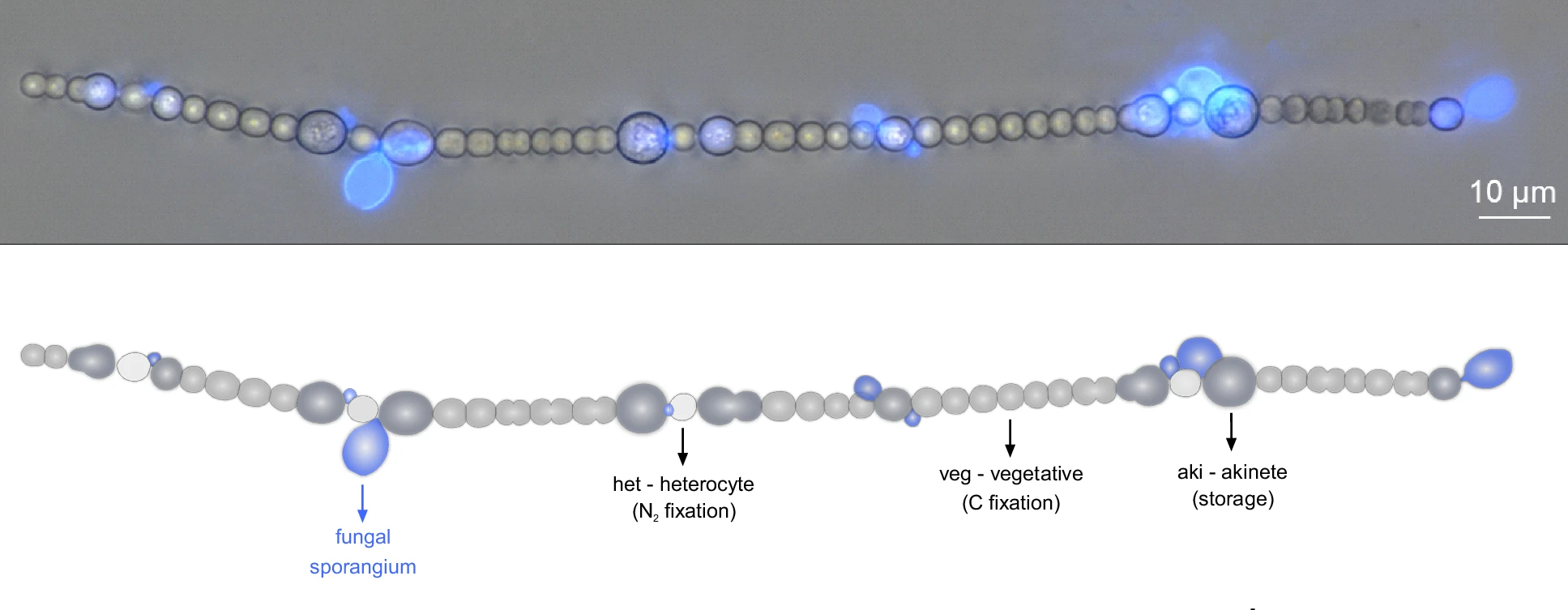
The akinetes proved especially vulnerable. Each akinete contains roughly ten times the carbon and nitrogen of a vegetative cell, making it a nutrient-rich target. In infected akinetes, carbon levels declined by 28% and nitrogen by 56% as fungi siphoned resources for their own reproductive use.
The crafty fungal culprit
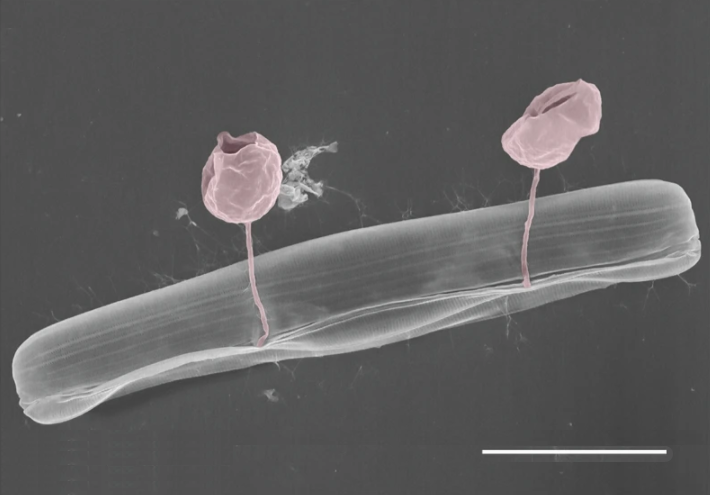
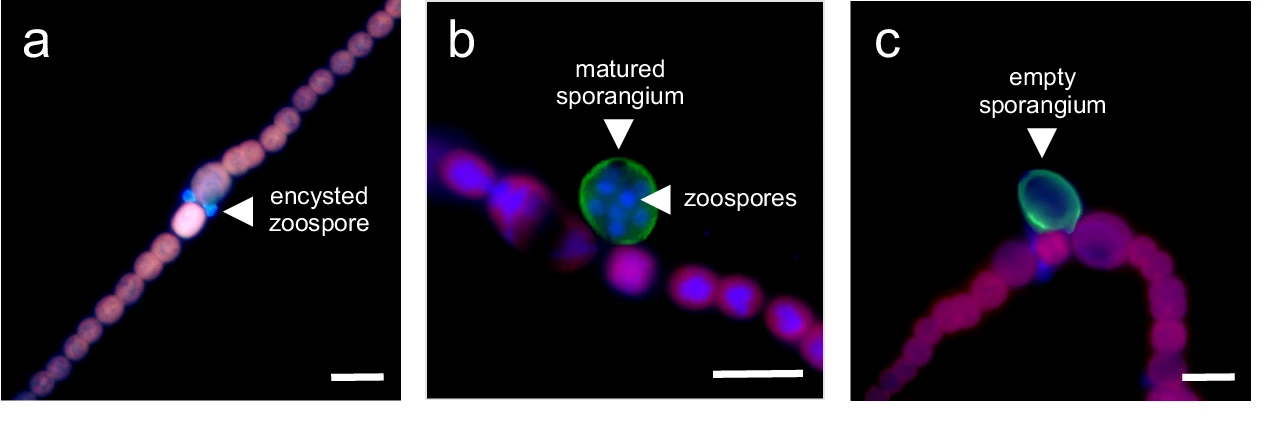
Genetic analyses identified the parasites as chytrids (phylum Chytridiomycota). Their life cycle is both efficient and destructive. Motile zoospores attach to a host cell, encyst, penetrate the cell wall, and redirect nutrients into a growing sporangium. Once mature, the sporangium ruptures, releasing a new wave of zoospores to infect additional hosts.
Importantly, Dolichospermum was not the only affected species. All three major nitrogen-fixing cyanobacteria in the Baltic Sea showed evidence of infection. Across blooms, fungi rapidly extracted stored carbon and nitrogen from their hosts. The researchers estimate that roughly 22% of newly fixed nitrogen was diverted to fungal parasites.
So who gets the nitrogen?
Yet this diversion does not necessarily halt nutrient flow; it occasionally reshapes it. Infection often fragments cyanobacterial filaments into shorter pieces, potentially making them more accessible to zooplankton grazers. Meanwhile, fungal zoospores are rich in surplus nutrients, offering a high-quality food source for microzooplankton grazers. Rather than acting as a dead end, fungal infection may redirect nitrogen and carbon into alternative pathways within the food web.
Still, the scale of nutrient capture is significant. In a region already stressed by eutrophication and climate change, siphoning off nearly a quarter of newly fixed nitrogen could influence bloom persistence, seasonal dynamics, and long-term ecosystem structure.
While algal blooms are a persistent presence on the marine surface, the microscopic struggle with fungi ultimately determines where vital nutrients end up.
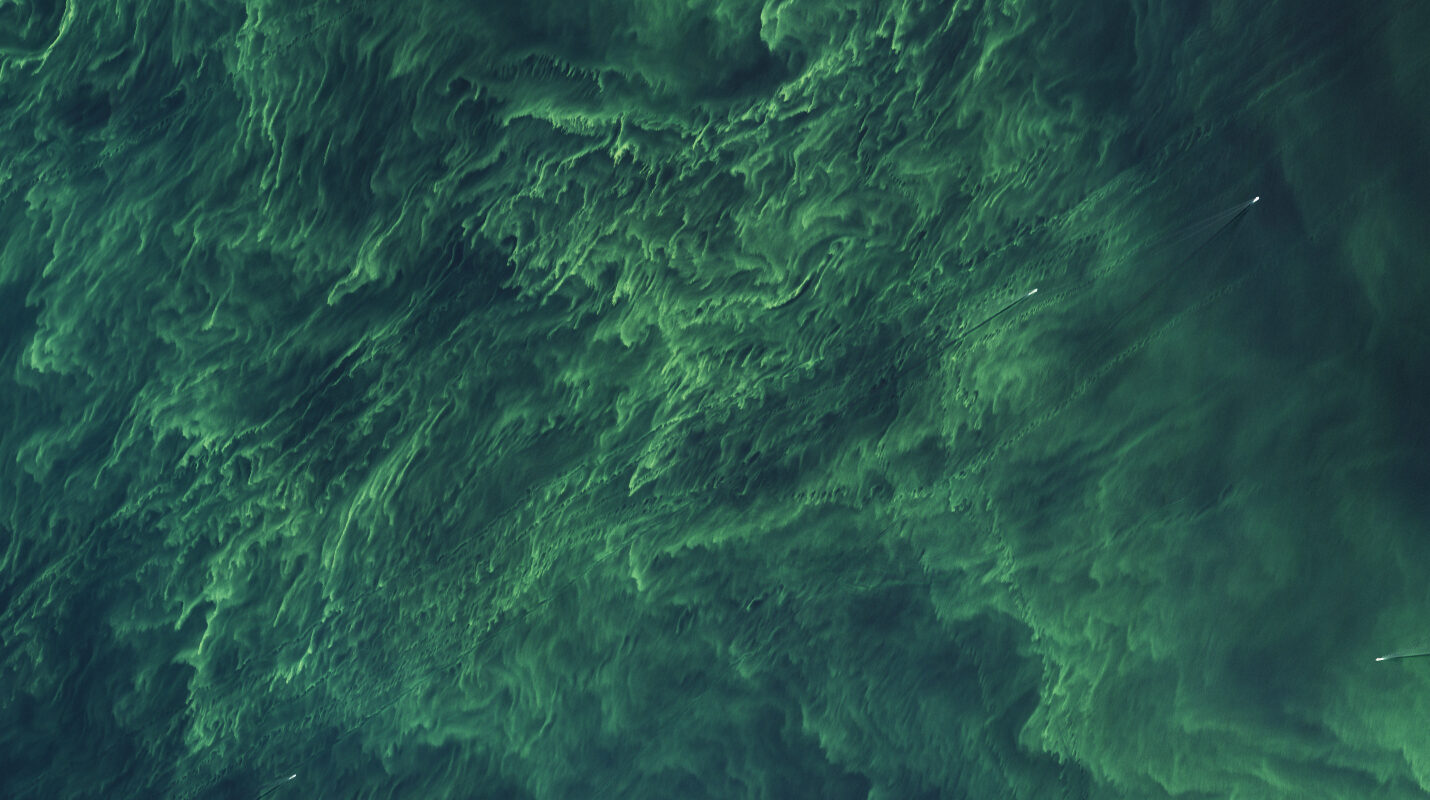
Cover image is a phytoplankton bloom in the Baltic Sea, NASA Earth Observatory by Michala Garrison, Wikimedia

I’m a former oceanographer with an MSc in Biological Oceanography from UConn where I studied mixotrophy in marine ciliates. After a year in Poland (studying freshwater critters) I moved to California. I currently work as a lab technician at Stanford. Outside of science, I enjoy a good book, a long run, and frozen fruit.


.jpg)