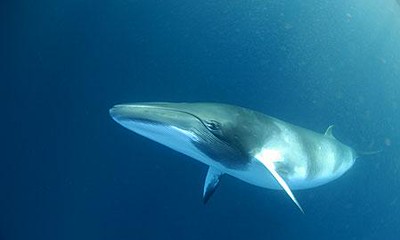
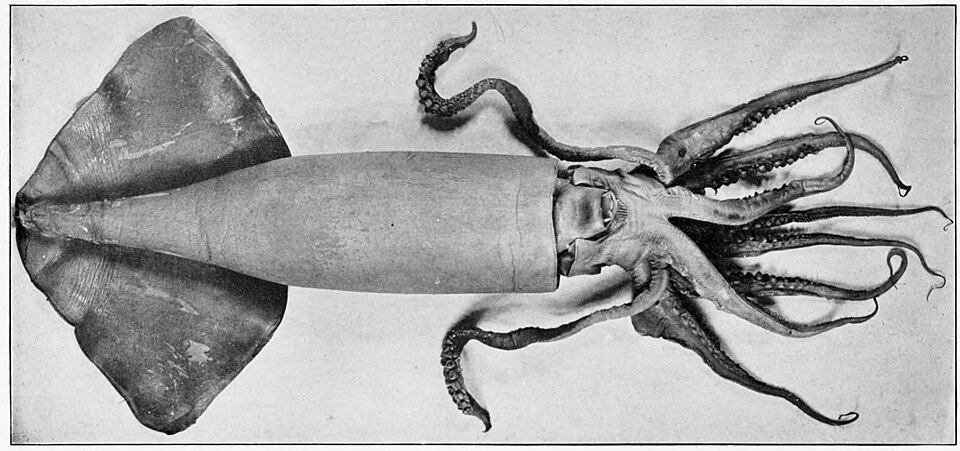
Jumbo squid (Dosidicus gigas), the subject of Jiang’s study. Photo courtesy of Wikimedia Commons.
El Niño and the jumbo squid
Reviewing: Jiang, M., Dong., S., Liu, B., Zhang, F., & Chen, X. (2026). Strong El Niño events reshapes migration routes and reproductive phenology of jumbo squid (Dosidicus gigas). Communications Earth & Environment. https://doi.org/10.1038/s43247-026-03509-9
Introducing the Players
Over the last several years, climate change and global warming have accelerated and had devastating consequences on habitats and wildlife across the oceans. As the environment shifts, the health and stability of marine ecosystems declines and species are forced to rapidly adapt for survival. One climate phenomenon known as the El Niño Southern Oscillation (ENSO) is a key player in shifting ocean conditions. ENSO is characterized by periodic fluctuations in ocean temperatures, atmospheric pressure, currents, and nutrient availability along the equatorial Pacific (Figure 1). As the climate continues to evolve, ENSO phases have increased in frequency and intensity. These significant swings in environmental factors impact the life cycles and habits of pelagic, or open-ocean dwelling, species, and it is crucial to understand how ENSO conditions impact population stability, reproductive processes, and migration patterns.
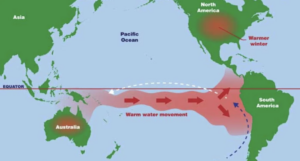
Figure 1: Illustration of El Niño conditions. Credit: NOAA.
Migration, a function primarily allowing animals to find food and mates for reproduction, is one area that has been impacted by changes in environmental factors. Typically, migration is driven by natural rhythms and access to resources. However, ENSO conditions alter historical migration patterns in pelagic species such as cephalopods. Cephalopods are a highly migratory class of animals composed of squid, octopus, cuttlefish, and nautilus. Previous studies have shown that cephalopods demonstrate flexibility in migration, but researchers are curious about how climate change and ENSO directly and indirectly has been affecting the way these species move throughout the ocean. Jiang and his team sought out to understand the physiological and behavioral responses of pelagic squid to ENSO.
Oceanic squids are excellent subjects because they show clear migration preferences and movement patterns. However, few studies have been conducted using pelagic squid because of complicated population structures and vast habitats. Jiang’s team aimed to identify and understand potential drivers, such as ENSO and climate change, that alter the migratory patterns of pelagic squid. The team chose jumbo squid (Dosidicus gigas) because they are a key species in the pelagic ecosystem and have a high economic value. Therefore, understanding how they are affected by ENSO is important for determining cascading impacts both in the ocean and out.
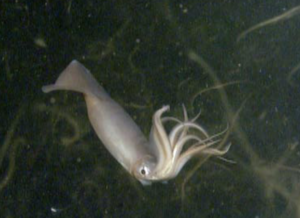
Figure 2: Jumbo squid (Dosidicus gigas) in the deep. Photo credit: NOAA / MBARI 2006.
The Study
Jiang’s team wanted to answer three main questions:
- How do ENSO events shift the reproductive migration of the jumbo squid?
- How do ENSO events shift overall migratory routes?
- What environmental factors drive these changes?
In order to answer these questions, the team focused on a specific population of jumbo squid who seasonally migrate to southern Peru and northern Chile for their spring spawning season. Between January 2009 and May 2024, over 50,000 female jumbo squids were collected by observers and research vessels, with over 12,000 brought to shore for measurements such as mantle length, sex, maturation level, body weight, and gonad (reproductive organ) weight. The remaining ~40,000 females were measured for mantle length and sex before being released back into the ocean. Additionally, the team received and recorded a variety of environmental variables such as temperature, dissolved oxygen concentration and levels of chlorophyll, which is crucial for photosynthesis. By the end of the study, 18 environmental factors, including those mentioned above, were significant in jumbo squid migration.
Jiang and the team found evidence for a major change: during an ENSO phase, spawning and the beginning of reproduction peaked in October. In non-ENSO phases, spawning typically occurs in the spring. Therefore, strong ENSO conditions shifted jumbo squid reproductive processes by several months. In terms of general migration, ENSO conditions resulted in a migratory route more southeastward, a shorter distance, and closer to the coast than during other climate phases.
Conclusions
Overall, ENSO-induced variations in marine conditions had a significant influence on the reproductive migration of the jumbo squid population. During an ENSO event, migration routes decreased and spawning occurred at a different time of year, likely because of abnormal sea surface temperatures and a south-eastward shift of suitable spawning habitats.
These major changes in reproductive sites and migration can affect the healthy biomass of jumbo squid, as the biomass is closely tied to the ENSO cycle. During El Niño, the biomass is much lower than during La Niña, the cooler, nutrient rich counterpart to El Niño. Changes in environmental conditions can impact the metabolism and other physiological characteristics of individuals, which influences the health of the population.
Furthermore, alterations to the population pose challenges to fisheries and conservation initiatives. Jiang and the team suggest the implementation of dynamic ocean management policies, which would provide real-time predictions of jumbo squid migratory routes to help protect the species from overfishing and bycatch.

I am a student in the Master of Oceanography program at the University of Rhode Island and enjoy scuba diving, boating, walking my dogs, reading, and being with friends and family.