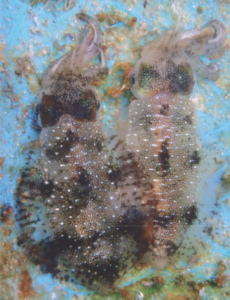
A pair of white-squid exhibiting a distinct camouflage pattern against the tank bottom. Image courtesy of Nakajima et al. 2025.
Reviewing: Nakajima, R., Lajbner, Z., Boo, W.H., Asada, K., Nishibayashi, T., Iglesias, T.L., Gutnick, T., Miller, J., & Kuba, M.J. (2025). Situational motionless camouflage of a loliginid squid. Scientific Reports, 15:41203. https://doi.org/10.1038/s41598-025-25212-z
Hide and seek: motionless camouflage of the white-squid
Imagine playing a game of hide and seek. Where are the best places to hide? It could be under a bed, behind a door, or in a closet. But what about hiding in plain sight? Cephalopods, the group of animals made up of octopus, cuttlefish, and squid, have the remarkable ability to do just that: hide extremely well while out in the open. This is known as camouflaging – a mechanism that allows cephalopods to completely blend into their surroundings, enabling them to avoid predators and sneak up on prey.
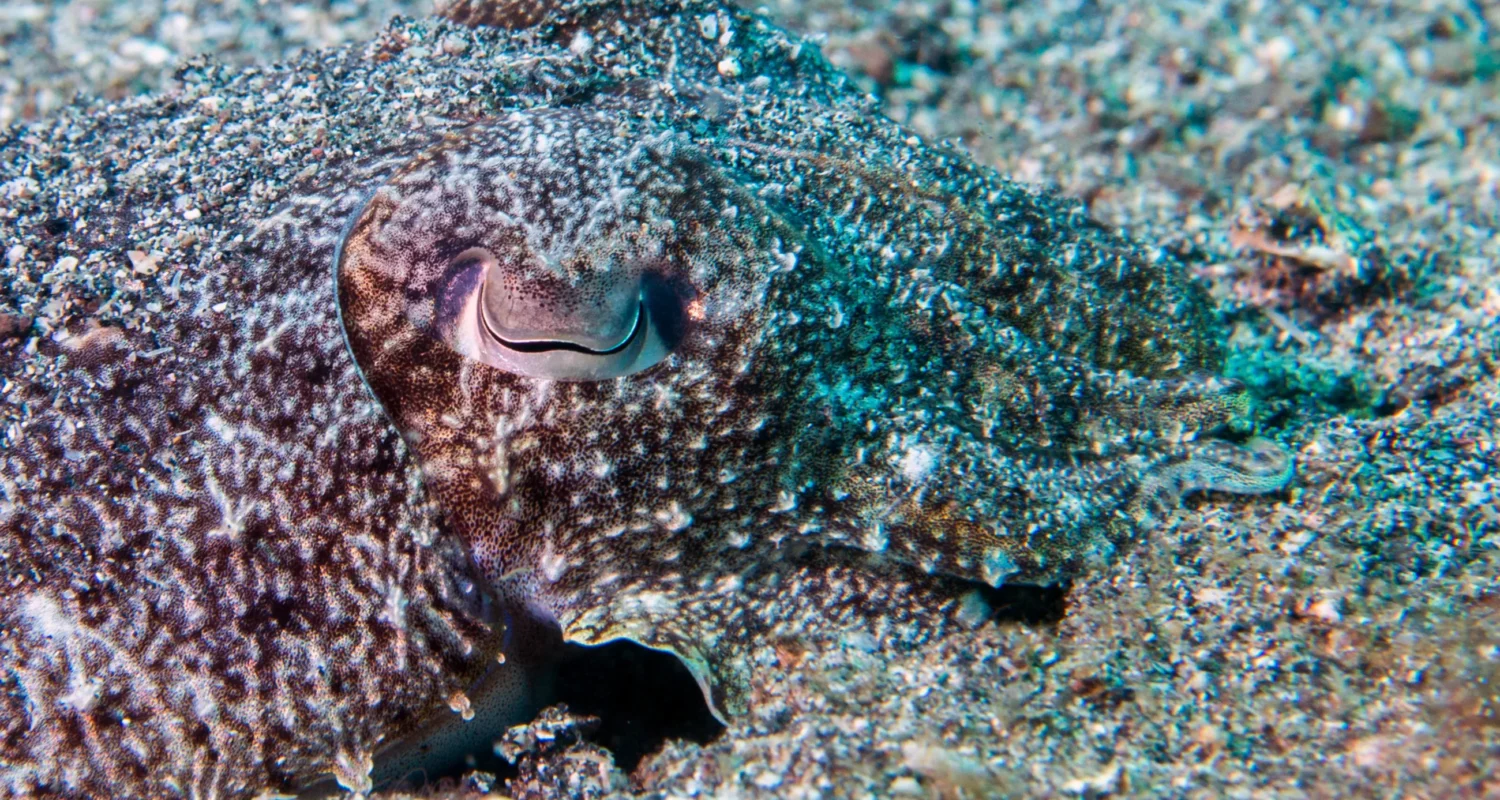
In order to perfectly fit in with their surroundings, cephalopods alter their coloring, pattern, texture, posture, and movement (Figure 1). They do this by neurally controlling chromatophores (color pigment sacks), iridophores (sacks allowing light refraction and color variation), and leucophores (cells that reflect and scatter light). The variety and amount of combinations that can be produced allows squids, octopus, and cuttlefish to have a massive repertoire of camouflage ability and body patterns.
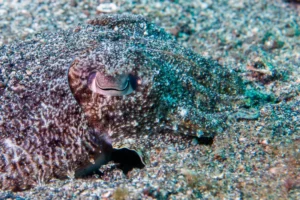
Figure 1: Image of squid camouflaging with sandy ocean floor. Photo credit: Andrea Izzotti.
Researchers have frequently observed cephalopods camouflaging while in motion, but there are fewer studies conducted on motionless individuals. It is difficult to observe and record data on camouflage because of challenges associated with open ocean and reef habitats. Squid are an important part of the food chain, as they provide food for fish, mammals, and birds. They also regulate lower levels of the food chain by eating small fish and crustaceans. Therefore, understanding how they camouflage is important for determining how they thrive in the middle of the food chain.
Studying motionless camouflage with the white squid
Nakajima and his team sought to address the knowledge gap surrounding squid motionless camouflage by focusing on the white squid, a species that inhabits temperate and tropical waters. It has a wide geographical and ecological distribution, and can be found in habitats characterized by seagrass, coral reef, or sand. For their study, the team used both juvenile and adult white squid that were bred and born in a laboratory setting (Figure 2).
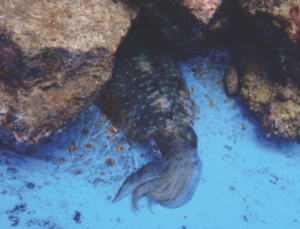
Figure 2: A white squid in the lab tank used by Nakajima’s team. The squid is displaying a “dark mottled pattern” to blend in with the surrounding rocks. Image courtesy of Nakajima et al. 2025.
To qualify as motionless, the squid had to be static and display the same body pattern for at least five seconds. By the end of the study period, the team had acquired photos and videos of 216 motionless camouflage “events” to examine. The events were organized into categories such as body pattern and position, and the relationship between locomotion, arm posture, and chromatic pattern was analyzed.
In 89.9% of the 216 captured events, an individual squid was sitting on the tank floor, while in the remaining ~10% of the events, the individual was hovering slightly above the floor. The squids also showed a strong preference for being in close proximity to objects placed in the tank. In 91% of observations, an individual would sit or hover next to, inside of, or underneath an object (Figure 2). In addition to positions, various postures and chromatic patterns were documented (Figure 3).
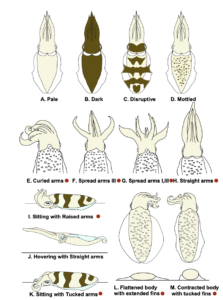
Figure 3: Visual descriptions of color (A-D), posture (E-H), and position (I-M). Red dots indicate a component newly described in Nakajima’s study. Figure courtesy of Nakajima et al. 2025.
White squid were constantly camouflaging with the tank floor. This behavior translates into the wild, where squid camouflage to avoid detection from both underwater and aerial predators. The high frequency of the sitting behavior could be correlated with the return of adult squid from deep to shallower waters when it is time to reproduce.
Studies such as Nakajima’s that focus on squid camouflage are critical to deepening our knowledge on their behavior. The more we know, the more accurately we can monitor and track multiple species of squid and inform policy decisions to protect this important species!

I am a student in the Master of Oceanography program at the University of Rhode Island and enjoy scuba diving, boating, walking my dogs, reading, and being with friends and family.