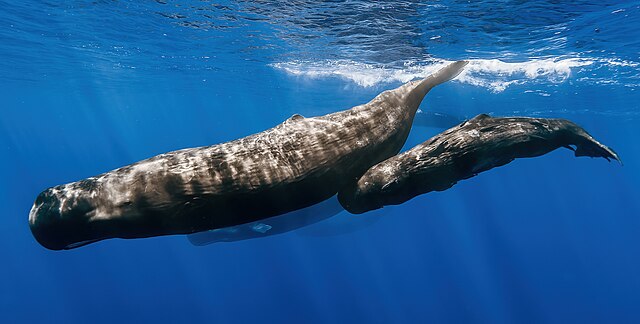
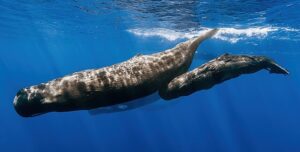
Sperm whale and her offspring swimming alongside their unit. Photo credit: Gabriel Barathieu.
How Social Dynamics Impact Sperm Whale Movements in the Caribbean
Reviewing: Mevorach, Y., Maalouf, A., Gubnitsky, G., Tønnesen, P., Gruber, D.F., Rus, D., Tchernov, D., & Gero, S. (2025). Predicting mesoscale movement of sperm whale units in the Caribbean based on social dynamics. Nature Portfolio 15: 39150. https://doi.org/10.1038/s41598-025-23733-1
Many marine mammals are highly social and form close-knit communities with whom they feed, play, and cooperate. Relationship dynamics within these units can be negative or positive and have cascading impacts both for the rest of the pod and nearby pods. Sperm whales (Physeter macrocephalus), a toothed-whale known for diving to incredible depths to hunt for prey, are both solitary and social. Males are typically sighted either alone or in loose groups, while females form tight bonds with their offspring and other females. They remain in tropical waters near the equator year round, with males migrating north before returning south to mate.
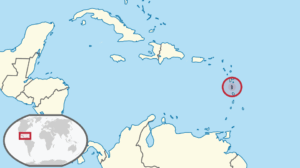
Figure 1: Dominica on a map (red circle). Photo courtesy of Wikimedia Commons.
Dominica, an island in the Caribbean, is home to multiple pods of female and juvenile offspring, and is visited by males during mating season (Figure 1).. One way that pods are distinguished from each other is by the songs, clicks, and whistles emitted by individuals within the pod. Two distinct vocal groups, named EC1 and EC2 by Mevorach and her team, each favor different regions surrounding Dominica. This could be because of food availability or familiarity with the environment. However, long-term studies in Dominica indicate that when a single sperm whale is present, its unit members are generally close by, while individuals from other units are absent. This indicates that pod movement is not only driven by the previously mentioned reasons, but also by social dynamics between pods. Through their study, Mevorach’s team sought to address an interesting knowledge gap: how do inter-pod relationships influence sperm whale movement?
Mervorach’s Study and Socially-Influenced Movement
Mervorach and her team collected photos of sperm whales in Dominica from March 2004 to March 2024. By using computer analytics, they were able to identify approximately 414 individual whales who established 32 distinct pods. More computer programs were used to identify which individuals were commonly associated with others to form a pod. Each pod was sighted numerous times throughout the years of the study (Figure 2).
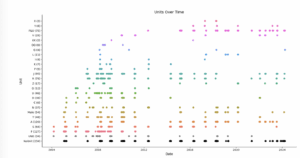
Figure 2: Sightings of sperm whale units off Dominica. The number in parentheses represents the amount of different dates unit was seen. Figure courtesy of Mervorach et al. 2025.
After identifying individuals and pods, analysis of sperm whale movement in Dominica suggests that units do not move randomly, but in fact follow a structurally and socially influenced pattern. Mervorach’s team observed that the presence of one pod typically predicted which pod would be observed next, which indicates that social relationships play an important role in the distribution of pods around Dominica.. Mervorach determined that movement patterns are deeply connected to social relationships, and units that are frequently spotted near each other have strong associations with one another.
Researchers hypothesized that socially-affiliated movements could occur because of communication and shared travel strategies between pods. Cultural feeding strategies and habitat preferences also could lead to shared movements. Pods with similar movements are more likely to encounter each other over time, which forges strong relationships that are reinforced with each subsequent interaction. To further investigate the role of social factors in sperm whale movement, Mervorach and her team suggest that data collection and analysis should focus on communication patterns produced during changes in movement. This would allow researchers to determine if pods share communication and how that impacts inter-pod relationships and movements. Understanding how whale pods move influences conservation management, as knowing where pods go, as well as when and why, will help place certain regions under protection.

I am a student in the Master of Oceanography program at the University of Rhode Island and enjoy scuba diving, boating, walking my dogs, reading, and being with friends and family.