Teder, N.J., Bennetts, L.G., Reid, P.A. et al. Large-scale ice-shelf calving events follow prolonged amplifications in flexure. Nat. Geosci. 18, 599–606 (2025). https://doi.org/10.1038/s41561-025-01713-4
Ice loss means more than just melting
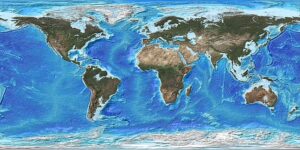
Ice is important to our changing climate. As the Earth warms, scientists and communities around the globe are becoming ever more concerned about sea-level rise due to melting ice. If all of the glaciers and ice caps in the world were to melt, global sea level would rise about 70 m (~230 ft), which would be enough water to flood every coastal community on the planet (Fig. 1; USGS).
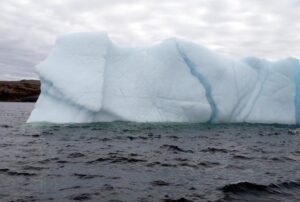
While temperature is clearly important, there are other processes, like calving, that can lead to major ice loss in the polar regions. Calving is when an instability, like a crack, makes it possible for a large piece of ice to break off another large piece of ice (Fig. 2). Large calving events can remove over 10% of the area of a body of ice over a matter of days, which is much faster than melting. Thus, it is important to understand the processes that lead to calving in an effort to properly model sea-ice loss and sea-level rise.
Feeling Exposed
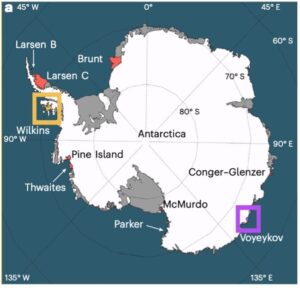
Teder and his team of scientists wanted to investigate the retreat of the Voyeykov and Wilkins ice-shelves in Antarctica via large calving events from 2007-2008. An ice shelf is a floating body of ice that is permanently attached to a landmass on at least one side. There are plenty of ice shelves in Antarctica (e.g. orange color on map), but the two of interest are shown in the purple and yellow boxes in Fig. 3.
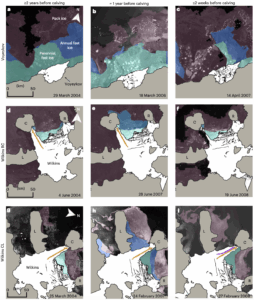
Using satellite imagery from September 2002 to August 2009, the scientists were able to track changes in the ice shelves (white in Fig. 4) and the surrounding environments that likely facilitated calving. At Voyeykov, a large fracture formed in September 2002 that spread to the front (towards the ocean) of the ice shelf before calving in April 2007. This event removed 14% of the ice shelf area in 4-5 days. The Wilkins Shelf can be divided into two sections by islands: the RC and CL sections. Like Voyeykov, the CL section experienced cracking near the front (gold and purple lines in Fig. 4) in July 2007 before calving in February 2008. The RC section was already unstable due to the refreezing of small icebergs onto the shelf front from a previous calving event, leaving lots of weak points. The RC section calved again in May 2008. These events removed 17% of the area of the Wilkins Shelf.
These three events were also accompanied by the loss of sea ice, which is seen as a decrease in the blue and purple colors in Fig. 4 as we move from the left-most panels to the right. This left the already unstable ice shelf fronts more exposed to stress caused by record high temperatures and larger swells (waves).
Some Implications
This work by Teder and his collaborators exemplifies a new way that climate change is influencing the loss of ice through mechanisms other than melting. Results from the team’s conceptual model support the idea that larger swells may also be dominating the stress on other unstable ice shelves around Antarctica and may contribute to future calving events, especially as the planet continues to warm and the protective layer of sea ice melts away. This new information will be added into climate models to better predict the extent of sea ice loss and where large calving events may take place next.
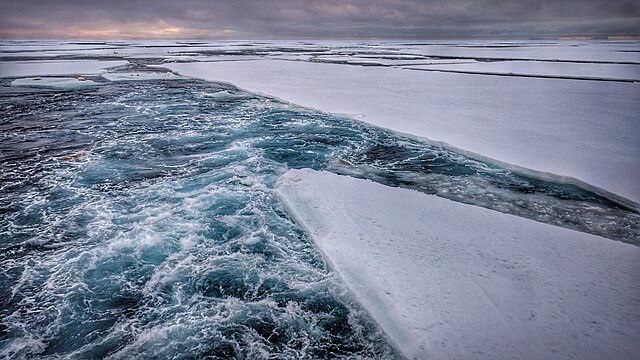
Cover photo is sea ice in the McMurdo Sound. Wikimedia.
I just completed my Ph.D. in Geological Oceanography at the University of Rhode Island, Graduate School of Oceanography. I received my B.S. in Geology from Union College (NY). I study submarine volcanoes! I use the chemical composition of lava to figure out what is happening inside the Earth and how magma is formed. When I’m not working with rocks, I enjoy reading on the beach, cooking, and hiking.
