Strudwick, P., Suggett, D.J., Edmondson, J. et al. Assessing protective shading and lowering of coral nurseries during a mass bleaching event on the great barrier reef. Coral Reefs 44, 1093–1105 (2025). https://doi.org/10.1007/s00338-025-02665-2
In April of 2024, the National Oceanic and Atmospheric Administration (NOAA) confirmed that we were in the midst of the 4th global coral bleaching event. A global coral bleaching event means that coral colonies across both the northern and southern hemispheres are all concurrently experiencing widespread bleaching. More recently, on September 11, 2025, NOAA released a status update, stating that high ocean temperatures from 2023 through the present have so far impacted 84.4% of the world’s coral reef area, and mass coral bleaching has been documented in at least 83 countries and territories. This global bleaching event is the fourth in recorded history, the second within the past decade, and it is the largest and most severe. The three previous global bleaching events occurred in 1998, 2010, and 2014-2017.
As global temperatures rise and the ocean absorbs heat, coral bleaching is becoming more frequent and more severe. In fact, even if all greenhouse gas emissions stopped today, the oceans would continue to warm over the next several decades to centuries. It is therefore important that we devise ways to mitigate the impacts of high temperatures on corals. A recent study by Paige Strudwick and co-authors published in the journal Coral Reefs explored the effects of two intervention methods – shading and relocating – on coral reef recovery from bleaching. But before diving into the results of this study, let’s explore what scientists mean by “coral bleaching” and why it happens.
Coral Bleaching – What is it?
Corals are colony-forming invertebrates made up of small individual animals called polyps that feed on plankton and other small animals in the water. They also have a symbiotic relationship with algae, called zooxanthellae, which provide additional food and energy through photosynthesis. However, when heated up, the zooxanthellae can begin to produce substances that are toxic to corals, leading the corals to expel this algae from their tissues. This removes color from the corals, leaving behind a white skeleton (hence the term “bleaching”).
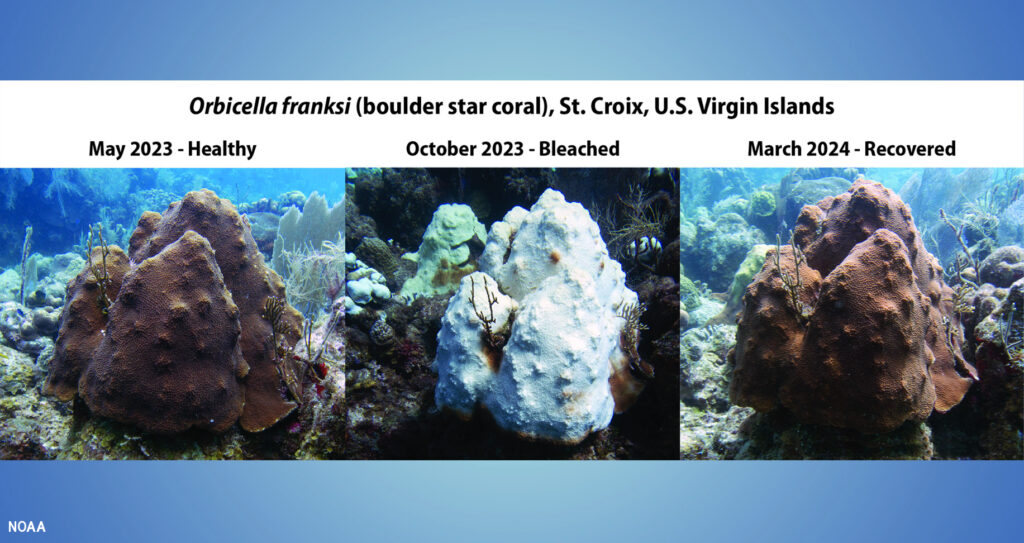
While bleaching does not immediately kill corals, it weakens them because they produce less energy without the algae. If high temperatures and bleaching continue over long periods of time, such as what is occurring now during the global bleaching event, corals have less of a chance of recovery, and mortality rates can be high.
Protecting Corals from Bleaching by Shading and Relocating

In order to prevent mortality, it is important to reduce bleaching length and severity. Since bleaching occurs due to high temperatures, methods for reducing bleaching involve devising ways to reduce temperatures at a local scale. Two common ways of doing this are by reducing light intensity and UV radiation through shading and reducing temperatures by relocating corals to deeper and therefore cooler waters. In order to evaluate the effectiveness of these two interventions – shading and relocating – during a prolonged bleaching event, Strudwick et al. tested them on coral nurseries at two sites on Opal Reef (part of the Great Barrier Reef) over 138 days from 2023-2024, to see if they could mitigate bleaching and mortality.
Results – Relocating Might be More Effective than Shading
Strudwick et al., found that lowering corals by about 7 meters reduced bleaching and mortality for one of their two study sites. Corals at this site that were located in deeper waters had higher survival and less bleaching compared to shallower ones at that same site. In contrast, they found that shading did not provide any consistent improvement on coral health at either study site. While shading did reduce the amount of incoming light, it was not enough to make a difference in coral survival.
Shading has been used effectively in the past to protect corals, but this study demonstrates that it may not always be the most effective method under certain scenarios. At the research sites used in this study, light exposure was not the primary stressor acting on corals. Therefore, shading did not make a difference in coral survival. In cases such as this one where light exposure is not the primary stressor, lowering corals by just a few meters could be a more beneficial intervention. However, it’s important to note that other environmental factors, such as currents, salinity, water flow, and disease exposure, will also impact the effectiveness of bleaching interventions. For example, in this study, lowering the corals only produced benefits at one of the two study sites, potentially because that study site had other more favorable ambient conditions.
This study demonstrates that there are lots of factors to consider when planning bleaching interventions. To provide the most benefit to corals, it’s important to act quickly to determine what the primary stressor is – if that stressor is light exposure or if lowering is not possible, shading might be the most effective method. But in locations where lowering corals is possible or where high cloud cover means light exposure is already relatively low, lowering might be the better choice.
The Moral of the Story
This study highlights the importance of interventions on coral bleaching, and it provides hope that some interventions can make a big difference on coral survival. However, it also tells a tale of caution. Putting shades over every coral nursery during a bleaching event would not be a cost-effective way of protecting corals because it will not work everywhere. Lowering corals can actually be a cheaper and easier alternative, and one that provides greater benefits. As bleaching events continue to become more frequent and severe, reef guardians should be sure to carefully assess site conditions before choosing an intervention – it could mean the difference between coral survival and loss.

I recently graduated with a masters degree in Marine Science from the University of North Carolina Wilmington. I am now working as an research fellow at the US Environmental Protection Agency in Washington, DC, where I focus on surface water quality concerns. My masters research evaluated the impacts of elevated salinity on bald cypress growing in forested freshwater tidal wetlands along the coast of North Carolina. In my free time, I love to travel, hike, read, and rock climb.