Reviewing: Chambers, L.E.H., Buck, J.R. & Rogers, T.L. Leopard seal song patterns have similar predictability to nursery rhymes. Sci Rep 15, 26099 (2025). https://doi.org/10.1038/s41598-025-11008-8
Finding a mate in the vast Southern Ocean…
Finding a mate in the open ocean can be difficult. Other members of your species may be scattered far and wide – or even, in the case of male leopard seals (Hydrurga leptonyx) – on ice nursing pups. If the breeding season is short, and you’re a solitary animal – you need to find a way to advertise your presence and identity, without swimming thousands of miles.
Singing as a solution
One way to do this is to use songs -or acoustic displays. We’re pretty used to the idea of this in birds, but it also happens in bats, rock hyraxes, gibbons, and humpback whales as well as many other species too. Including leopard seals. It makes sense; sound travels well underwater, so the use of a song or vocal display to communicate information is much more efficient than travelling large distances looking for other members of your species. Their vocalizations can travel effectively under water, so they can cover a lot of ground.
A recent study by Lucinda Chambers and her team, published in Scientific Reports, used recordings made in Antarctica in the 1990ʻs to study the structure of the song of the male leopard seal. The recordings were made between 1600 and 0300, the hours when the seals are most vocally active.
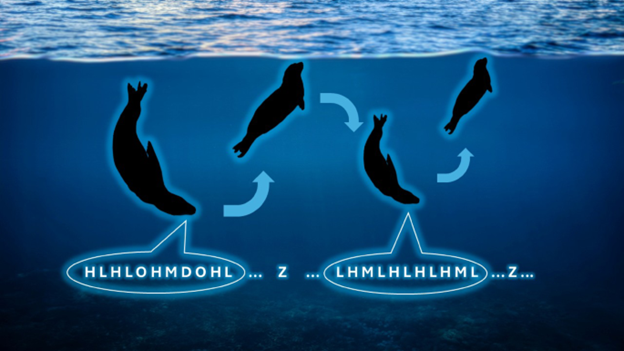
Leopard seal songs are eerie and otherworldly — a mixture of electronic-sounding trills, warbles, and hoots that wouldn’t be out of place in a sci-fi movie. Their unique sound has even made them a favorite in underwater documentary soundtracks. But for other leopard seals, these sounds carry crucial information during the short Antarctic breeding season. The researchers identified five distinct call types, which they labelled:
- “high double trills” (H),
- “medium single trills” (M),
- “low descending trills” (D),
- “low double trills” (L),
- and a hoot with a low single trill (O).
These five call types form the basic building blocks of a song. By combining them in different sequences, seals can produce more complex vocal displays.
Seal songs are surprisingly complex…
Chambers and her team wanted to understand how complex these vocalizations were. They examined the structure, variability, and predictability of the calls, using a measure called entropy to estimate complexity. In this context, entropy is a measure of how predictable or repetitive the calls are. A highly repetitive song has low entropy, while a song with many different elements and arrangements has high entropy. More complexity in the song suggests the potential to communicate more nuanced information, perhaps about the singers identity, or condition, or maybe their mating readiness. They found that leopard seal songs are more complex than simple human nursery rhymes, suggesting that these animals may be communicating more than just “I’m here!” Songs with structured, stereotyped patterns are particularly good for long-distance communication in noisy environments like the Southern Ocean.
What does this tell us?
We still don’t know exactly what leopard seal songs mean (and we might never know), but studies like this reveal how acoustic communication evolves under different social and environmental pressures. For example, seal species that breed in high-density colonies (where individuals are close together) often use a wide variety of call types. But for solitary species like leopard seals, call structure becomes more important than variety. In this study, researchers found that leopard seal songs were less predictable, implying that seals may be using structure to encode information in a different way.
Understanding how and why animals like leopard seals sing helps researchers explore the evolution of communication in extreme environments. In the vast, icy, and sparsely populated Antarctic, producing a structured, far-reaching song may be essential for finding a mate. Studies like this also provide valuable insight into how solitary marine mammals adapt to acoustic challenges. This is a growing concern in a world where ocean noise is increasing due to human activity.
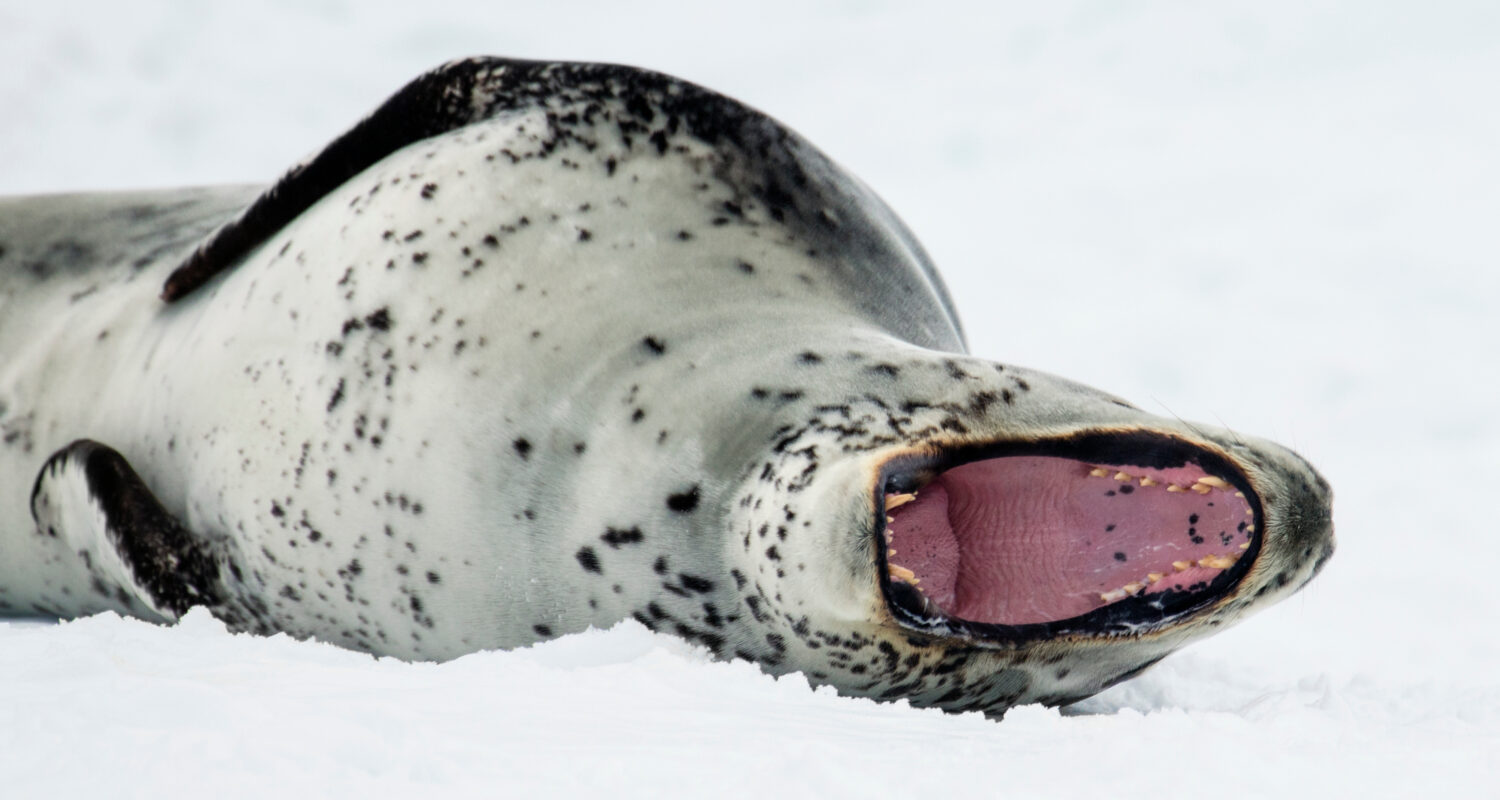
Cover photo – A Leopard seal (Hydrurga leptonyx) with open jaws laying on ice. by Andrew Shiva

I am a post-doctoral researcher at the University of Hawaiʻi at Mānoa. My research interests cover many aspects of the ecology of marine mammals, in particular the factors that drive distribution and abundance of whales and dolphins, as well as the impacts of human activities on these animals. I’ve spent a lot of time in the field, conducting surveys (very lucky). When back at my desk, I use ecological modelling techniques to investigate relationships between animals and their environment.

