Pirotta, E., Tyack, P. L., Adams, J., Asaro, M. J., Bouchet, P. J., Crocker, D. E., … & Thomas, L. (2025). The combined effects of multiple stressors in an endangered, long‐lived species: Lessons learned and ways forward. Ecological Applications, 35(8), e70144.
DOI: 10.1002/eap.70144
If it’s not one thing, it’s another…
It’s hard to read the news these days without coming across another example of humans putting pressure on our environmental resources and wildlife. Our cities are getting larger, industry is developing and we are continually extracting resources from the environment. On top of all that of course, we have climate change. In management speak, these examples (and others like them) are often referred to as “stressors”. We have regulatory frameworks that are designed to take the environment into account when new actions or developments are considered, trying to estimate what the impact of different stressors will be on wildlife and the environment, but it is very difficult for these frameworks to consider the cumulative risk of multiple stressors acting at once. For example, we can model the effect that the construction of a new offshore windfarm may have on an existing area, but it is hard to model the effect of constructing that new windfarm, plus climate change, plus fisheries, plus shipping traffic, plus pollution, plus, plus, plus. This is made worse because we often don’t know all the “plusses” that need to go into the equation.
Assessing the unknown…
Many researchers have tried to develop methods to help with assessing the combined effects of different stressors, and the success of these methods often comes down to the requirements of the management framework (what knowledge does the framework require) and what data are available. In effect, do we have enough information to answer the question. For many species, the data availability challenge is one of the biggest hurdles. This is particularly true in the marine environment where information on species that range across large geographical areas (and across international boundaries), and may be very long lived is hard to obtain.
When the stakes are high…
The North Atlantic right whale (Eubalaena glacialis) is one of the world’s most endangered whale species; it’s estimated that there are only about 380 individuals remaining, of which only 70 are reproductively active females. The species was brought to the brink of extinction during the commercial whaling era, but has never recovered to pre-whaling numbers, and today their population is primarily threatened due to entanglement in fishing gear and being hit by vessels.
In a new study, Enrico Pirotta and co-authors have designed a new model to assess the health, survival and reproduction of these critically endangered whales, to investigate the combined effects of their two primary stressors – entanglement and vessel strikes – alongside prey availability.
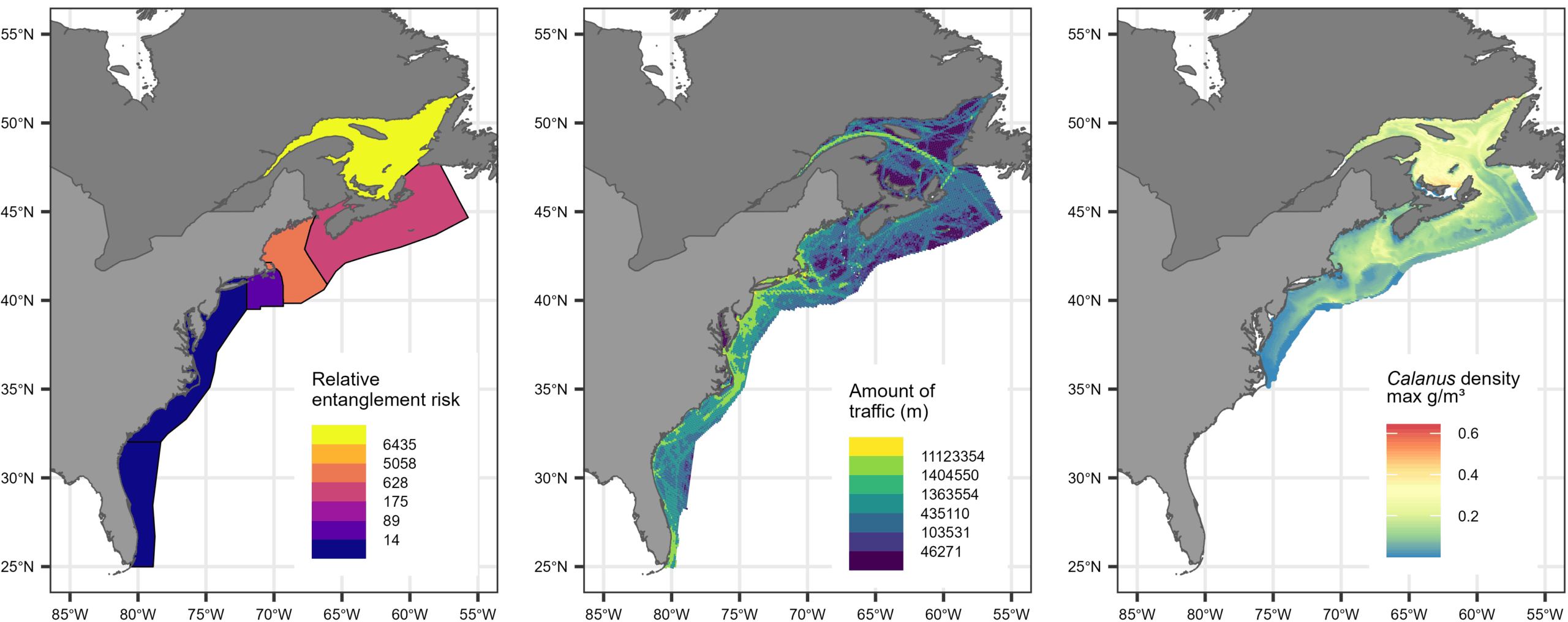
Pirotta and his team have estimated that changes in whale distribution that were observed after the year 2010 have lead to increased risk of entanglement in fishing gear. Whales that are carrying tangled fishing gear in turn are associated with poorer prey conditions. Whilst this study did expand on previous methodologies, they did note that the overall results on combined effects were not conclusive.
One of the main conclusions of the paper was highlighting some of the key data gaps which are still hampering these models. In particular focusing on the need for long term measurements of individual health and life history information, as well as the need for more extensive information on the geographical distribution of the stressors themselves, and how different animals use their habitat. These long-term studies can be difficult to conduct as funding for research is often only given in short one- or two-year intervals, and these types of studies can be expensive to conduct. Hopefully funding agencies will heed this plea for information…
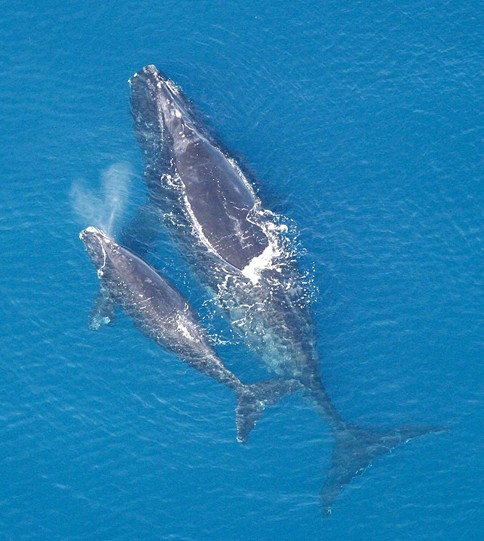
Cover photo – North Atlantic right whale (Eubalaena glacialis) with calf. © https://www.nmfs.noaa.gov/pr/species/mammals/cetaceans/rightwhale/photos.htm
I am a post-doctoral researcher at the University of Hawaiʻi at Mānoa. My research interests cover many aspects of the ecology of marine mammals, in particular the factors that drive distribution and abundance of whales and dolphins, as well as the impacts of human activities on these animals. I’ve spent a lot of time in the field, conducting surveys (very lucky). When back at my desk, I use ecological modelling techniques to investigate relationships between animals and their environment.