
Rouby, E., Plard, F., Ridoux, V., Mauchamp, A., Dabin, W., Spitz, J. and Authier, M., 2025. Longevity Collapse in Dolphins: A Growing Conservation Concern in the Bay of Biscay. Conservation Letters, 18(5), p.e13142. https://doi.org/10.1111/conl.13142
Conservation conundrum
One of the most challenging things in conserving wild animal populations, is knowing when to step in and introduce management actions. Getting robust information on how many animals there are, particularly for species that live at sea, can be very difficult and oftentimes also very expensive. What makes it more difficult still, is that our methods for estimating population size for marine mammals often aren’t powerful enough to detect declines in numbers of animals, unless the decline is huge or we are monitoring that population of animals over a long period of time. This means that sometimes, serious declines in animal populations can be missed, particularly if they happen quickly.
Maybe not so common…
Common dolphins (Delphinus delphis) are the most abundant dolphin species in the Northeast Atlantic Ocean, and they regularly use habitat in the Bay of Biscay, off the coast of France. This is also an area which is subject to intense fishing pressure, and common dolphins are regularly caught as unintended bycatch in fishing nets. It is difficult to determine the number of animals caught in nets per year, as dolphin carcasses are not always recovered, but to give an idea of the problem, an estimated 6900 common dolphins were incidentally captured in fishing gear in winter 2021. You probably start to see the problem – we know there is a large number of animals being caught in nets, but we don’t know how much of an impact that is having on the population size as a whole. The authors of a new study, Etienne Rouby and her team, have come up with a novel way to work on understanding what type of population level impacts this bycatch may be having.
Estimating the age of a dolphin…
Age of dolphins is commonly estimating by looking at teeth. If you remove a tooth and slice it, there are visible growth rings – the same idea as aging a tree. Rouby and her team looked at the ages of 759 dead, stranded dolphins (397 males and 362 females) and estimated their ages from teeth. The specimens had been collected between 1997 and 2019.
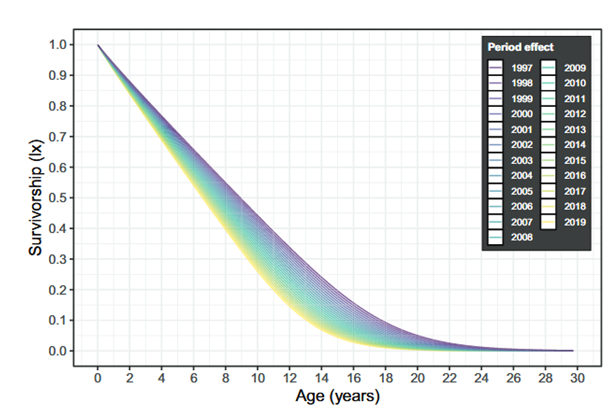
Rouby and her team found some concerning results. Lifespan (longevity) of female common dolphins in the Bay of Biscay declined dramatically from 24 to 17 years between 1887 and 2019. If females are dying younger, than means that there are fewer available animals to give birth, and there was a corresponding 2.4% reduction in population growth rate. This is worrying – and means that the Bay of Biscay may be acting as a “sink” for the population – an area where the mortality rate exceeds the birth rate. This is an important finding because existing abundance estimates are stable, probably due to animals moving in to the area, so this would have gone undetected without this study. This shows that alternative data sources – such as looking at strandings data – can give useful information on population level impacts for animals which can move large distances. They also provide early warning indicators which can be used for conservation.
Cover photo – Common dolphins (Delphinus delphis) © Mmo iwdg

I am a post-doctoral researcher at the University of Hawaiʻi at Mānoa. My research interests cover many aspects of the ecology of marine mammals, in particular the factors that drive distribution and abundance of whales and dolphins, as well as the impacts of human activities on these animals. I’ve spent a lot of time in the field, conducting surveys (very lucky). When back at my desk, I use ecological modelling techniques to investigate relationships between animals and their environment.

