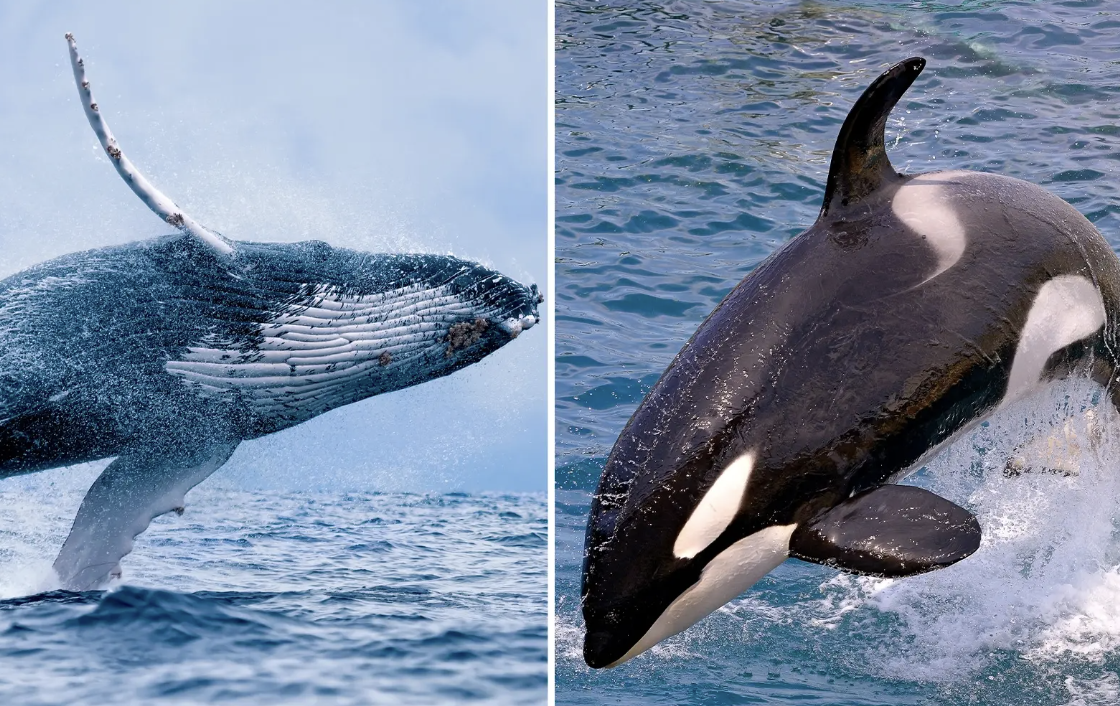
Humpback whale (left) and orca whale (right) breaching. Photo credit: https://www.newsweek.com/orca-terrorizing-humpback-whales-battle-off-washington-coast-1748353
Reviewing: Pitman, R.L., Deecke, V.B., Gabriele, C.M., Srinivasan, M., Black, N., Denkinger, J., Durban, J.W., Mathews, E.A., Matkin, D.R., Neilson, J.L., Schulman-Janiger, A., Shearwater, D., Stap, P., & Ternullo, R. 2017. Humpback whales interfering when mammal-eating killer whales attack other species: mobbing behavior and interspecific altruism? Marine Mammal Science, 33(1): 7-58.
Altruism in Humpback Whales
Whales and dolphins are known for having strong communication skills, complex social lives, and advanced emotional capabilities. Within their populations, social bonds are formed and a wide variety of interactions occur between individuals. For hundreds of years, humans have witnessed and recorded stories of these interactions. Famously, dolphins have been observed holding injured individuals at the surface to help them breathe, orca whales have presented humans with food, and humpback whales have protected one another from orca whale attacks. Pitman and his team compiled observations of interactions between humpback and orca whales over a 62 year period (1951-2012) and analyzed the interactions to determine whether there is a deeper mechanic driving them: altruism.
Altruism is a category of behavior that involves an individual helping another. Humans previously believed we were the only species capable of exhibiting altruism, as it is an advanced social behavior and has no obvious evolutionary benefits. In the case of humpback and orca whales, altruism is especially interesting because humpbacks face a direct threat from orcas. However, Pitman’s team determined that humpbacks deliberately interfere when orcas attack in order to protect the most vulnerable individuals. Figure 1 provides four images of humpback whales in the vicinity of orca whales during hunts.
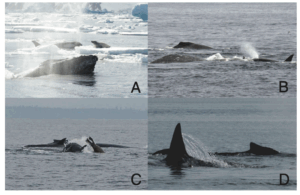
Figure 1: Examples of humpback whales interacting with orca whales attacking various prey: A) crabeater seal; B) gray whale calf; C) Stellar sea lion; D) harbor seal. In each photo, prey, humpback whale(s), and orca whale(s) are present. Photos courtesy of Pitman et al. 2017.
Humpbacks vs Orcas
Currently, researchers believe that humpbacks are the only cetacean that purposefully approaches and deters orca whales. Pitman and his team described a poignant instance of humpbacks coming to the aid of one another: “we observed the harassment of a humpback whale by about 15 (orca) whales once; during the attack, other humpback whales rapidly converged on the attackers and appeared to drive the (orca) whales away.” The approach of humpbacks often had this effect of driving off the attackers, thanks to the humpbacks’ aggressive behaviors of slapping their flukes at the surface or slashing them side-to-side, bellowing, and flipper slapping. They also followed, chased, and charged at attacking orcas. Humpbacks are much larger than orcas, and therefore rely on their own bulk and power, oversized appendages, and group defense to ward off the predators.
In the majority of reported interactions, juvenile or calf humpback whales were present. Figure 2 is a beautiful aerial photograph of a calf with its mother, positioned safely between her front flipper and fluke. Mothers are known to take specific countermeasures to defend their calves, including raising the calf out of the water on her back or head, or flanking or surrounding the calf with other whales.
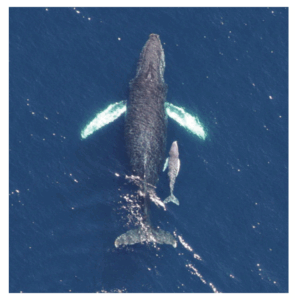
Figure 2: A mother humpback whale and newborn calf off Baja California, Mexico, in October, 2009. Photo credit: M. Lynn, NOAA, Southwest Fisheries Science Center (Pitman et al. 2017).
Theories for Altruistic Behavior
Observations of humpbacks coming to the aid of one another, or other species such as seals, are far from rare. This altruistic behavior has been reported from widely scattered locations and throughout dozens of years. Researchers, including Pitman and his team, have theorized that altruism stems from kin selection or reciprocity. Kin selection occurs only among related individuals. By protecting each other from orca attacks, humpbacks increase the odds that their family members will survive and thrive. Another theory is reciprocity. Reciprocal altruism occurs as a form of “paying it forward:” when a whale has been helped before, they will go on to help another individual at a future date.
While kin selection and reciprocity are the two leading theories for altruism, there is still debate about the ultimate dynamics and drivers of the behavior. Pitman suggests that a focus of future studies could be genetic or cultural drivers of altruism, both among the same species and different species. By understanding the motivation behind altruism, more light will be shed on other social behaviors in cetaceans. This increased knowledge can contribute to informing and influencing conservation policies, which will lead to a healthy and balanced ocean.
I am a student in the Master of Oceanography program at the University of Rhode Island and enjoy scuba diving, boating, walking my dogs, reading, and being with friends and family.