Winter, K., Woodward, J., Dunning, S.A. et al. Thinning Antarctic glaciers expose high-altitude nunataks delivering more bioavailable iron to the Southern Ocean. Nat Commun 16, 9994 (2025). https://doi.org/10.1038/s41467-025-65714-y
Primary Production in the Southern Ocean
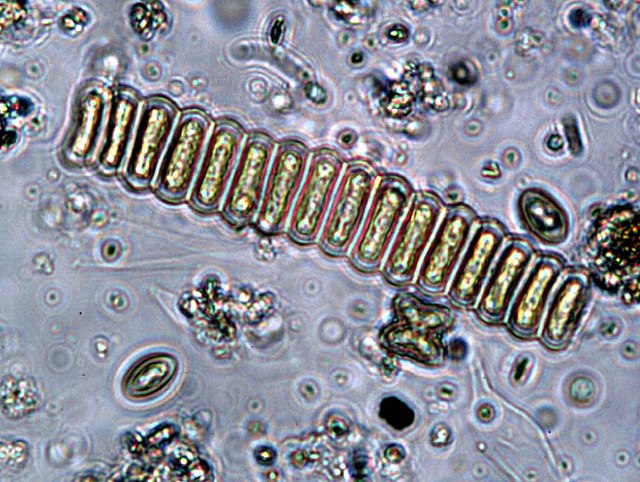
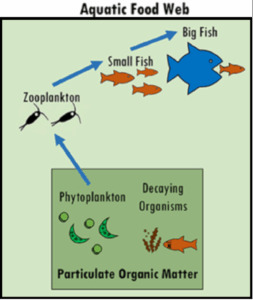
Primary production is the conversion of energy into organic matter that constructs the base of the food web. The energy provided by that matter is subsequently passed up the food chain from prey to predator (blue arrows; Fig. 1). Photosynthesis is the most well-known form of primary production in which plants turn sunlight into usable food. There are, however, microscopic organisms called phytoplankton that carry out photosynthesis in the surface ocean and serve as primary producers. When thinking about climate change, these tiny guys are extremely important because their growth allows them to draw CO2 out of the atmosphere and have a regulatory effect on climate.
While phytoplankton can be found all around the world, the Southern Ocean (around Antarctica) is known for being a rather productive region and accounts for 5-10% of total global ocean productivity. This productivity, however, can be variable and is limited by the availability of nutrients for the phytoplankton. Think of it like a basketball team getting together to eat a meal before a big game, except there isn’t enough food for everyone – only the athletes that got to eat and fuel up before the game will have energy to play. The same concept applies to the phytoplankton. One nutrient that can really help spike phytoplankton growth and productivity is iron (Fe), commonly found in sediments and dust that make their way into the ocean from land.
Melting, Exposure, Weathering, and Transport
While Fe can enter the Southern Ocean in several ways, Winter and her team are most interested in sediment transport on top of glaciers as the landscape of Antarctica changes. In this case, sediment transport is the movement of any sediments, pieces of rock, or other particles by ice. Her team focused in on the Gunnestad Glacier in the northern area of the East Antarctic Ice Sheet (EAIS) shown with the star in Fig. 2. As Earth’s temperature warms due to climate change, more ice melts, which exposes the tops of mountains that have long been buried under Antarctic ice (Fig. 2C). These exposed mountaintops surrounded by glacial ice are called nunataks.
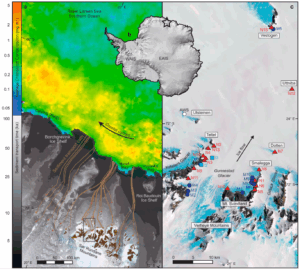
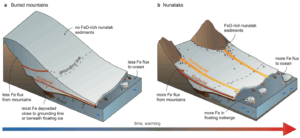
Winter notes that these nunataks have been exposed long enough that weathering, the process of breaking down rocks, has occurred. The team proposed that weathered rock chunks and sediment could fall off the mountainside onto the glacier and be slowly transported to the front where ice and ocean meet (Fig. 3). If the sediment has a lot of Fe, the phytoplankton may ultimately be more productive once the material is introduced into the ocean. To test this model, the scientists analyzed the chemistry of 27 samples collected from exposed, rocky areas around the glacier to see if the material from the nunataks has Fe (Fig. 2c). Their results show the exposed mountaintops indeed have an abundance of Fe that could promote phytoplankton growth in the Southern Ocean. The team also proposed possible transport paths for the sediment, as seen in Fig. 2A.
The Iron Diet for a Changing Climate
With a warming climate and the results of their model, Winter and her team suggest that this sediment transport may help to regulate climate over long timescales by introducing more Fe into the Southern Ocean. As mentioned above, an increase in Fe availability in the water can cause a boom in phytoplankton productivity and increase the amount of CO2 that can be taken out of the atmosphere. Thus, while phytoplankton are tiny, they are in fact mighty tools in the battle against climate change. And to that I say, let them eat Fe!
Cover photo from Wikimedia.
I just completed my Ph.D. in Geological Oceanography at the University of Rhode Island, Graduate School of Oceanography. I received my B.S. in Geology from Union College (NY). I study submarine volcanoes! I use the chemical composition of lava to figure out what is happening inside the Earth and how magma is formed. When I’m not working with rocks, I enjoy reading on the beach, cooking, and hiking.