Francesco Garzon, Ghalia Abel, Ian Burrett, Owen M. Exeter, Lucy A. Hawkes, Thomas W. Horton, Mario Lambrette, Alex Plaster, David Righton, Hannah Rudd, Jessica L. Rudd, Bryce D. Stewart, Simon Thomas, James Thorburn, Paul S. M. Whittaker, Matthew J. Witt, Survival and recovery of three shark species in North-East Atlantic recreational fisheries, ICES Journal of Marine Science, Volume 82, Issue 10, October 2025, fsaf191, https://doi.org/10.1093/icesjms/fsaf191
Fishing for Sharks
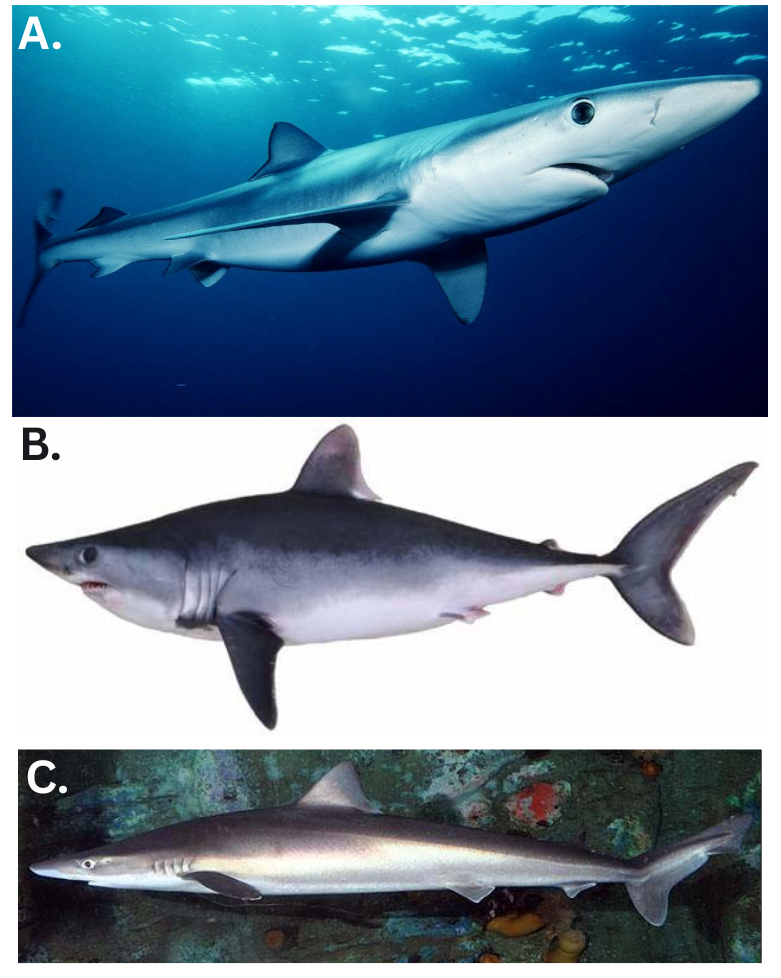
Big game fishing or offshore sportfishing is popular around the world. The blue shark (Prionace glauca), porbeagle shark (Lamna nasus), and tope shark (Galeorhinus galeus) are particularly popular catches in the United Kingdom. While recreational fishing doesn’t impact shark populations at the same scale as commercial fishing operations, there is still some debate on how individuals and local populations handle this pressure. In the UK, shark angling is almost exclusively catch and release. While the shark may be released, there is very little information on what happens afterwards. Specifically, what is the survivability of a shark after being released from a hook and line – do they make it?
Post-Release Mortality
Post-release mortality (PRM) describes this survivability by measuring the likelihood an animal will die after being released. It’s a simple calculation by dividing the number of individuals that die by the total number of individuals caught. So if one shark died out of 10 caught, the PRM would be 10%. The higher the number, the higher the risk that the shark won’t survive.
As a group, elasmobranchs (sharks and rays), specifically sharks, have a wide range of PRM depending on the region and species. Many species of lamnid sharks (also known as mackerel sharks, including white sharks and mako sharks) have shown low PRM while carcharhinids (also known as requiem sharks, including species like bull sharks and tiger sharks) have higher variability (Table 1).

Best Practices
While the PRM calculation is straightforward, there are many hidden factors that can impact the likelihood of an individual surviving an angling event. These factors include:
- Fight time
- Handling time
- Hook location
- Physical condition of the animal
- Vitality of the animal on arrival and release
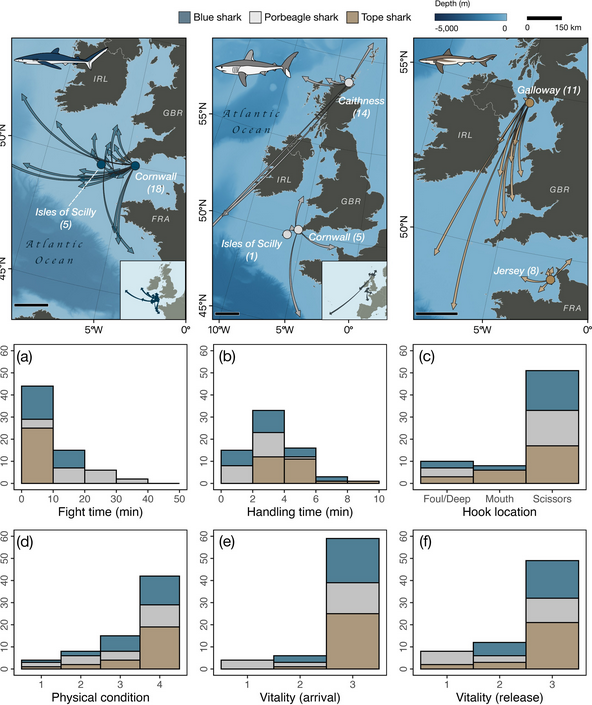
In recent years, there’s been a push to reduce the impact of these factors by anglers adopting “best practices.” Simple things like using circle hooks to reduce hook injuries or limiting the time the shark is on the line have been advocated by angling clubs, government agencies and conservation organizations. However, many of these suggestions are not backed by scientific evidence or haven’t been tested yet. It doesn’t help that the UK and even Europe lack PRM rates for sharks in their waters. Therefore, Garzon et al. investigated the PRM of blue, porbeagle and tope sharks off the UK and Channel Islands. By attaching satellite tags, the researchers tracked the sharks for 45 days to analyze behavior and potential mortality events.
Surviving the Hook
Of the 69 sharks caught and tagged by the team, only 3 individuals, one of each species, died (Table 2). Therefore the PRM for blue, porbeagle, and tope sharks was 4%, 5%, and 4% respectively. These rates are similar to those in other studies for the blue and porbeagle. Tope sharks have actually never had their PRM reported prior to this study.

It’s suspected that some of the “hidden factors” discussed earlier may have contributed to the porbeagle and tope shark mortalities. Both were hooked deep in their mouths, so researchers weren’t able to safely remove the hooks. Rather, they cut the lines where it entered the sharks’ mouths. A hook can damage an animal’s digestive tract and other internal organs if left, causing internal bleeding or disrupting feeding.
As for the blue shark, there was no obvious reason why it may have died after release. The researchers did note it took over twice as long to reel it in compared to the average fight time for other individuals (24 minutes compared to 10 minute average). This fight time could have exhausted the shark to the point it couldn’t recover from the stress of the event.
Ethics
There can be some ethical concerns with a study like this. Purposefully catching sharks with a hook and line can put undue stress on the animal. This may be why a study like this hadn’t been done before in the area. However, the benefits were found to outweigh the potential harm during review. Now, there is an established methodology that minimizes risk to the animals while collecting the data we need to determine post-release mortality rates.
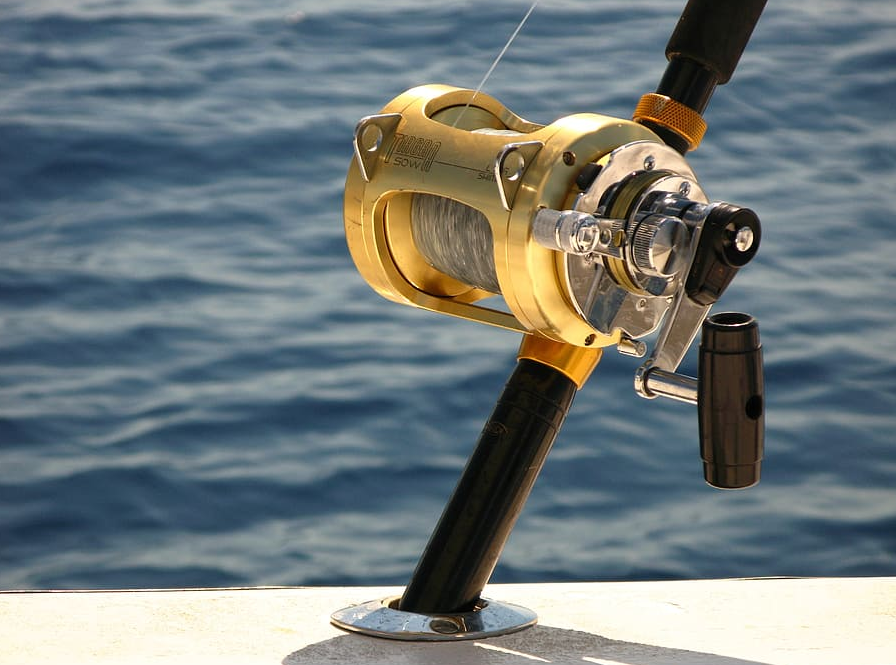
Cover photo: Example of a spincast reel typically used in deep sea fishing (Unknown author).

I am a recent MSc graduate in marine biology from Bangor University, where I studied population dynamics of elasmobranchs off the coast of Wales. My interests lie in ecological data analysis to understand environmental processes and identify natural patterns. However, nothing beats being in the field and interacting directly with the marine life.


