
Spring, D.L., Fox, M.D., Green, J.A.M., Guillaume-Castel, R., Jacobs, Z., Roche, R.C., Turner, J.R. and Williams, G.J. (2025), Climate change impacts to upwelling and shallow reef nutrient sources across an oceanic archipelago. Limnol Oceanogr. https://doi.org/10.1002/lno.70172
Imagine you are at one of those sushi restaurants where food is delivered on a conveyor belt. You are happily picking and choosing which pieces to enjoy because there is a constant stream of sushi coming out of the kitchen. But then the conveyor belt slows…and eventually stops altogether. Without the conveyor belt bringing you fresh sushi, there is nothing there for you to eat. You are left unfulfilled and walk away from dinner still feeling hungry.
This situation is just like what happens to shallow coral reefs when a process called ocean upwelling is interrupted. Ocean upwelling is the process by which deep, cool, and nutrient-rich water is brought up to the shallows. This delivery of nutrients to the shallow layer of the ocean supports primary production by photosynthesizing organisms – the base of the food web on a coral reef. The amount of primary productivity on a reef directly influences the amount of prey available for higher trophic levels of the food web. This means that when the delivery of nutrients (“sushi” in the metaphor above) slows as a result of slowed or stopped ocean upwelling (the “conveyor belt”), the whole coral reef community suffers from a lack of food.
One of the main drivers of ocean upwelling are large-scale climate oscillations, such as the El Niño Southern Oscillation or the Indian Ocean Dipole. These are natural climate patterns that bring different ocean temperature conditions to ocean basins on irregular schedules. For example, the Indian Ocean may experience a positive dipole some years, which is when the western Indian Ocean is warmer than average, while the eastern part is cooler. Other years, this relationship may be flipped, and a negative dipole causes the western portion of the basin to be cooler and the eastern part to be warmer. This climate pattern has impacts all across the ocean basin, driving patterns of precipitation or drought for much of Australia, India, and the east coast of Africa.
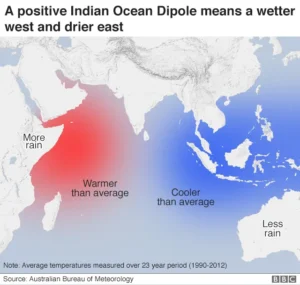
Different ocean temperatures also have a large impact on coral reefs in the Indian Ocean. During a positive Indian Ocean Dipole, ocean upwelling stops for much of the western and central Indian Ocean, preventing the delivery of cool water and nutrients to coral reefs in these regions. Climate change is disrupting patterns of upwelling and increasing ocean temperatures, which increase stress on coral reefs and can lead to mass bleaching events. It is therefore important that we understand the drivers of ocean upwelling, the tipping points at which disruptions to upwelling might damage coral reefs, and improve our ability to predict upwelling impacts to coral reefs.
A recent paper by Spring et al. published in the journal Limnology and Oceanography sought to do just that; they explored the impacts of a strong positive Indian Ocean Dipole on a shallow coral reef in the central Indian Ocean called the Chagos Archipelago to better understand the interactions between upwelling and reef communities.
To conduct their study, they used a multi-faceted approach. They integrated in situ temperature data collected at several sites across the reef and at different depths, stable isotope data from a type of macroalga, and statistical modeling to expand their analysis over a 40-year time period. Combining these complex methods, they were able to come to some striking conclusions about both the patterns of upwelling in the Indian Ocean and the impacts these patterns have on shallow reef organisms. Three main conclusions are discussed below.
1. The depth of the surface mixed layer was the most important predictor of exposure to upwelled waters.
Across the Chagos Archipelago, a mixed layer depth – the thickness of the upper layer of the ocean where water properties like temperature and salinity are relatively uniform due to mixing from wind, waves, and currents – greater than about 60 meters prevents upwelling from occurring where reef communities reside. On the other hand, when the mixed layer depth is shallower (about 40 meters), upwelling to these reefs is maximized. This finding is really important because as climate change alters wind patterns and surface ocean warming deepens the mixed layer, many shallow reefs may receive fewer nutrient inputs from below. This could limit primary productivity – the base of the reef food web – reducing overall health of coral reefs.
2. Variations in upwelling correlate with shifts in nutrient sources for reef organisms.
Using stable isotope analysis of nitrogen (δ15N), the authors found that upwelling correlates with enriched δ15N values in a common reef macroalga. This demonstrates that upwelling does bring a new source of nutrients up to the reef system. During periods of reduced upwelling, the reef community would not have access to this source of nitrogen, which could alter primary productivity and, in turn, the entire reef food web and structure.
3. Positive Indian Ocean Dipole events are linked to reduced upwelling.
The results of the authors’ statistical modeling approach demonstrated that there is a strong link between positive dipole phases and a deeper surface mixed layer over the past 40 years. Each time the mixed layer deepens, the shallow reef community is not able to access the nutrient-rich waters from deeper parts of the ocean. This finding was important because extreme positive Indian Ocean Dipole events are predicted to increase in frequency over the coming decades as a result of climate change. If this happens, reefs may face prolonged nutrient shortages just when they’re already stressed by warming and acidification. The combination of heat stress and nutrient limitation could slow coral recovery after bleaching, shift reef dynamics, and ultimately make coral reef ecosystems more vulnerable to collapse.
The relationships between climate change, ocean upwelling, and coral reef health are complex, but understanding how these large-scale processes interact with one another is vital to the future of our oceans.

I recently graduated with a masters degree in Marine Science from the University of North Carolina Wilmington. I am now working as an research fellow at the US Environmental Protection Agency in Washington, DC, where I focus on surface water quality concerns. My masters research evaluated the impacts of elevated salinity on bald cypress growing in forested freshwater tidal wetlands along the coast of North Carolina. In my free time, I love to travel, hike, read, and rock climb.