Schnitzler, J.G., Moysan, L., Escobar-Calderon, J.F., Baltzer, J., Schaffeld, T., Kindt-Larsen, L., Siebert, P. and HC Doc, U., 2025. Artificial clicks (Porpoise ALert-PAL) affect acoustic monitoring of harbour porpoises and their echolocation behaviour. Frontiers in Marine Science, 12, p.1591839. https://doi.org/10.3389/fmars.2025.1591839
The harbour porpoise (Phocoena phocoena) is a cetacean (the collective name for whales, dolphins and porpoises) that doesn’t often get a lot of attention – especially compared to some of its flashier cousins. Maybe it’s due to their small size, or perhaps it’s their elusive nature, but they often pass unnoticed, despite being the most common cetacean in the European northeast Atlantic.
In the Baltic Sea, harbour porpoises are particularly susceptible to impacts from fisheries, particularly to being caught in gillnets, which are used extensively in the region. One of the methods intended to prevent this from happening includes the use of acoustic deterrent devices – also called ADDs – which can be attached to fishing nets. The idea is that the devices make a sound which acts to deter harbour porpoises away from the area with the net. These deterrent devices raise their own concerns however – ranging from excluding animals from too wide an area and preventing them using critical habitat, to the animals getting used to the sound and ignoring them, to the devices causing harbour porpoises to echolocate less often. Since porpoises navigate using echolocation, if they stop clicking and echolocating, they may become more likely to get caught in the nets, since they aren’t echolocating to find them. More recently, a newer type of deterrent device has become available – the Porpoise ALert (PAL). Unlike the more traditional ADD’s mentioned above, which aim to deter porpoises away from nets, the PAL was intended to encourage porpoises to click more often. The idea is that the device plays back artificial click noises, essentially mimicking the sound of another porpoise, and nearby animals respond with their own clicks. If porpoises are clicking more often, the hope is that they will have a better chance of detecting fishing nets.
Quick Echolocation Explainer…
Harbour porpoises “see” with sound. They produce very short, high-frequency clicks — much too high for humans to hear — and then listen for the echoes that bounce back from nearby objects. Each echo gives information about the environment around them. Capable of producing hundreds of clicks every second when needed, a porpoise can build up a detailed acoustic image of its environment. It’s how they find food, navigate and also detect obstacles in their path, such as fishing nets. Since they live in dark often murky water where it isn’t easy to see well, echolocation is their main way of finding their way around. If something interrupts or changes their clicking behavior, it would roughly equivalent to someone turning the light out on us.
What the study tested and found
The clicks porpoises make aren’t just useful to the porpoises themselves – they can also be very useful to researchers looking to monitor porpoises without disturbing them. Using devices called C-PODS, which are devices you can deploy underwater that log porpoise clicks, researchers are able to detect animal presence over long periods of time (months).
During this study, Schnitzler and his team deployed 11 C-PODS at different distances, between 5- and 350m from a PAL device, and logged porpoise clicks for 3 months. Some of the time the PAL device was operating, some of the time it wasn’t. The research team was hoping to see whether the clicks made by the PAL may “confuse” the porpoise detector, the C-POD. If the sounds were too similar, the C-POD may confuse a fake porpoise click with a real one. However, the results weren’t so straightforward.
The C-PODs actually did a great job at distinguishing between the artificial PAL clicks and the genuine porpoise clicks. Which is good news – you don’t want the artificial devices messing up long term porpoise monitoring programs with fake clicks. However the PAL devices may also have changed the behavior of the porpoises themselves behavior itself.
Porpoises clicked less regularly when the PAL devices were operating, and they also slowed their clicks down – possibly suggesting a change from foraging activity (usually characterized by fast click rates) to click patterns usually associated with long-range orientation – like looking further ahead. If they are searching furtehr ahead – that could potentially be useful for finding nets. But it can create a big problem for the scientists conducting porpoise monitoring: if you’re relying on acoustic data to estimate how many porpoises are present, and the PAL reduces the amount of clicking done by an individual porpoise, it could make it seem like there are fewer animals around than there really are.
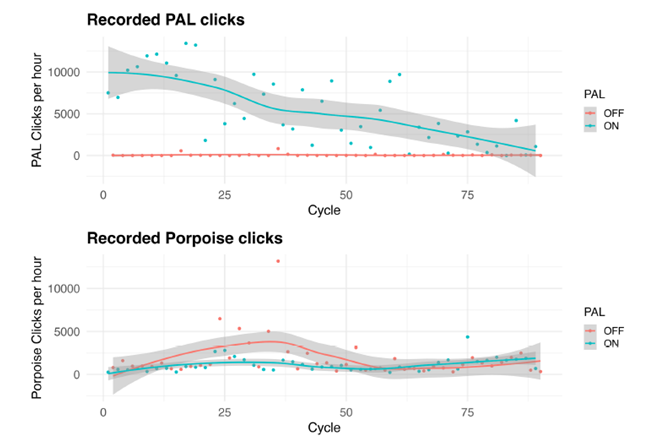
Figure 1: Clicks detected per hour by the C-POD click loggers, aggregated by on/off cycles of the PAL devices. The top panel shows the recorded PAL clicks, the lower panel recorded porpoise clicks. From Schnitzler et al., 2025
Why it matters for conservation
Accurate monitoring is the foundation of conservation management. Regulators and scientists need to know how many animals are out there, where they spend their time, and how their numbers are changing. If a tool like the PAL affects porpoise behavior, it could also potentially disrupt monitoring data, which in turn could lead to misleading conclusions about population size or habitat use. And those conclusions can flow directly into management and conservation decisions. This is an important theme in conservation technology: interventions don’t always have the neat, predictable outcomes we imagine.
Conservation is rarely straightforward: every solution comes with trade-offs, and the challenge is to weigh them carefully. The story of the PAL reminds us that even well-intentioned tools can have unforeseen consequences, and that’s why testing, questioning, and refining our approaches is such a vital part of protecting species like the harbour porpoise.
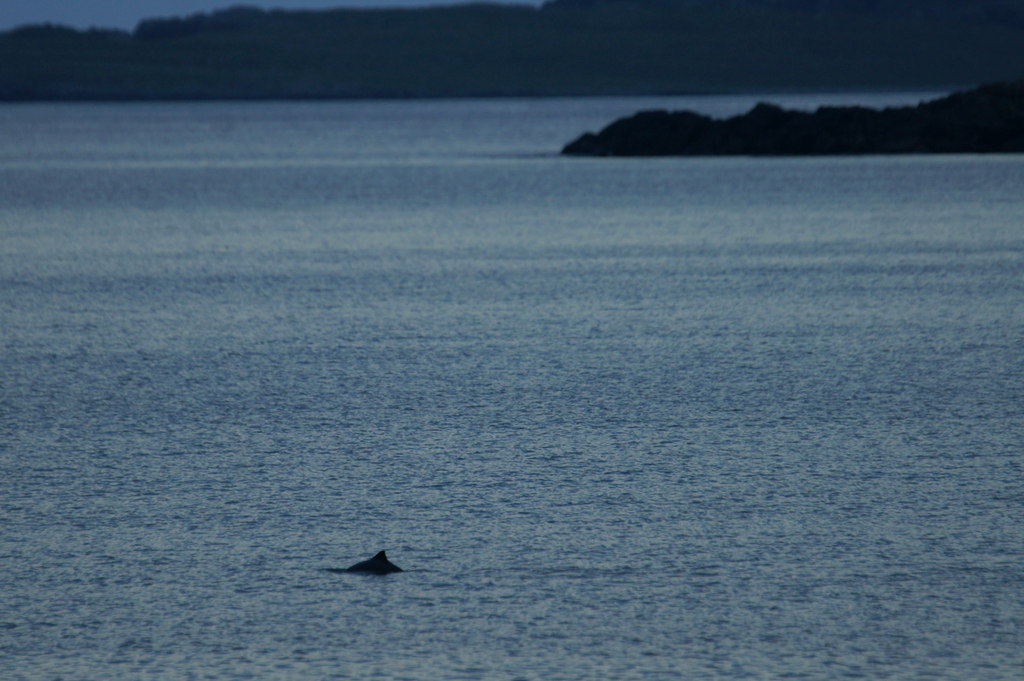
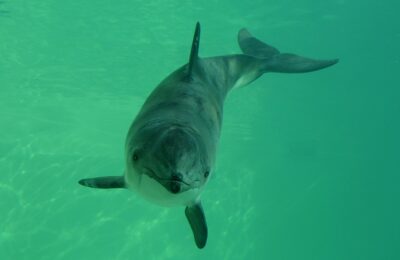
Cover photo – Harbour porpoise (Phocoena Phocoena). © Mike Pennington
I am a post-doctoral researcher at the University of Hawaiʻi at Mānoa. My research interests cover many aspects of the ecology of marine mammals, in particular the factors that drive distribution and abundance of whales and dolphins, as well as the impacts of human activities on these animals. I’ve spent a lot of time in the field, conducting surveys (very lucky). When back at my desk, I use ecological modelling techniques to investigate relationships between animals and their environment.

,_Haroldswick_-_geograph.org.uk_-_5020071.jpg)