Qi, L., Wang, M., Barnes, B.B. et al. Global floating algae blooms are expanding. Nat Commun 17, 612 (2026). https://doi.org/10.1038/s41467-025-66822-5
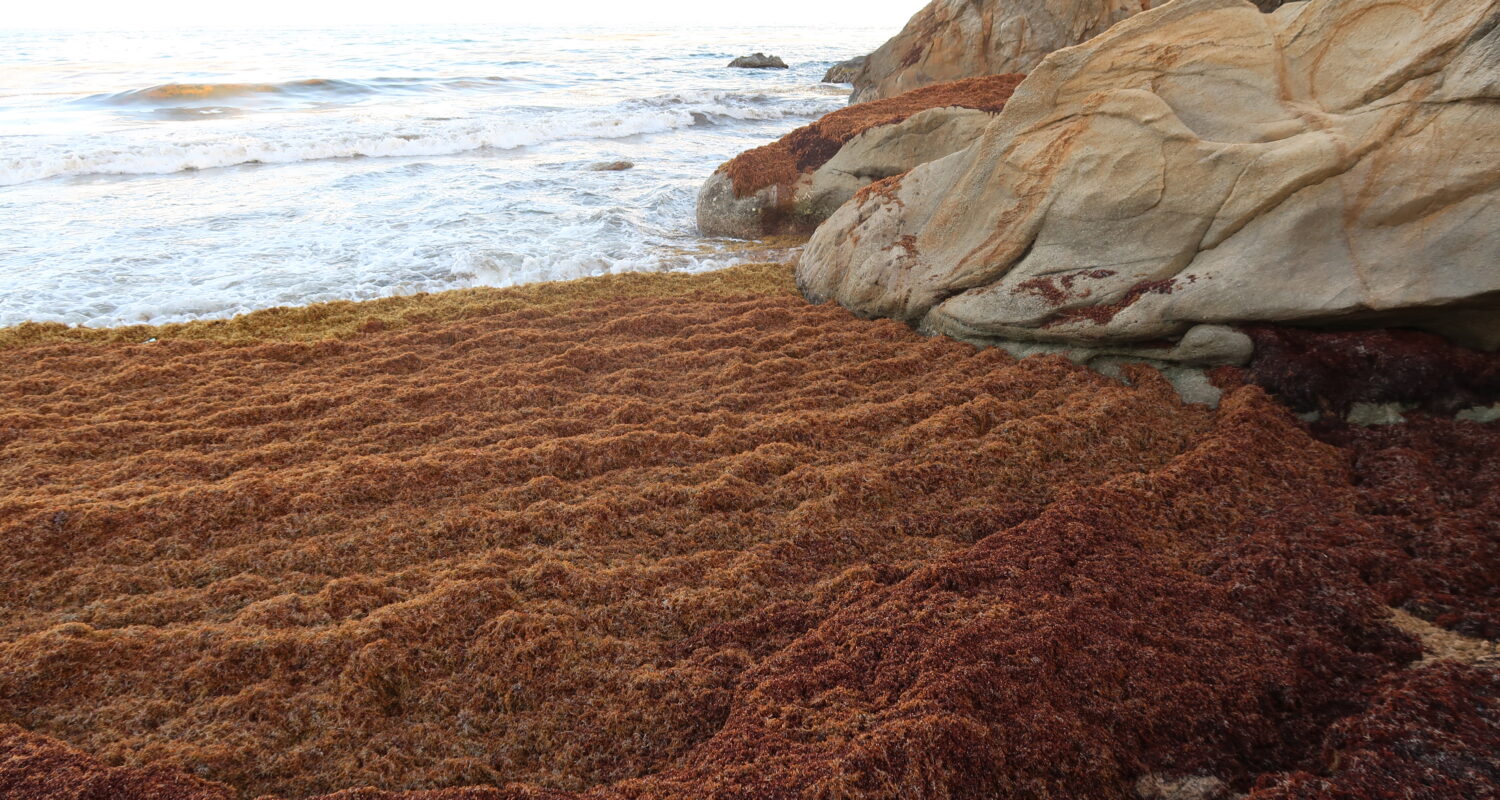
Have you ever seen an image of a beach completely covered in a reddish seaweed washed ashore? Or perhaps you’ve experienced this yourself along the tropical Atlantic coast. What should be a relaxing, refreshing beach day can quickly turn unpleasant.
Scientists have known for years that these macroalgal blooms – a category of algae including seaweed – were increasing in some regions, but until recently, there was no clear global picture. That changed with a new study published in Nature, offering the first large-scale analysis of floating algae across the world’s oceans.
In this study, scientists used artificial intelligence to look at over 1.2 million satellite images taken from 2003-2022 to track floating algae across the world’s oceans. The findings were striking – seaweed blooms in both the tropical Atlantic and western Pacific expanded at an unprecedented rate of 13.4% per year since 2003. This rapid increase suggests a major shift in the global ocean. What was once considered a regional issue is now clearly a widespread, global phenomenon.
What is floating algae?
The term floating algae refers to both microalgae and macroalgae. Most ocean water is full of tiny organisms invisible to the naked eye called phytoplankton or microalgae. Although individual phytoplankton are minuscule, together, they provide over half of the world’s consumable oxygen through photosynthesis. This type of microscopic algae is detectable through satellite imagery and laboratory techniques, and it has been studied extensively. We know a lot about its distribution and trends over time as our oceans have changed.
But there is another type of algae that has not been studied as much – macroalgae like seaweed. Although it is visible to the human eye, its global patterns have not been studied as extensively. Just like microalgae, macroalgae are important in supporting marine life and maintaining healthy ecosystems. However, excessive amounts of macroalgae in coastal waters and on beaches can be harmful to the environment, human beings, and economies. Several local reports have demonstrated increases in macroalgae over the past decade, but what does the global picture look like?
Algal blooms are expanding worldwide
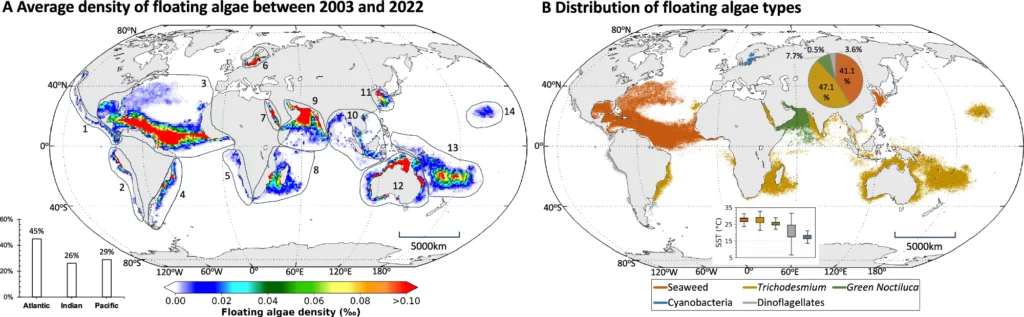
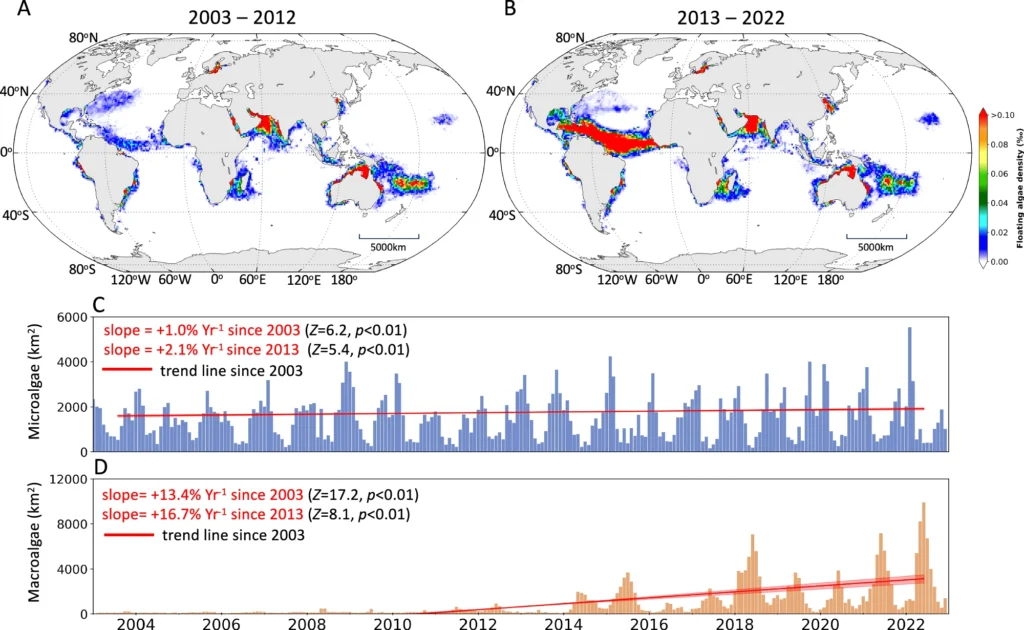
By analyzing global satellite images, the scientists were able to identify global trends in the two types of floating algae. Floating algae now occupy an enormous 43.8 million square kilometers, which is roughly 12% of the global ocean’s surface area (Figure 1). They are concentrated in the tropical Atlantic and western Pacific ocean regions.
Splitting the data up into 10-year periods clearly revealed that there is more floating algae in the past 10 years relative to the first 10 years (Figure 2). While both macroalgae and microalgae are increasing, the most rapid increase has occurred in macroalgae. So, not only has there been an overall increase in macroalgae surface area of 13.4% per year since 2003, that rate is increasing over time; since 2013, that rate grew to 16.7% per year (Figure 2D).
Why are algal blooms increasing?
This increased rate of algal blooms coincides with accelerated ocean warming, particularly since 2010. This suggests that we have perhaps reached a tipping point in ocean temperatures leading to conditions that favor macroalgae growth. Warmer waters can speed up algal growth while also altering ocean circulation patterns that distribute nutrients that algae need to grow.
Why does this matter for people and the planet?
Floating algae covering such large areas of the ocean will have significant ecological impacts. It will decrease the amount of light in the water column reaching seagrass and corals, which will negatively impact these organisms’ growth. Also, more seaweed and less seagrass or coral is sure to impact marine food webs in ways we have yet to investigate. This could also affect how the ocean stores carbon, potentially weakening its ability to act as a long-term carbon sink.
There will also be widespread economic and societal impacts. Large piles of seaweed washing onto tropical beaches will likely impact tourism. Who would want to swim or relax at a beach with giant piles of rotting (and smelly) seaweed? Increased seaweed will also impact fisheries by making it harder for fishermen to navigate their local waters and by changing where fish may be found.
Seaweed blooms may seem like a local nuisance, or just something that ruins your beach day. But this study demonstrated that they are also a visible symptom of a larger transformation underway in the global ocean. These blooms offer both a warning of our rapidly changing world as well as an opportunity to better understand and manage those changes. Whether through improved monitoring, reducing nutrient pollution, or protecting vulnerable ecosystems like seagrasses and coral reefs, there are many ways we can respond to this new threat to ocean ecosystems.

I recently graduated with a masters degree in Marine Science from the University of North Carolina Wilmington. I am now working as an research fellow at the US Environmental Protection Agency in Washington, DC, where I focus on surface water quality concerns. My masters research evaluated the impacts of elevated salinity on bald cypress growing in forested freshwater tidal wetlands along the coast of North Carolina. In my free time, I love to travel, hike, read, and rock climb.