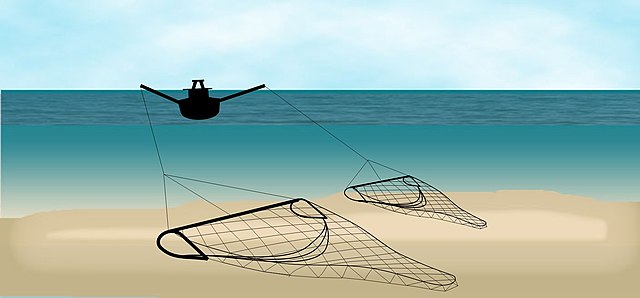
Illustration of trawling nets dragging along the bottom of a desolate seafloor. Courtesy of Oscar Bos.
The Impacts of Bottom Trawling on Seafloor Communities
Reviewing: Hiddink, J.G., Valanko, S., Batts, L., Beukhof, E.D., Blomqvist, M., Bolam, S., Calero, B., Casini, M., Delgado, M., Depestele, J., Desmidt, J., Di Bona, G., Di Lorenzo, B., Dinesen, G.E., D’Onghia, G., Egekvist, J., Fanelli, E., Farriols, M.T., Franceschini, G., Gil, J, González-Irusta, J.M., Laffargue, P., Maina, I., Maiorano, P., Mamede, R., Mangano, M.C., Xuan, A.N., Papadopoulou, N., Penna, M., Pierucci, A., Pulcini, M., Raicevich, S., Rakaj, A., Reizopoulou, S., Riva, G., Russo, T., Sala, A., Sará, G., Sbrana, A., Scarcella, G., Sciberras, M., Sköld, M., Smith, C.J., Sobrino, I., Spedicato, M.T., Todorova, V., Tsikopoulou, I., van der Reijden, K.J., Vaz, S., Vina-Herbon, C., Vrgoc, N., Wright, K., Zhang, W., Zupa, W., van Hoey, G., Eigaard, O.R., van Kooten, T., van Denderen, P.D. (2025). Assessment of Bottom Trawl Impacts on the Status of Seabed Communities in European Seas. Fish and Fisheries 0:1-15. https://doi.org/10.1111/faf.70054
What is bottom trawling, and what are the issues associated with it?
Where does the seafood you eat come from? Approximately 25% of the world’s seafood is caught through bottom trawling – the dragging of massive, heavy nets along the ocean floor. Despite accounting for ¼ of global seafood, bottom trawling faces public backlash and anti-trawling campaigns because of its status as one of the leading causes of environmental destruction. Bottom trawling results in the demolition of seabed habitats, high bycatch rates, non-selective killing of marine animals, and littering of fishing gear. The need to balance fishery production and ecosystem sustainability creates a challenge that Hiddink’s team began addressing through monitoring and assessing the impact of bottom trawling in European waters.
Successful analysis of the impacts of bottom trawling is essential for ecosystem-based management, which guides sustainable fisheries and habitat protection strategies while supporting the seafood system. Hiddink and his team analyzed sections of the seafloor from the Baltic and Atlantic seas to the Mediterranean and Black Sea to understand how bottom trawling affects the local marine life and habitat (Figure 1). The areas assessed complied with the legal depth limits for trawling, which is 800 meters deep in both the Baltic and Atlantic, 1000 meters in the Mediterranean, and 100 meters in the Black Sea.
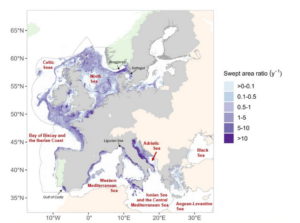
Figure 1: Map of region Hiddink’s team conducted its investigation on bottom trawling impacts. Swept area ratio (SAR) represents level of fishing intensity. Data are included from the countries colored grey, supplemented with incomplete data from countries colored light green. Figure courtesy of Hiddink et al. 2025.
Hiddink’s Results
A main indicator for the health of an ecosystem is the biomass, or the amount of material from living organisms. Biomass is an effective measurement of ecosystem health because a higher biomass suggests diversity of species and more productivity. Hiddink’s team used measurements of biomass in two ways to determine the health and functionality of each habitat throughout the study region: Relative benthic status (RBS) total and relative benthic status sensitive. The total RBS represented the amount of biomass in a study region, while the sensitive RBS looked specifically at the biomass of the top 10% most sensitive species. After assessing a total area of 3.8 million square kilometers per year, Hiddink’s team determined that the sensitive RBS was more strongly affected by bottom trawling than the total RBS. They also found that there was a tight negative correlation between the two categories, meaning that as total RBS decreased, so did sensitive RBS. This makes sense, as it can be expected that if the overall biomass is impacted, the most sensitive species will be affected even more.
Hiddink’s team also investigated the swept area ratio (SAR) of the study region, which refers to the ratio of seafloor covered by bottom trawlers to the total study area. In areas with a high SAR, the surrounding biomass more likely to be negatively impacted. This result can be expected because in areas more frequently trawled, all living organisms face greater threat (Figure 2).
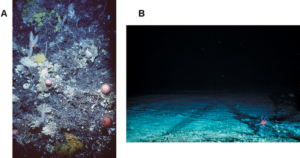
Figure 2: Ocean floor before trawling (A) and after trawling (B). Photos courtesy of CSIRO Marine Research.
Hiddink and his team determined that the regions most severely impacted by bottom trawling were the North Sea, western Mediterranean Sea, Ionian and central Mediterranean Sea, and the Adriatic Sea. The team also found that bottom trawling harmed epifauna (organisms living above or on the seafloor) more than infauna (organisms who burrow and live in the seafloor). This is because epifauna are more sensitive to habitat disturbances and fishing intensity tends to be higher where epifauna live.
The Future of Bottom Trawling and Sustainability
Ecosystem health can be assessed using information from studies such as Hiddink’s, as well as through continuing to monitor and estimate trawling intensities by region. Methods and measurements such as swept area ratio and relative benthic status are useful for determining management strategies and where, when, and how to reduce the use of bottom trawling. Although bottom trawling is still a prominent method of fishing, awareness surrounding the consequences of it is growing. Reconciling fishery production with conservation is a persisting challenge, but with research from Hiddink, his team, and other scientists from around the world, there may be a way to carefully balance the two.

I am a student in the Master of Oceanography program at the University of Rhode Island and enjoy scuba diving, boating, walking my dogs, reading, and being with friends and family.