Cantor, M., Santos‐Silva, B., Daura‐Jorge, F.G., Machado, A.M., Peterson, D., da‐Rosa, D.X., Simões‐Lopes, P.C., Valle‐Pereira, J.V., Zank, S. and Hanazaki, N., 2025. Changes in the users of the social‐ecological system around a reciprocal human‐dolphin relationship. People and Nature, 7(5), pp.974-989. https://doi.org/10.1002/pan3.10679
The ultimate meal deal…
We’re all familiar with the countless headlines about overfishing and the exploitation of wildlife. But what if there was a story about humans and wild dolphins working together, for mutual benefit?
Historically, some Indigenous Peoples and Local Communities have maintained harmonious relationships with nature. They have learned responsible use and appreciation for nature in a way that would be considered remarkable to many of us today. One amazing example of this takes place in the city of Laguna, in southern Brazil. Here, for over 100 years, fishers and wild Lahilleʻs bottlenose dolphins (Tursiops truncatus gephyreus) – a subspecies of bottlenose dolphin with only around 600 estimated individuals – have developed a cooperative relationship that benefits both humans and dolphins. The dolphins herd fish toward the fishers, and the fishers know exactly the moment to cast their nets based on cues from the dolphins. Both then get a meal out of the deal.
A recent study by Maurício Cantor and Bruna Santos-Silvas and their team, published in People and Nature, explores how this long-standing collaboration is changing. The research team set out to understand how fishers’ experience, reliance on dolphins, and the ways they learn fishing skills have changed over time, and what might help protect this partnership into the future.
A Cultural Connection
This isn’t just about catching fish – it’s what scientists call a “social-ecological system”: the idea that nature and human society are connected in complex ways.
In the Laguna system, dolphins help fishers by corralling mullet toward the shore. Fishers respond to dolphin signals such as a tail slap, to know the right moment to cast their nets. Both groups benefit: the dolphins catch disoriented fish escaping the nets, while the fishers get a more successful haul. This relationship has persisted for over a century, passing down through generations of fishing families. But now, changes in tourism, local economies, and community structures may be changing how people interact with dolphins—and whether they continue this tradition at all.
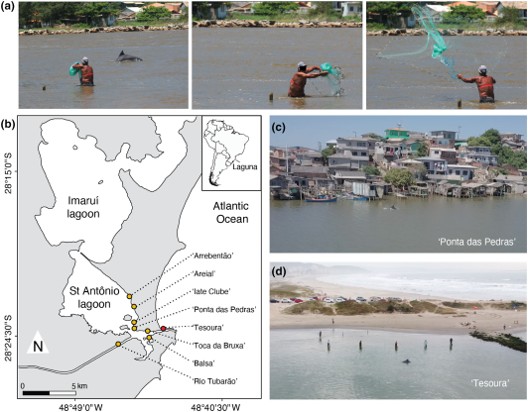
F I G U R E 1: The cultural human- dolphin cooperative fishery in Laguna, Brazil.
(a) Dolphins and fishers working together: dolphins approach the coast herding fish schools and cue where and when fishers should cast their nets, resulting in increased catch.
(b) The locations of the eight main fishing sites in the study.
c) in more restricted sites, located in the inner parts of the lagoon (e.g. Ponta das Pedras), fishers wait for dolphins in moored canoes
(d) in the more accessible site, at the lagoon canal (Tesoura), fishers wait for dolphins standing in the shallow beach waters.
(Photos: a and d, M. Cantor; c, A.M.S. Machado). Cantor & Santos-Silva et al., 2025
Tracking Change over Time
Cantor and colleagues interviewed 188 fishers in Laguna over 16 years: from 2008 to 2024. They compared two types of fishing areas:
- Restricted areas: Local access only, with stronger family traditions and fewer outside influences.
- Accessible areas: Open to outsiders, tourists, and visiting fishers—more economically diverse and exposed to new ideas.
During their interviews, the researchers asked how long the fishers had worked with dolphins, how important dolphin-assisted fishing was to their income and food security, and how they had learned their fishing skills – whether from family members (vertical learning) or from peers and neighbors (horizontal learning). Their goal was to see whether changes in the local community were affecting either the fishers’ reliance on this tradition or their ability to pass it on.
What The Research Team Found
Fishers in both accessible and restricted areas had about the same level of years spent fishing with dolphins, but fishers in restricted areas depended more on dolphin-assisted fishing as their main source of income and food. In contrast, fishers in accessible regions had more ways to earn money and weren’t as dependent on dolphins all year round.
Researchers noticed that in accessible regions, fishers are starting to rely slightly less on dolphin fishing and less on family-based (vertical) learning. But these declines in dolphin fishing weren’t yet strong enough to be statistically considered “real” across the board.
The pattern in restricted areas was more stable, with fishers consistently depending on dolphins and traditional teaching.
Why It Matters
If fishers lose the skill or opportunity to work with dolphins, their livelihoods and way of life could be at risk. This is especially true for those who rely heavily on this practice for income or food. The dolphins may also suffer: without their human partners, they could lose valuable feeding opportunities that they’ve learned to depend on. This tradition is more than just a clever fishing trick. It represents a deep cultural connection between people and nature. If it fades away, it would mean the loss of a rare and meaningful relationship that ties generations of coastal communities to the marine world.
Protecting the Partnership
The researchers suggest that to protect this remarkable system, we need to think about the big picture. That means not just monitoring dolphin populations or fish stocks, but also supporting the human side of the system, especially traditional learning and local access to fishing areas.
Keeping this tradition alive could involve encouraging intergenerational learning, recognizing the value of cultural practices in conservation, and making sure policies consider both people and dolphins.
More Than Just a Fishing Story
This isn’t only a cool example of animal cooperation – it shows that conservation isn’t always about separation; sometimes, it’s about connection. This dolphin–fisher partnership shows an unusual example of humans and wild animals helping each other. But it’s also fragile – changing fast when communities become more open to outside influences. Keeping it alive means caring for both people and dolphins, honoring old ways while making room for new ones. By understanding how fishers learn, live, and rely on dolphins, everyone can help protect this special coastal culture for future generations.
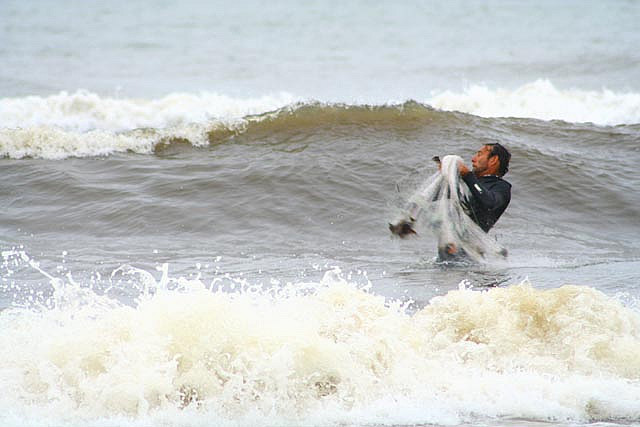
Cover photo – Fisherman in Matinhos, Paraná, Brazil (illustration only – not one of the study sites included in this study), by Eduardo Nogueira

I am a post-doctoral researcher at the University of Hawaiʻi at Mānoa. My research interests cover many aspects of the ecology of marine mammals, in particular the factors that drive distribution and abundance of whales and dolphins, as well as the impacts of human activities on these animals. I’ve spent a lot of time in the field, conducting surveys (very lucky). When back at my desk, I use ecological modelling techniques to investigate relationships between animals and their environment.