Reviewing: Fleming, B. F. M., E. Simon-Lledó, N. Benoist, B. O’Malley, and D. O. B. Jones. 2025. Influence of seabed heterogeneity on benthic megafaunal community patterns in abyssal nodule fields. Elem Sci Anth 13: 00049. doi:10.1525/elementa.2024.00049
A habitat blanketing the deep seafloor
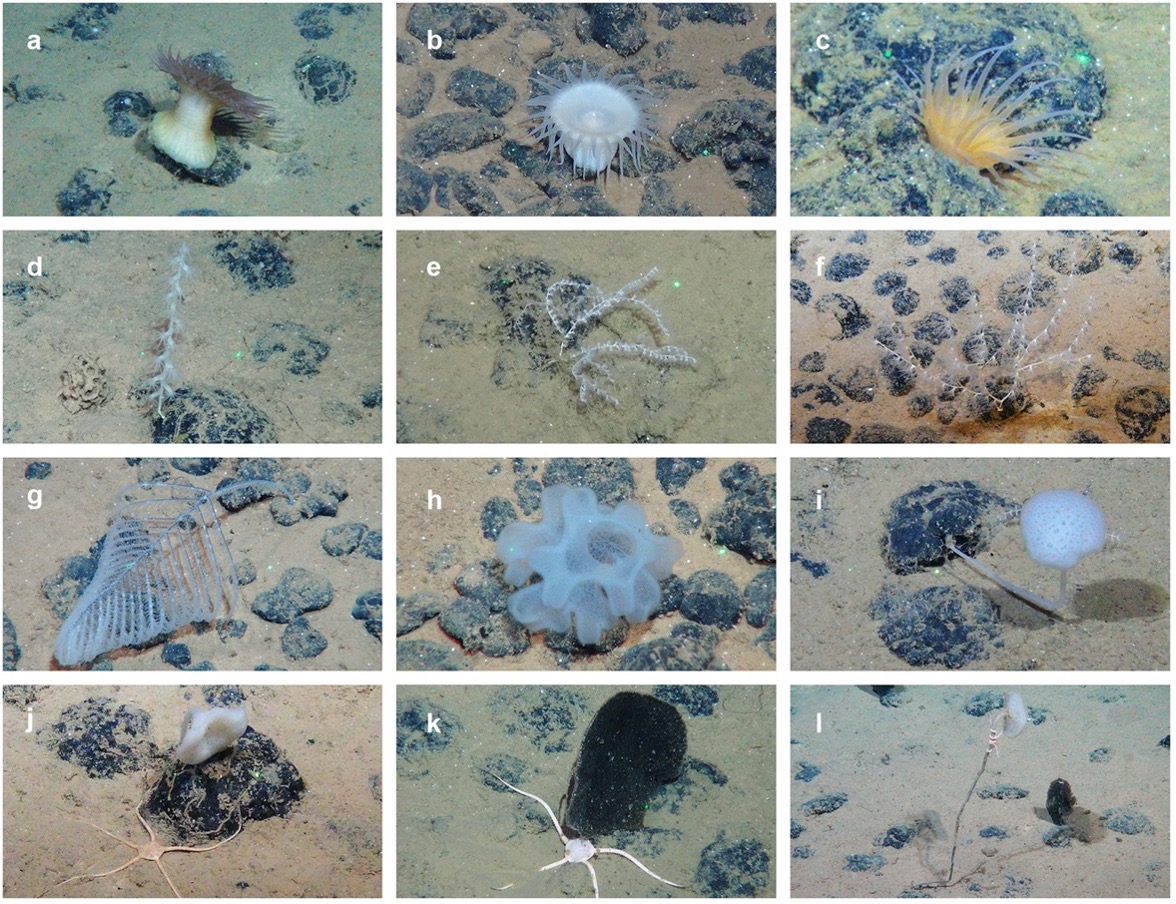
When you think of the deep seafloor, what do you imagine? Besides darkness in the land beyond light, approximately 3000-6000 m below the surface of the ocean, what do you think the seafloor looks like? Did you imagine that much of the deep seafloor actually looks like an expansive desert, with small, sand-like particles (sediment) as far as the eye can see? Across these abyssal plains, the seascape doesn’t appear very complex, and few hard, rocky surfaces for animals to live on. One exception is nodule fields that blanket large swaths of the deep seafloor. Here, rock-like features scatter the seafloor and provide a home for a variety of animals. Sessile animals are affixed or anchored to the nodule, including corals, sponges, and crinoids (Figure 1). Also, the varied surface of the nodules provides a home for small animals that live in the nooks and crannies, such as worms and crustaceans. Finally, many mobile deposit-feeding animals, like sea stars, sea cucumbers, and sea urchins, are often among these nodule fields too, feeding on the complex nodule surface or using it as a gathering site. These nodule fields represent a hotspot for diversity in the deep sea and are home to specialized animal communities distinct from sediment fields and even other hard substrates. To see footage of these animals, check out this video or read this article.
What do nodule patches look like?
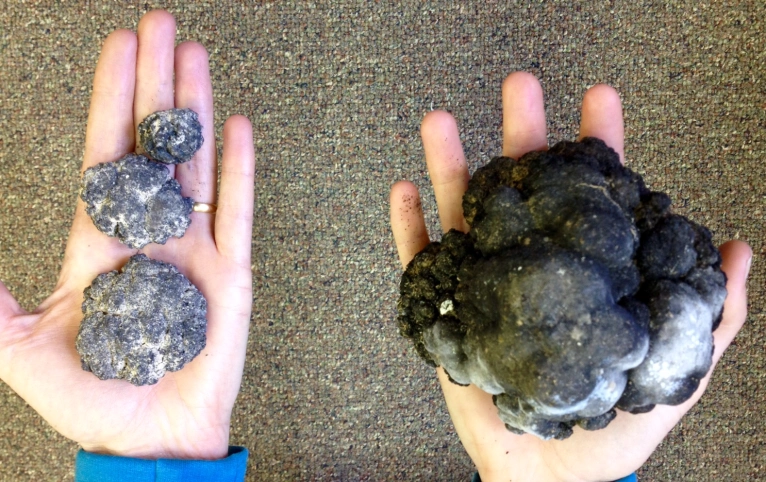
Nodules are diverse not only in the animals they house, but also among the nodules themselves! They can vary in size, from egg size to bowling ball size, as well as in shape and texture (Figure 2). Some nodules are smooth and round, and others are flatter in shape and bubbly in appearance. Across the seafloor, nodule fields can be so densely packed that there is hardly any space between each nodule. Or, nodule fields can be pretty sparse, with each nodule standing out like an island in a sea of sediment instead. The different degrees of nodule coverages can be visualized in Figure 3. Together, nodule coverage, size, shape, and texture create distinct patches of nodule habitat across the seafloor, much like a unique fabric block on a quilted blanket.
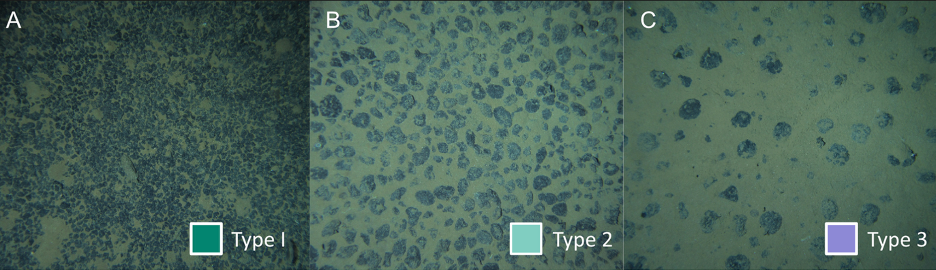
So, if nodule patches represent distinct habitats, do they also support distinct animal communities? For example, do patches with dense nodules have animals different from those that are sparse? To uncover how this patchwork seascape shapes deep-sea life, researchers led by Bethany Fleming at the National Oceanography Centre in the UK, dove into hours of video footage collected by robotic submarines (ROV’s) as they prowled the seafloor. From this, they defined nodule patches by size and density and identified animals and their abundances in each type of patch.
Different patches, different communities
The researchers identified that areas with higher nodule cover (Type 1 and 2 in Figure 3) supported more numbers of animals, but areas with lower nodule cover (Type 3 in Figure 3) had more species richness. Areas that alternated between different habitat types on small scales were particularly diverse made of up sediment- and nodule-associated animals, distinct from communities on large swaths of the same habitat type. Specifically, they identified that dense nodule patches had many more sessile, nodule-dependent animals, like corals, and bryozoans, while more sparse nodule patches had a greater number of mobile sediment animals like sea urchins, sea stars, and bivalves. These results demonstrate that nodules are quite a complex habitat and important for shaping diversity in the deep ocean!
A tattered blanket?
In the last several decades, nodules have become of economic interest. These rock-like features contain a high concentration of valuable metals, such as copper, cobalt, nickel, and lithium, which are needed for technology and alternative energy solutions. Various nations and companies are interested in collecting the nodules from the seafloor and extracting the metals they contain, a process called deep-sea mining.
To be most economically favorable, mining groups may target areas with the highest density of large nodules compared to areas with lower densities of small nodules, for example. With distinct communities found among each nodule patch, we can expect that animals may be affected differently by mining based on the patch type on which they live. This result is most concerning if mining efforts target densely packed nodules, which the researchers demonstrated disproportionately house nodule-dependent animals. These nodule-dependent animals have no means to escape a mining vehicle, will lose their habitat entirely if mining occurs, and are therefore at the greatest risk of extinction from mining. The authors recommend that, prior to mining, it is critical that nodule patches are documented and adequately represented in neighboring protected areas to protect the highest diversity of animals.
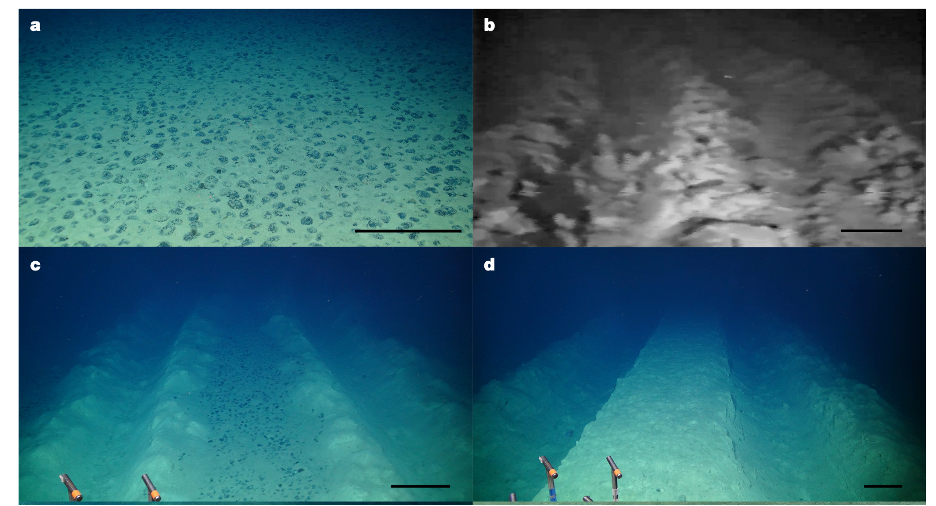
These nodules are one of the slowest geological features on Earth, forming at a rate of 10 mm per million years! Most nodules are older than human life on Earth! With these very slow formation rates, it goes without saying that this resource is nonrenewable; the removal of nodules will permanently remove the substrate that animals rely on (Figure 4), much like sinking an island in the ocean would destroy ancient reefs and the life they support. To read more about nodule formation, check out this article; to read more about the mining process, check out this article.
Some countries have signed a moratorium or outright banned mining due to its destructive effects. Check to see if your country has signed on here, as one of the countries taking a stand to protect this fragile frontier.

I am a recent PhD grad in Biological Oceanography at the University of Hawaiʻi at Mānoa. I study the community ecology of abyssal animals across space, time, and habitat, and I ask questions often with regard to human impact, specifically deep-sea mining.